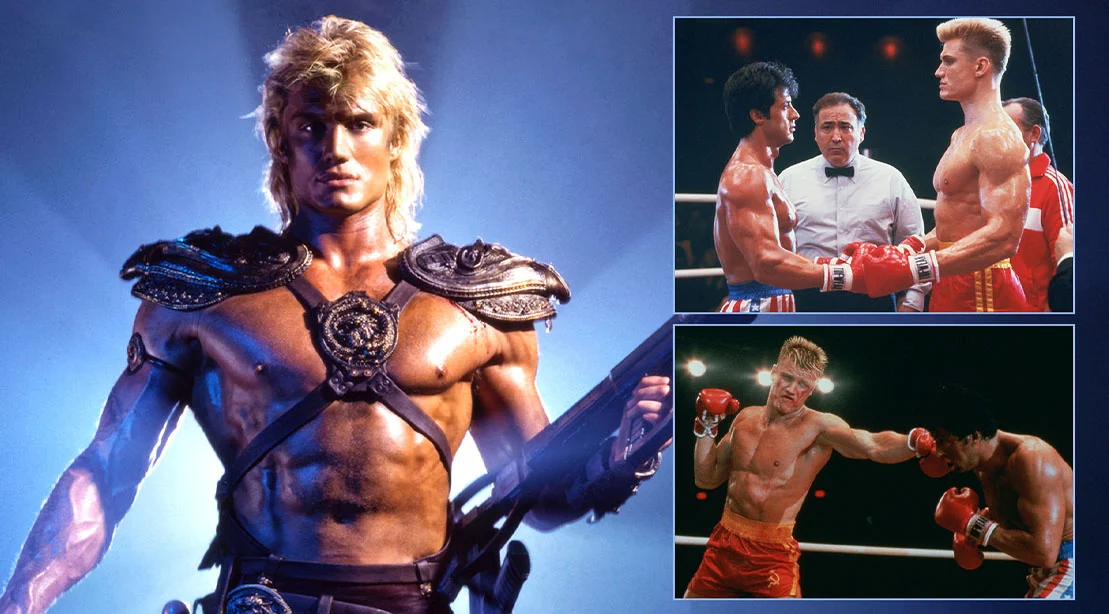
For decades, the name Dolph Lundgren has been synonymous with cinematic invincibility. Standing at a towering 6’5”, the Swedish powerhouse etched his place into the annals of pop culture history as the formidable Ivan Drago in Rocky IV, the cosmic savior He-Man in Masters of the Universe, and the relentless soldier of the Universal Soldier franchise. With a career spanning over 100 screen credits, Lundgren has long projected an image of granite-like strength and unwavering resolve.
However, behind the curtain of Hollywood stardom, a different, far more harrowing narrative was unfolding. Away from the klieg lights and the choreography of stage combat, the real-life action hero was locked in a decade-long battle against a terminal diagnosis. Now, through his raw and vulnerable autobiography, Fights Worth Fighting: Finding Strength in Struggle, Lundgren invites readers to look past the screen legend and witness the man who defied a death sentence, prioritizing his health and finding profound meaning in the face of his own mortality.
The Scholar-Warrior: A Life Beyond the Stereotype
To categorize Dolph Lundgren merely as an "action star" is to ignore the complex, high-achieving individual beneath the muscle. Born in Stockholm, Sweden, Lundgren’s life trajectory was defined by intellectual rigor as much as physical prowess. A standout in ice hockey and a world-class martial artist, he simultaneously pursued a path of academic excellence, ultimately earning a master’s degree in chemical engineering. As a Fulbright scholar, he possessed a mind as sharp as his striking technique, long before he stepped onto a film set.
His transition into Hollywood was serendipitous yet earned. The 1985 breakout role as the Soviet boxer Ivan Drago catapulted him into global stardom, establishing a career that has remained remarkably consistent for over 30 years. Yet, even as he traversed the globe filming sequels and leading blockbuster franchises, a shadow began to loom over his personal life—a shadow that would eventually threaten to consume everything he had built.
Chronology of a Silent Struggle
The battle began in 2015, not on a set, but in the quiet reality of a doctor’s office. After discovering blood in his urine following a routine training session, medical testing revealed a malignant tumor on his kidney. The initial surgical intervention seemed successful; the tumor was removed, and Lundgren began a regimen of regular surveillance.
For several years, the situation appeared contained. However, the true nightmare emerged in 2020. During a routine scan, doctors discovered multiple new tumors in the proximity of the original site. While these, too, were surgically excised, the disease proved more resilient than anticipated. A new, malignant tumor was discovered in his liver, and due to its size and location, it was deemed inoperable.
Lundgren was placed on a rigorous schedule of infusions every three weeks, but the cancer continued to metastasize, with new nodes appearing in his kidney. Complications mounted, including severe blood clots—a side effect of his medication. At his lowest point, a physician delivered the chilling prognosis: his time on Earth was likely nearing its end. He was advised to spend his final days surrounded by family, effectively preparing for the inevitable.
The Turning Point: Precision Medicine and Resilience
Rather than retreating into the silence of defeat, Lundgren chose to weaponize his remaining energy. He continued to work, channeling his focus into his craft while simultaneously refusing to accept the terminal prognosis at face value. In a move that saved his life, the actor sought a second opinion at UCLA Health.
It was here that Dr. Alexandra Drakaki performed a comprehensive review of his tissue samples. The findings were a medical revelation: the tumors were not simply a recurrence of the original kidney cancer, but were driven by a specific mutation commonly associated with lung cancer. This breakthrough allowed the medical team to pivot, tailoring a new, more effective treatment plan.
The results were nothing short of miraculous. The targeted therapy caused his tumors to shrink by approximately 90%. With the disease significantly reduced, the remaining cancerous tissue was successfully destroyed via ablation—a procedure utilizing heat, cold, or lasers. By late 2024, the medical community confirmed what had once seemed impossible: Dolph Lundgren was cancer-free.
The Philosophy of "Fights Worth Fighting"
Reflecting on his journey during his current book tour and the lead-up to his 2026 documentary, Dolph: Unbreakable, the star views the process of writing his autobiography as a form of therapeutic excavation.
"It’s a bit like doing therapy," Lundgren explains. "You’re going back and re-examining your life. It was good for me because it was a way to appreciate the young man who set out from Sweden on some sort of adventure, pay my respects to him to some degree, and internally, just kind of feel good about myself."
His motivation for transparency is altruistic. He understands that his status as a screen icon gives him a platform to reach others currently trapped in their own medical or personal labyrinths. "It’s for other people who have their own fights, medically or going through hardships in life," he says. He emphasizes that the act of seeking a second opinion—a choice he was initially hesitant about—was the most pivotal decision of his life. "I ended up being smart enough to just go ahead and get a second opinion. I just had a feeling about it… it turned out to be the right decision."
Sustaining the Legacy: Training at 68
Even at 68, Lundgren’s commitment to physical fitness remains an anchor for his longevity. He maintains a rigorous training schedule, balancing strength training with his lifelong passion for karate, three times per week. He asserts that maintaining muscle mass and optimizing hormone levels are non-negotiable pillars of aging gracefully.
"It’s very important, I think, as you get older, to keep your muscle mass, keep your testosterone level up," Lundgren notes. "It’s really helped me, especially after the cancer diagnosis. Those treatments were quite tough, so the strength training really helped me."
He advocates for a simple, accessible approach to wellness, suggesting that even 30 minutes of physical activity—removed from the distractions of technology—can yield significant benefits for both the body and the mind. It is a philosophy that has carried him through his most intense athletic preparations for film and, ultimately, through the brutal physiological toll of chemotherapy and recovery.
Implications: A New Chapter for the Icon
Dolph Lundgren’s career could have taken a vastly different path. Had he not been discovered for his role in the Rocky franchise, he might have pursued a career as a teacher or a karate coach. Looking back, he acknowledges that such a life might have left his creative spirit unfulfilled.
"I think it would have been frustrating for me," he admits. "Because I had the creative side of me, and a lot of energy. I think I made the right choice."
The broader implication of Lundgren’s story is a powerful testament to the necessity of self-advocacy in healthcare. His journey underscores the reality that even the most formidable figures are vulnerable to the fragility of the human body. By sharing the details of his medical battle, he has transformed from a mere entertainer into an advocate for proactive health management.
As he continues to move forward, both as a storyteller and an actor, his legacy is no longer defined solely by the punches he threw on screen, but by the resilience he displayed when the stakes were truly life-and-death. His story is a poignant reminder that while we cannot always control the battles we are forced to fight, we can always choose to fight them with everything we have.
For more information on Dolph Lundgren’s book, "Fights Worth Fighting: Finding Strength in Struggle," visit the HarperCollins website. The documentary "Dolph: Unbreakable" is scheduled for release on October 6, 2026.