Introduction: The Mystery of the Clammy Base Layer
During periods of high physical exertion—whether ascending a steep mountain trail or engaging in a winter alpine trek—the human body acts as a biological furnace. To maintain thermal homeostasis, the body produces sweat at a rate that frequently outpaces the atmosphere’s ability to evaporate it. Consequently, liquid sweat accumulates on the skin, and our base layers are tasked with a singular, vital mission: transport that moisture away from the skin and into the outer layers of our clothing system.
For years, outdoor enthusiasts have relied on the marketing promise of "moisture-wicking" fabrics. Yet, a common, frustrating reality persists: two garments, both labeled as moisture-managing, often perform with vastly different results. Why do some shirts leave us feeling dry and comfortable, while others become heavy, saturated, and clammy?
Recent empirical testing, conducted through a specialized "Liquid Transfer Test" apparatus, has finally begun to quantify the mechanics behind these failures. By tracking the migration of liquid water as it moves through a simplified multi-layer clothing system, we have moved beyond theoretical marketing claims to reveal the stark physical realities of textile performance.
Chronology of the Investigation
The impetus for this research began several months ago, following an initial evaluation of three standard base-layer garments. While performance differences were noted, the fundamental question remained: When skin is wet, where does the water actually go?
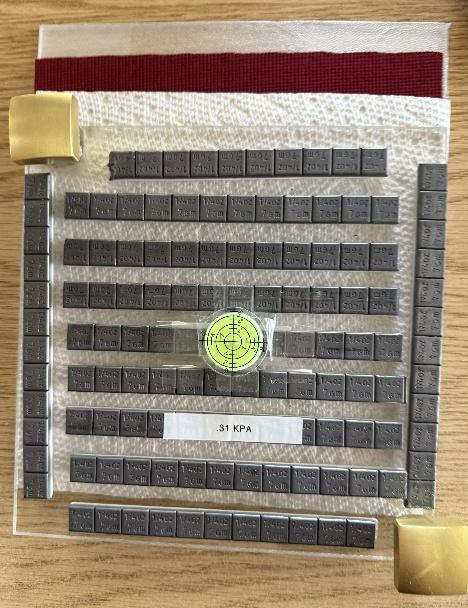
- Phase I: Defining the System. The initial phase involved the development of a custom testing device (Figure 1). This apparatus uses a grid of stacked metal plates to simulate the "skin" surface, the base layer, and the secondary layer, allowing for the precise measurement of water weight in each specific zone.
- Phase II: Expanding the Scope. Recognizing that a three-garment sample size was insufficient for broad conclusions, the testing was expanded to include eight distinct fabric designs. This expansion allowed for the identification of consistent behavioral patterns across both hydrophilic (water-attracting) and hydrophobic (water-repelling) textiles.
- Phase III: Data Synthesis. The final phase focused on cross-referencing these laboratory measurements with established principles of fluid dynamics—specifically the work of Young, Laplace, and Washburn—to explain why certain fabrics "hold" sweat while others "let go."
Supporting Data: The Physics of Moisture Transport
The testing results highlight a divergence in how different chemical structures manage liquid water.
Hydrophobic Fabrics: The Pressure Paradox
Hydrophobic materials are often marketed as "staying dry." Technically, this is accurate regarding the fibers themselves, which lack the hydrogen bonding sites necessary to attract water. However, the data reveals a critical flaw: fabrics are predominantly comprised of empty space.
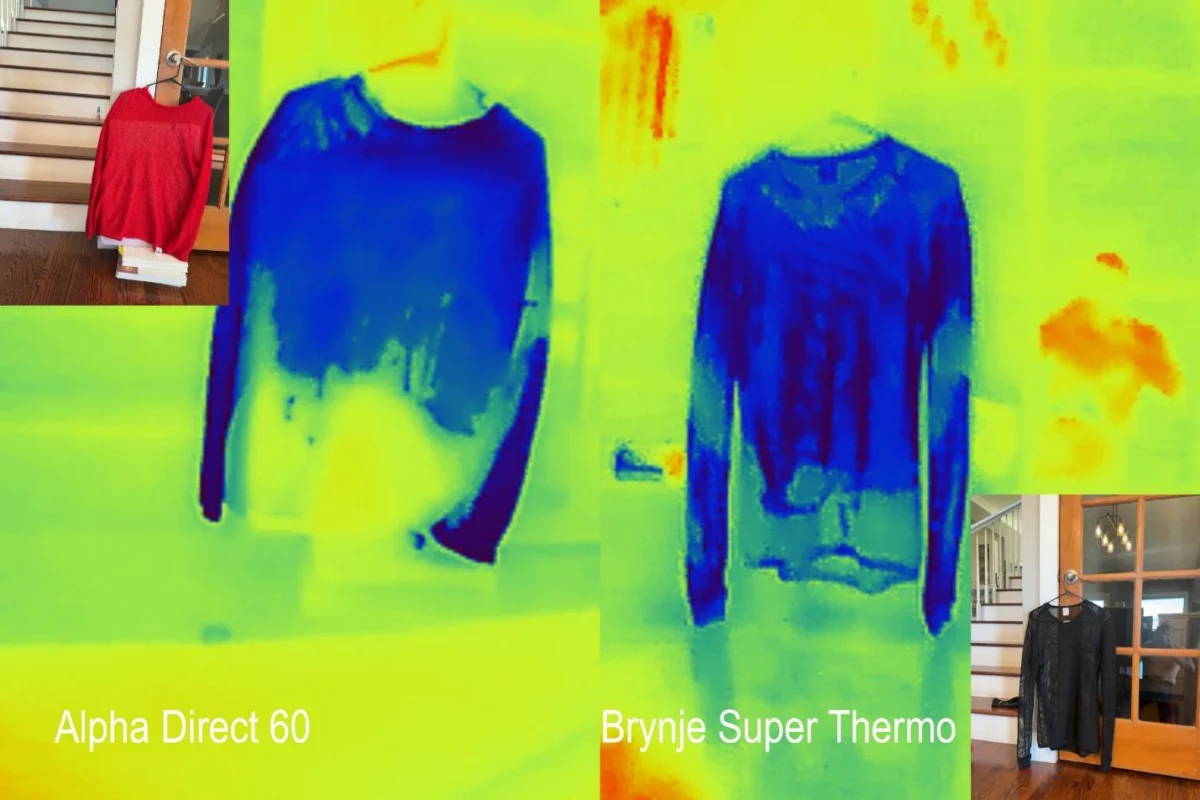
When sweat is produced rapidly, it collects in these pore spaces. Our infrared imaging (Figure 2) illustrates this clearly. In tests involving Brynje mesh and Alpha Direct shirts, significant liquid retention was recorded—87 grams and 62 grams respectively—despite the hydrophobic nature of the fibers.
The mechanism at play is Breakthrough Pressure. Because hydrophobic fibers do not wick, they require external pressure—generated by pack straps, body movement, or fabric tension—to force water into their pores. If the rate of incoming sweat exceeds the rate of flow through these pores, the garment acts as a reservoir rather than a conduit. If the pressure threshold (determined by pore size and contact angle) is not met, the water simply pools against the skin, leading to the "clammy" sensation familiar to many hikers.
Hydrophilic Fabrics: The Wicking Trap
Hydrophilic fabrics operate on the principle of capillary action, drawing moisture away from the skin by absorbing it into the fibers. While this is highly effective during low-to-moderate activity, the testing uncovered a significant, non-intuitive limitation.
The very forces that draw water into the fabric also ensure that the fabric retains that water. In our testing, the transfer of moisture to a secondary layer became a competitive process. As the receiving layer grew saturated, its ability to draw further moisture from the base layer decreased. Consequently, the hydrophilic base layer—having already absorbed the sweat—held onto it, effectively trapping the moisture against the skin.
Official Perspectives and Scientific Context
The conclusions drawn from this study are rooted in foundational physics. As noted in the Author’s Note, the behavior of these textiles is not random; it is predictable based on the work of Thomas Young and Pierre-Simon Laplace (1805) regarding surface tension, and Edward Washburn (1921) regarding capillary flow.
These researchers established the mathematical framework for how liquids move through fibrous materials. The testing confirms that fabric performance is a function of:
- Pore Geometry: The size and connectivity of the internal pathways.
- Contact Angle: The angle at which a water droplet meets the fabric surface. An angle below 90° signifies hydrophilic behavior, while an angle above 90° indicates hydrophobic properties.
Our data shows that larger pore openings generally reduce the required "breakthrough pressure," but this must be balanced against the overall structural integrity of the fabric.
Implications for Outdoor Performance
What does this mean for the user? The implications for layering systems are profound:
- The "Dry" Myth: A hydrophobic garment is only as effective as the pressure applied to it. In low-exertion scenarios, these garments may feel "drier" because they don’t absorb water, but under heavy exertion, they can fail if the liquid volume overwhelms the fabric’s breakthrough pressure.
- The Saturation Limit: Hydrophilic fabrics are excellent for moisture management until they reach a saturation point. Once the receiving layer is damp, the "wicking" process effectively stalls, creating a micro-environment of trapped humidity.
- Layering Strategy: Effective moisture management requires a system where the receiving layer has a higher capillary demand than the base layer. If the outer layer is already saturated, the base layer—regardless of its chemistry—will cease to perform its primary function.
Final Summary for the Consumer
If you are seeking a quick takeaway for your next gear purchase, consider the following:
- Hydrophobic layers work best when there is consistent mechanical pressure (like a tight fit) to help push moisture through the fabric.
- Hydrophilic layers are superior for steady, moderate output but require a dry, highly absorbent outer layer to remain effective.
- The "Goldilocks" Zone: The most effective systems are those that match the fabric’s transport capacity to the intensity of the activity. If you are prone to heavy sweating, avoid fabrics that rely solely on passive absorption without a clear, lower-pressure path to the outer environment.
This research raises the bar on how we evaluate technical apparel. By shifting our focus from marketing buzzwords to the underlying physics of capillary flow and pressure, users can make more informed decisions about the gear they choose for the trail. While the complexity of textile science is high, the takeaway is simple: your base layer is not just a piece of fabric; it is a critical component of your body’s thermal management system, and it must be treated with the same precision as any other piece of technical equipment.