As the global community grapples with the urgent necessity of reaching net-zero emissions, the spotlight has shifted from simple electrification to the formidable challenge of "hard-to-abate" sectors. Heavy industry, long-haul shipping, and aviation remain tethered to fossil fuels, not by choice, but by the physical limitations of current energy storage and density. Decarbonizing these pillars of the global economy hinges on a radical evolution in how we produce, store, and transport low-carbon energy.
While green hydrogen, ethanol, and synthetic fuels have emerged as the primary contenders, they face a grueling gauntlet of scalability and cost-competitiveness. A new wave of research across the solar, wind, and tidal sectors is now working to bridge the gap between laboratory success and industrial-scale viability.
Main Facts: The Challenge of Hard-to-Abate Sectors
The fundamental barrier to the transition is the energy density required by heavy industry. Traditional battery technology, while transformative for passenger vehicles, often falls short for maritime shipping or steel manufacturing. Consequently, the focus has pivoted toward "molecular energy"—liquid or gaseous fuels that can be manufactured using renewable energy and utilized in existing infrastructure.
The core dilemma is the Levelized Cost of Hydrogen (LCOH). Current electrolysis-based production methods are energy-intensive and often struggle with the intermittency of renewable sources. The researchers currently leading this charge are looking to bypass traditional bottlenecks, either by eliminating the need for electricity entirely or by optimizing the integration of renewable energy at the point of generation.
Chronology of Innovation: From Lab Bench to Real-Sea Trials
The timeline of progress in this sector is characterized by a rapid acceleration of "first-of-its-kind" demonstrations:
- 2021: A landmark moment in aviation occurred as the first aircraft took flight powered by synthetic fuel, marking a critical proof-of-concept for drop-in, low-carbon alternatives.
- 2023–2024: Advanced testing at the European Marine Energy Centre (EMEC) saw the integration of tidal turbines with vanadium flow batteries and electrolysers, demonstrating a stable, predictable hydrogen production model.
- 2025: Researchers, including Alessandro Giampieri, published definitive techno-economic assessments comparing the efficacy of offshore versus onshore hydrogen production, providing a roadmap for future infrastructure investment.
- Present Day: Pioneering efforts in photocatalysis and artificial photosynthesis have moved beyond theoretical modeling, with startups like photreon and academic teams developing physical panels that bypass the electrical grid.
Supporting Data: Efficiency and Economic Trade-offs
The economic viability of these fuels is heavily dependent on the "conversion chain." According to research conducted by Alessandro Giampieri at the Durham Energy Institute, the logistical cost of hydrogen is a primary hurdle.
- Conversion Losses: Transporting electricity from offshore wind farms to onshore electrolysers involves converting alternating current (AC) to direct current (DC), resulting in significant energy dissipation. Offshore production eliminates these losses but introduces maintenance complexity.
- Liquefaction Penalties: Producing liquid hydrogen is energy-intensive, accounting for up to 20% of the total production cost. Furthermore, the "boil-off" effect in storage tanks presents a significant loss of product over time.
- Curtailment Opportunity: In the UK alone, energy curtailment—the wasting of generated electricity due to grid congestion—costs approximately £1.5bn ($1.98bn) annually. Integrating electrolysers directly into offshore wind farms allows developers to harness this "wasted" energy, effectively lowering the final cost of green hydrogen production to levels that challenge fossil fuel parity.
Expert Perspectives: The Architects of Change
Four prominent voices are currently shaping the discourse on low-carbon alternatives: Maren Cordts (photreon), Motiar Rahaman (University of Liège), Catrin Garrett (EMEC), and Alessandro Giampieri (Durham Energy Institute).
Maren Cordts and the Photoreactor Revolution
Maren Cordts, co-founder of photreon, is championing a radical shift in hydrogen production. "Our photoreactor panels use light directly to split water solar-chemically," she explains. By bypassing the need for electrolysers, electricity, or grid connections, the system reduces the complexity and cost of the hydrogen supply chain. "The sunlight is absorbed by the photocatalyst that sits inside the panel, submerged in the water. In this excited state, the sun’s energy facilitates the chemical reaction to split water into oxygen and hydrogen."
Motiar Rahaman and the Artificial Leaf
At the University of Liège, Motiar Rahaman is developing "artificial leaves" for sustainable fuel production. Unlike traditional solar panels, these devices mimic biological photosynthesis. "An artificial leaf produces oxygen and multi-carbon alcohols as a renewable fuel," Rahaman notes. By focusing on ethanol, the team is targeting a fuel that already enjoys widespread global infrastructure, such as E10 gasoline blends, making it an ideal candidate for rapid adoption.
Catrin Garrett: Harnessing the Tides
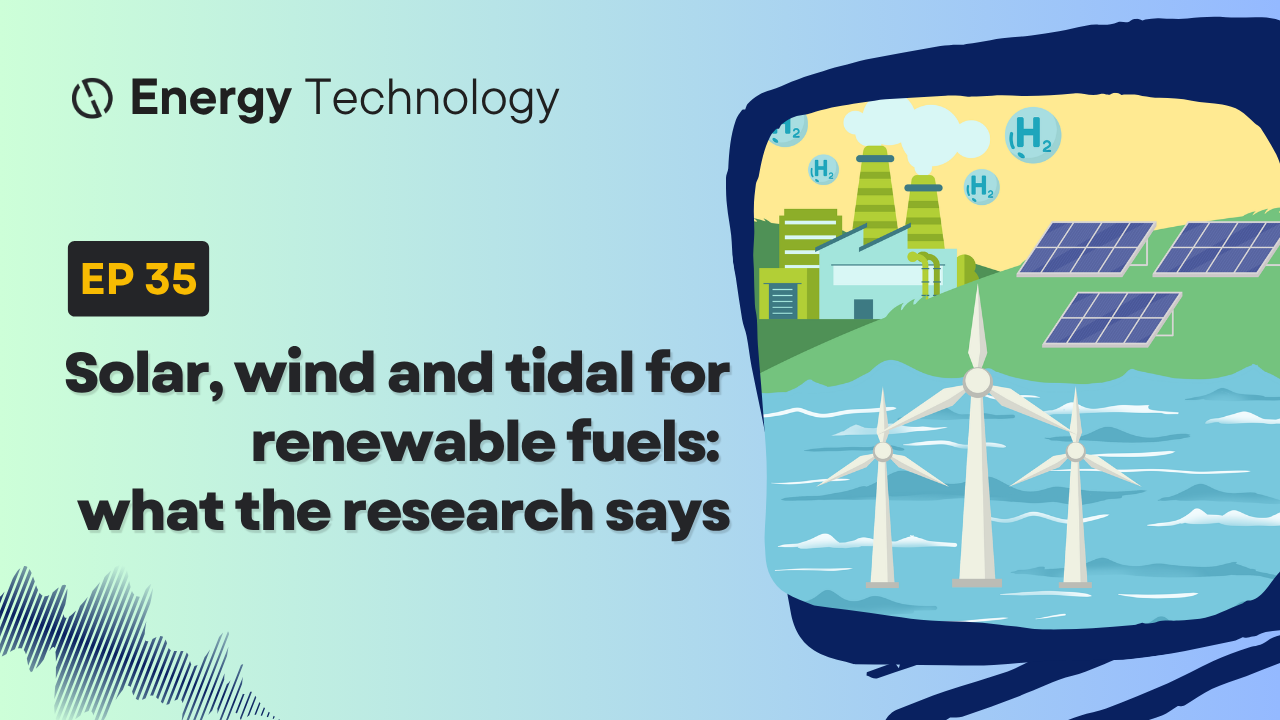
Catrin Garrett, an energy systems engineer at EMEC, emphasizes the importance of location-based industrial use. EMEC’s work with tidal energy has proven that the predictability of the tides—unlike the volatility of wind or solar—can be leveraged to create a resilient energy system. By integrating tidal turbines with vanadium flow batteries, EMEC has demonstrated that it is possible to maintain a constant flow of electricity, effectively smoothing out the intermittency that has historically plagued renewable energy systems.
Implications for the Global Energy Landscape
The shift toward these technologies has profound implications for global energy security and industrial policy.
1. Repurposing Existing Infrastructure
A major theme among researchers is the potential to repurpose existing oil and gas infrastructure. While hydrogen poses material challenges—such as steel embrittlement—the cost of building new pipeline networks is prohibitive. Adapting existing assets for hydrogen or synthetic fuel transport remains a key area of study for the next decade.
2. The Move Toward E-Fuels
As noted by Catrin Garrett, there is a growing consensus that while hydrogen is a vital component, it is not a silver bullet. The industry is increasingly looking toward ammonia, methanol, and synthetic e-fuels. These substances are generally easier to store, transport, and distribute than pure hydrogen, making them more attractive for international trade and maritime shipping.
3. Decentralized Production
The development of photoreactor panels and artificial leaves suggests a future where fuel production could be decentralized. Rather than relying on massive, centralized refineries, industrial facilities could potentially produce their own fuel on-site, using sunlight as their primary feedstock. This would significantly reduce the reliance on global supply chains and mitigate the risks associated with geopolitical energy instability.
4. Economic Resilience and Grid Integration
The work of Giampieri highlights that the "waste" of the current system—curtailment—is actually a massive reservoir of potential. By aligning the production of green hydrogen with periods of peak renewable energy generation, the industry can stabilize the grid while simultaneously driving down the cost of green fuels. This creates a feedback loop where the energy transition funds itself through increased efficiency and reduced waste.
Conclusion: The Path Forward
The transition to a low-carbon economy is no longer a question of "if," but "how." The innovations presented by Cordts, Rahaman, Garrett, and Giampieri illustrate a multi-faceted approach to the problem. By combining breakthroughs in solar-chemical water splitting, artificial photosynthesis, tidal integration, and sophisticated techno-economic modeling, the scientific community is building a robust framework for a post-fossil-fuel world.
While challenges remain—particularly regarding the scalability of manufacturing and the material durability of transport infrastructure—the trajectory is clear. The future of energy lies in the synthesis of high-tech engineering and the raw, abundant power of the natural environment. As these technologies move from the test facility to the commercial market, they promise not only to decarbonize our heaviest industries but to fundamentally reshape the global energy map, making it cleaner, more resilient, and ultimately, more sustainable for generations to come.