For the modern backpacker, the spec sheet is often the final word in purchasing decisions. Consumers are bombarded with technical jargon—Dyneema, X-Pac, Cordura, PFC-free DWR coatings—all promising superior abrasion resistance, high tear strength, and impenetrable water resistance. Yet, there is a recurring dissonance between the laboratory performance of a textile and the reality of a rainy day on the trail.
The fundamental truth of gear manufacturing is that a backpack is not a sealed vessel. While a fabric might boast a 20,000mm hydrostatic head rating, that metric becomes largely irrelevant the moment it is punctured by a sewing needle or compromised by a zipper. To understand why your gear fails when the clouds break, we must look beyond the fabric and toward the architecture of the pack itself.
The Illusion of Impermeability: Understanding Pack Construction
Backpacks are complex systems of geometry and assembly. Even the most advanced, high-performance fabrics are frequently defeated by the realities of construction. Water ingress is rarely a failure of the textile itself; it is almost always a failure of the assembly.
The Vulnerability of Seams and Interfaces
Every stitch in a backpack creates a micro-perforation. Even if a pack uses high-tenacity thread, those holes act as capillary channels. Under the pressure of a sustained downpour, water molecules are forced through these needle holes, often soaking the interior contents long before the fabric itself saturates.
Furthermore, zippers, hydration ports, and roll-top closures represent "weak links." A zipper, no matter how "water-resistant" its coating, is essentially a mechanical bridge that allows for potential moisture migration. When these elements are placed in high-exposure areas—such as the top lid or the front face—they become prime targets for water ingress.
The "Shower Test": A Methodology for Practical Assessment
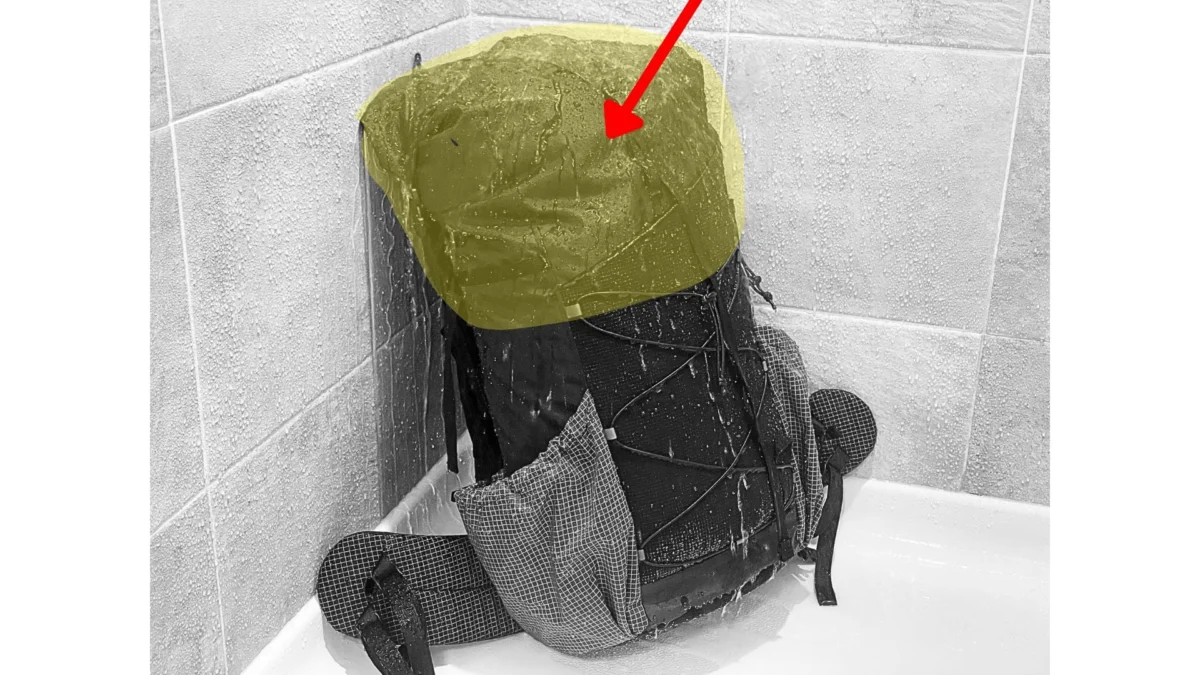
To bridge the gap between marketing claims and real-world performance, we have developed a standardized, albeit simple, "Shower Test." This is not a laboratory-grade simulation of a mountain storm, but rather a controlled, repeatable stress test designed to expose structural flaws.
The methodology is straightforward:
- Preparation: The pack is stuffed with a large, dry cotton pillowcase. This acts as a "witness material," which will darken and show even minor traces of moisture.
- Exposure: The pack is placed under a standard household shower for a sustained 30-minute duration.
- Evaluation: Upon completion, the interior is inspected. The cotton pillowcase provides a clear, visual indicator of exactly where and how much water has penetrated the main compartment.
Chronology of the Testing Process
The development of this test protocol was born from years of anecdotal reports from thru-hikers and gear testers who found that "water-resistant" packs often failed within hours of sustained precipitation.
- Phase 1: Baseline Assessment: Identifying the pack’s design intent. Is it an ultralight frameless pack or a heavy-duty expedition hauler?
- Phase 2: Pre-Test Inspection: Documenting seam taping, zipper orientation, and the presence of external pockets that might channel water toward zippers.
- Phase 3: The 30-Minute Exposure: Subjecting the pack to a high-volume, consistent spray that simulates heavy rain.
- Phase 4: Quantitative and Qualitative Analysis: Assessing the "witness material" and mapping the path of the water ingress. Did it come through the roll-top? Was it pulled through the shoulder strap anchor points?
Supporting Data: Why Fabric Specs Can Be Deceiving
When manufacturers report the water resistance of a pack, they are often reporting the fabric’s resistance to hydrostatic pressure. However, this data is often misinterpreted by the consumer.
For instance, a fabric with high hydrostatic resistance—say, 10,000mm—is excellent at preventing water from passing through the fibers. But in a backpack, the water takes the path of least resistance. Our testing suggests that even with a waterproof fabric, if the seam taping is inconsistent or the internal geometry creates "pooling zones," the pack will fail.
Data from our recent test cycles indicate that packs with "floating lids" or complex external compression systems consistently allow more water into the main compartment than simple, roll-top "dry bag" style designs. This is not due to fabric failure, but due to the number of points of failure (seams, anchors, and zippers) inherent in the design.
Official Responses and Industry Standards
The outdoor industry is notoriously guarded regarding "waterproof" claims. Most reputable brands avoid the term "waterproof" entirely, opting for "highly water-resistant" or "weather-resistant." This distinction is legal and technical.
In conversations with design leads at major outdoor brands, the consensus is clear: creating a truly waterproof pack adds weight, cost, and complexity. A truly waterproof pack requires seam welding (as opposed to sewing), specialized hardware, and often less breathable materials. Most consumers prioritize weight and features over absolute water integrity.
"We design for the most likely scenarios," says a senior design engineer at a prominent pack manufacturer. "For 95% of our users, a pack that handles light to moderate rain is sufficient. For the remaining 5%, we recommend a pack liner or a rain cover. We don’t build the pack as a submersible vessel because it would compromise the pack’s primary function—comfort and accessibility."
Implications for the Modern Hiker
The implications of these findings are profound for those planning extended backcountry expeditions. If your gear is not inherently waterproof, you must change your strategy.
1. The Hierarchy of Protection
Relying on a pack to keep your sleeping bag dry is a dangerous gamble. The "Shower Test" proves that, under pressure, almost any sewn pack will eventually leak. Hikers should adopt a tiered approach to gear protection:
- Layer 1: Dry Bags. Essential items like sleeping bags and electronics should be kept in dedicated, roll-top dry bags.
- Layer 2: Pack Liners. A heavy-duty trash compactor bag or a dedicated waterproof pack liner acts as the primary shield for the contents of the main compartment.
- Layer 3: The Pack Itself. View the pack as a container for your protected items, not as the protection itself.
2. Strategic Packing
When packing, consider where your gear is most vulnerable. If your pack has exposed zippers on the lid, do not store moisture-sensitive items like a down jacket or a spare pair of socks in those top pockets. Place them deep in the center of the main compartment, protected by a liner.
3. Maintenance
Water resistance is not a static quality. DWR (Durable Water Repellent) coatings on fabrics degrade over time due to abrasion and dirt accumulation. Regularly cleaning your pack and reapplying DWR treatments can help the fabric bead water longer, which prevents the outer layers from "wetting out" and becoming heavy.
Conclusion: A Shift in Expectations
The "Shower Test" serves as a reality check. While it is tempting to believe that a $400 backpack made from space-age materials will keep our gear bone-dry in a deluge, the engineering reality suggests otherwise. By understanding that backpacks are systems of seams, zippers, and interfaces rather than solid, impenetrable objects, we can better prepare for the realities of the trail.
The objective of any gear test is not to shame manufacturers for failing to achieve the impossible, but to empower users to understand the limitations of their equipment. When you stop expecting your backpack to perform like a dry bag, you can start packing in a way that ensures your core gear remains dry, no matter how hard the rain falls.
In the final assessment, water resistance is a spectrum. By recognizing where your pack sits on that spectrum, you can adjust your strategy, protect your gear, and ultimately enjoy a safer, more comfortable experience in the backcountry. The next time you head out into the clouds, remember: the fabric is only as strong as the seams that hold it together.