For the backcountry enthusiast, the transition from summer trekking to winter mountaineering introduces a formidable adversary: the cold. As temperatures plummet, standard upright canister stoves suffer from pressure loss, rendering them sluggish or entirely useless. The solution—a remote inverted canister stove—has long been the gold standard for reliable winter performance. Yet, for veteran designer and engineer, the commercial offerings have historically been heavy, clunky, and prone to mechanical inefficiency.
This is the story of a multi-year engineering quest to perfect the remote inverted canister stove, tracing the evolution from humble "stove stand" modifications to the ultra-light, high-performance V8 Vortex design.
Main Facts: The Quest for Thermal Reliability
The fundamental challenge of winter stove design is twofold: achieving consistent fuel vaporization in sub-zero environments and maintaining a weight profile that satisfies the modern ultralight (UL) ethos.
When a canister is inverted, it feeds liquid fuel into the stove. Without proper management, this results in dangerous flare-ups. The primary mechanism to prevent this is a "heat shunt"—a conductive bridge that pulls thermal energy from the burner flame back to the stove body to vaporize the fuel before it reaches the jet.
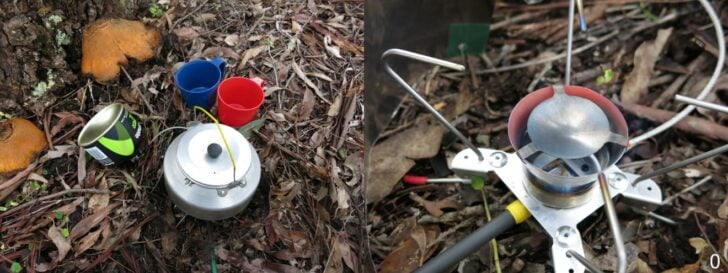
The engineering journey detailed here centers on achieving a "thermal balance." The goal is to maintain the stove body at a stable temperature—ideally around 120°C—to ensure complete vaporization without reaching the 200°C+ threshold that risks degrading Viton O-rings or PFA tubing. Achieving this requires precise measurement, iterative design, and an uncompromising approach to material selection.
Chronology of Development
The Genesis: From Brunton to V0
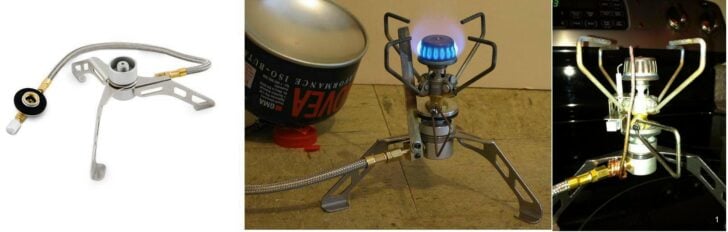
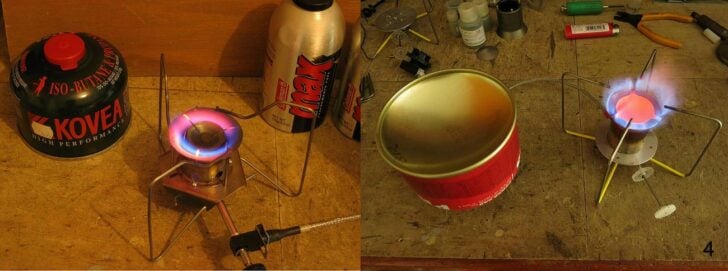
The journey began with the Brunton "Stove Stand," an early attempt to lower the center of gravity of upright stoves. While effective at increasing stability, it lacked the ability to safely run in an inverted configuration. The introduction of a copper strip—the "V0" design—from the flames to the inlet fitting proved that liquid fuel could be successfully vaporized. This early proof-of-concept inspired a series of iterations aimed at shedding weight and increasing reliability.
The V1 Era: Customization and CNC Machining
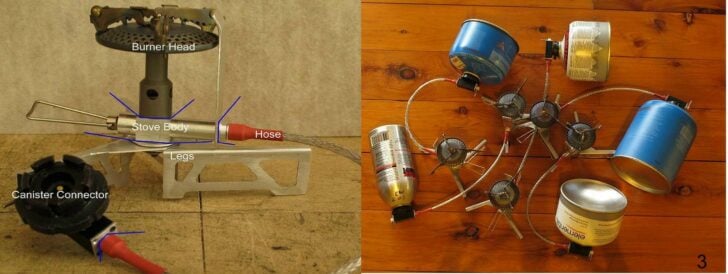
The V1 design marked the transition from "experimental" to "production-grade." It featured a custom stove body, a flexible hose, and a versatile canister connector compatible with both screw-thread and lug-style valves. To ensure the 115 units produced were identical, the designer mastered CNC machining, a process that allowed for the high precision required for interchangeable parts.
V2 and V3: The Vortex Revolution
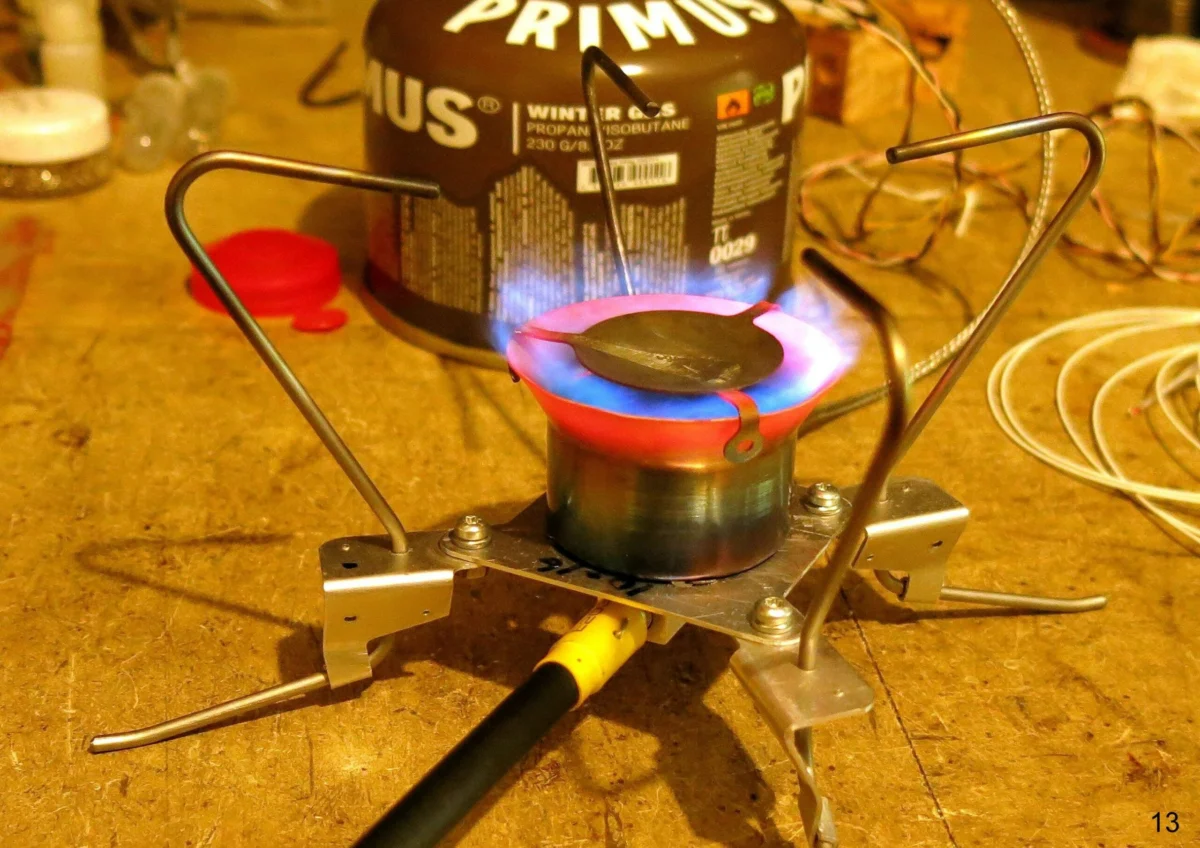
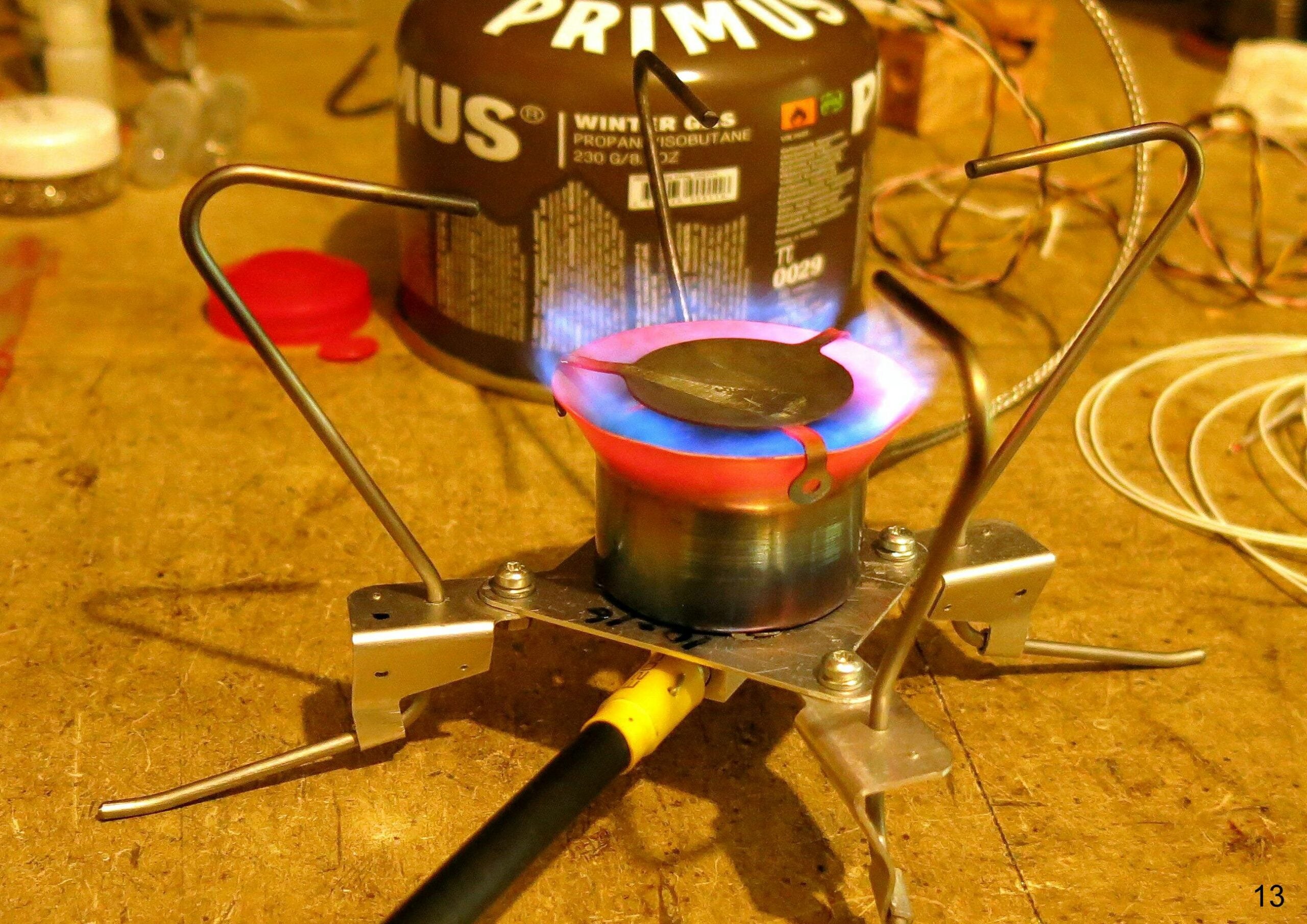
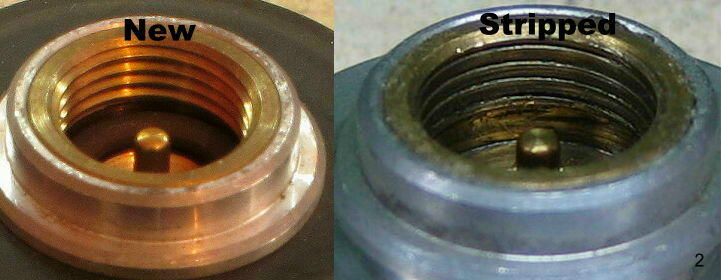
Moving away from stock burner tops, the V2 and V3 iterations adopted the "Vortex" concept—a closed-chamber design similar to the MSR XGK. By directing flames inside a chamber, these stoves provided superior heat transfer. However, the use of titanium wire supports proved problematic; the "spot welding" of these wires was structurally unsound, leading to failures under load. The design was refined to ensure only the tips of the supports reached the flame, a change that not only increased durability but also reduced carbon monoxide (CO) production.
V4 and the Upright Experiments
After the Vortex experiments, a return to an upright burner head—the V4—brought new challenges, particularly regarding the complexity of internal gas-mixing baffles. This phase emphasized the importance of support structures, leading to the discovery that simple, bent wire legs were significantly more weight-efficient than the complex, sheet-titanium zigzag designs previously tested.
V5 to V7: The Pursuit of SUL (Super Ultra-Light)
The V7 iteration represents the pinnacle of the SUL philosophy, dropping the total weight to a mere 45 grams. By utilizing a BRS-3000T burner as a base and custom-braided PFA tubing, the design achieved a drastic reduction in mass. This phase required rigorous data logging to maintain a balanced heat flow despite the reduced mass of the heat exchanger components.
The V8 Vortex: A Modern Iteration
The current project, the V8, aims to push the Vortex concept into the SUL category. By testing various mini-burner chamber designs and refining the leg geometry, the V8 seeks to combine the raw, powerful heat output of a vortex system with the weight efficiency of a modern, minimal stove.
Supporting Data: The Physics of Combustion
The engineering process relied heavily on precise telemetry. Using a LabJack data logger, the designer monitored the thermal behavior of the stove body against ambient laboratory temperatures.
Key findings from the data suggest:
- Thermal Decoupling: In early designs, the stove body temperature often struggled to stay above the flash point of butane during high-output operation, risking flare-ups.
- The "Snow Correction": Because testing was conducted at +20°C, a standard deviation—typically subtracting 40°C—was applied to simulate performance in -20°C snow conditions.
- Air-Fuel Ratio: A critical insight was the role of excess air. While some air is necessary to ensure clean, blue-flame combustion, an excess cools the burner and reduces efficiency. Precise control of the air intake proved essential for reliable ignition and optimal thermal output.
Implications for the Industry
The work presented here serves as a critique of modern commercial stove manufacturing. Many manufacturers prioritize robust, "idiot-proof" components—such as heavy-duty, stiff hoses and bulky brass fittings—that add unnecessary weight for the experienced user.
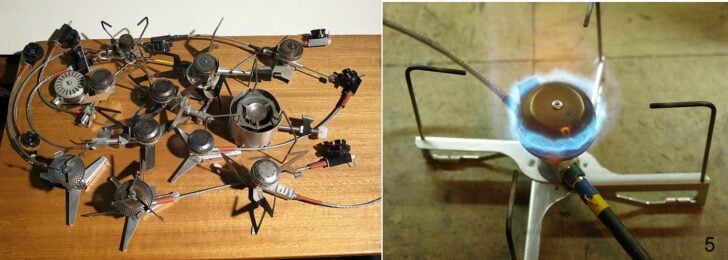
The success of the V1 through V8 series demonstrates that:
- Material Innovation: Moving from heavy-duty rubber to custom-braided PFA tubing is a viable path to weight reduction without sacrificing safety.
- Data-Driven Design: The use of personal laboratories and data loggers allows for the creation of equipment that is precisely tuned to specific environmental conditions, something mass-market manufacturers often generalize.
- The DIY Future: With the accessibility of CAD/CAM software and desktop CNC machines, the individual engineer is now capable of producing high-performance gear that challenges the dominance of established outdoor brands.
Conclusion: The Path Forward
The V8 Vortex stove is not just an iteration; it is a testament to the idea that winter equipment can be both feather-light and exceptionally reliable. By treating the stove as a thermal engine rather than just a fuel-burning accessory, the designer has provided a blueprint for the next generation of backcountry heating solutions. As the industry looks toward more sustainable and lightweight materials, the lessons learned from these eight iterations offer a clear path: prioritize thermal efficiency, embrace precise measurement, and never fear the complexity of a custom-engineered solution.