In the high-stakes world of environmental emergency response, few scenarios present as complex a challenge as a spill on a frozen or partially frozen river. While inland spill response is inherently demanding, the introduction of sub-zero temperatures, shifting ice sheets, and the relentless force of moving water creates an environment where the margin for error is razor-thin. For responders, the mission is no longer just about containment; it is about survival in one of the most unforgiving professional landscapes on earth.
The High-Risk Reality of Winter Operations
Responding to oil or chemical spills in cold-weather climates requires a total paradigm shift from standard temperate-zone operations. When a spill occurs on a river during winter, the primary directive is to work from the shore or on solid ice whenever possible. However, the presence of moving water beneath the surface introduces a dynamic hazard that renders traditional lake-ice safety protocols insufficient.
Unlike the static, predictable nature of frozen lake ice, river ice is subject to the constant hydraulic pressure of the current, temperature fluctuations, and the accumulation of frazil or anchor ice. If a responder breaks through ice on a lake, they face a cold-water immersion incident. If they break through on a river, they face a life-threatening entanglement scenario where the current can drag them beneath the ice shelf, making extraction nearly impossible. Consequently, safety plans must be established and rigorously vetted before a single boot touches the ice.
Chronology of an Ice-Based Response
A successful response in these conditions follows a strictly ordered, safety-first methodology:
- Initial Size-Up (0–2 Hours): The site commander must assess current velocity, water depth, and structural integrity of the ice. This phase is exclusively conducted from stable ground.
- Strategic Planning (2–4 Hours): Teams establish an Initial Safety Plan (ISP). This includes designating an ice rescue instructor to oversee the initial approach, establishing belay systems, and identifying secondary egress points.
- Deployment of Assessment Teams (4–6 Hours): Responders, equipped with specialized PPE and tethered to a belay, begin drilling test holes from the shore outward. Each hole is logged for thickness and ice quality.
- Operational Implementation (Ongoing): Once the zone is cleared, operations commence using weight-distribution measures like plywood sheets or inflatable platforms. Continuous monitoring of weather and ice integrity is maintained throughout the operation.
Data-Driven Safety: Calculating Ice Strength
The assumption that ice is a monolithic, uniform surface is a dangerous fallacy. Responders must utilize mathematical models to approximate load-bearing capacity while applying significant "safety factors" to account for the unique variables of river environments.
The standard formula for estimating load-bearing capacity is:
P = 50 × T²
(Where P = load in lbs, and T = thickness in inches).
For example, four inches of clear, stable lake ice provides roughly 800 lbs of support. However, this figure is highly optimistic for river operations. Best practices dictate a mandatory 15% reduction in capacity to account for current-driven erosion and a further 50% reduction if the surface is composed of "snow ice"—a milky, opaque, and inherently porous structure that forms when snow saturates and freezes on top of a sheet.
Ice Classification Guide
- Clear/Lake Ice: The gold standard of strength; forms quickly during rapid temperature drops.
- Frazil Ice: Slushy, disc-shaped ice representing the early, unstable phase of formation.
- Candled Ice: Deteriorating ice that appears thick but lacks structural integrity, often appearing whitish-gray.
- Snow Ice: Highly dangerous; opaque, milky, and significantly weaker than clear ice.
- Anchor Ice: Forms on submerged objects; highly unpredictable and a frequent cause of ice jams that can compromise local ice stability.
Official Response Procedures and PPE
When personnel must venture onto the ice, the equipment list is non-negotiable. Every responder must be outfitted in a high-visibility, thermal-rated drysuit, a rescue-rated Personal Flotation Device (PFD), ice awls for self-rescue, and aggressive ice cleats.
Tactical Operational Guidelines
- The Buddy System: No individual ever steps onto the ice alone. Every worker is paired with a safety observer.
- Weight Distribution: Use plywood sheets or specialized inflatable platforms to minimize localized pressure on the ice surface.
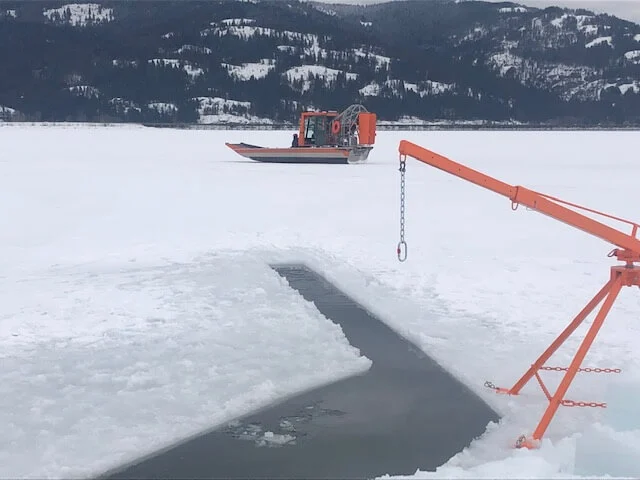
- Belay Stations: Responders should be tethered to a land-based belay system. In situations where open water is not present downstream, a "rescue slot" should be cut in the ice as a contingency for immediate extraction.
- Containment Zoning: Once assessment holes are drilled, the area must be clearly cordoned off with high-visibility protective fencing to prevent accidental entry by non-essential personnel.
- The Warming Station: A climate-controlled environment—such as a heated tent or mobile command unit—is mandatory. This facility must be stocked with hypothermia wraps, AEDs, oxygen, and extra layers of PPE.
The Invisible Threat: Wind Chill and Hypothermia
In northern climates, the air temperature is rarely the sole indicator of danger. The Wind Chill Temperature Index (WCTI) serves as a critical decision-making tool for the Incident Commander. As wind speeds increase, the convective heat loss from the human body accelerates, leading to rapid onset frostbite and hypothermia.
When ambient temperatures drop to 15°F and winds hit 30 mph, the "feels like" temperature plummets to -5°F. At these levels, exposed skin can freeze in less than 10 minutes. Operations must be paused or rotated frequently if wind chill thresholds are met. Responders must be trained to recognize the "umbles"—stumbling, mumbling, and fumbling—as the earliest warning signs of cognitive impairment due to cold stress.
Self-Rescue: The Final Contingency
Despite every precaution, the risk of a breakthrough remains. Every responder must be physically and mentally drilled in self-rescue techniques:
- Remain Calm: Panic accelerates heart rate and causes rapid heat loss.
- Stabilize: Extend arms across the ice shelf to distribute weight and prevent full submersion.
- Horizontal Orientation: Kick legs to propel the body horizontally toward the solid ice edge.
- The "Roll" Exit: Once the torso is onto the solid ice, roll away from the break-in point to distribute weight over a larger surface area, rather than attempting to stand immediately.
Implications for Future Spill Response
The trend toward more volatile weather patterns suggests that responders will face these extreme conditions with increasing frequency. The professionalization of winter spill response lies in the integration of specialized ice-rescue training with traditional hazardous material mitigation.
Agencies are now moving toward a "pre-emptive assessment" model, where maps of high-risk river corridors are maintained with historical ice-thickness data and current-speed models. By investing in specialized platforms—such as airboats that can transition from water to ice and drone-based thermography to detect thin spots—the industry is slowly narrowing the gap between the danger of the environment and the safety of the responder.
Ultimately, the goal is to eliminate the necessity of working on the ice altogether through remote sensing and autonomous containment technologies. Until that day arrives, the rigorous application of these protocols—size-up, tethered operations, and constant meteorological vigilance—remains the only barrier between a successful environmental cleanup and a preventable tragedy. The frozen river is a formidable adversary; it demands respect, preparation, and an unwavering commitment to the safety of those on the front lines.