Introduction: The Invisible Struggle Against Moisture
During periods of high-exertion activity—whether alpine climbing, backcountry skiing, or long-distance trekking—the human body functions as a high-output furnace. To maintain thermal equilibrium, the body generates sweat. When the rate of sweat production exceeds the rate of evaporation, liquid water begins to pool against the skin. At this critical juncture, the base layer—the garment worn directly against the body—must perform a sophisticated mechanical task: it must capture that liquid and move it outward to subsequent layers.
For decades, outdoor enthusiasts have relied on marketing terminology such as "moisture-wicking" or "stay-dry" to guide their purchasing decisions. However, these labels often fail to account for the physical reality of how water behaves once it transitions from vapor to liquid. A significant performance gap exists between garments that share similar marketing claims, leaving many hikers wondering why their "wicking" shirt feels like a sodden sponge while another remains functional.
To move beyond anecdotal evidence, we initiated a rigorous, multi-fabric study designed to track the physical movement of liquid water through a simulated clothing system. By measuring exactly how much moisture remains on the "skin," how much is sequestered within the base layer, and how much successfully migrates to an outer layer, we have finally quantified the "tug-of-war" that occurs during intense physical activity.
Chronology of the Testing Protocol
The investigation began with an evaluation of three primary base-layer fabrics, but as data points emerged, the scope was expanded to eight distinct materials. This selection allowed us to observe a broader spectrum of fiber technologies, ranging from hydrophobic synthetics to hydrophilic natural and treated blends.
The testing process was structured to mimic a real-world saturation scenario. We utilized a custom-built transfer device—a series of stacked metal plates—that allowed for precise measurement of water volume at every stage of the fabric interface. The testing was conducted in controlled, repeatable phases:
- Initial Saturation: Measuring the absorption capacity of the base layer.
- Transfer Dynamics: Applying controlled pressure to observe the migration of liquid from the base layer to a receiving layer.
- Retention Analysis: Measuring the residual moisture trapped in the garment after the transfer phase.
This methodology was informed by foundational scientific literature, specifically the work of Young and Laplace (1805) and the 1921 research of Washburn on the dynamics of capillary flow. By applying these century-old physical principles to modern textile engineering, we established a clear, empirical framework for evaluating moisture management.
Supporting Data: The Hydrophobic vs. Hydrophilic Divide
The data reveals a fundamental dichotomy in fabric behavior. The results challenge the popular misconception that "hydrophobic" means "waterproof" or that "hydrophilic" is always superior for moisture transport.
The Hydrophobic Paradox
Hydrophobic fabrics are frequently marketed as "stay-dry" because the fibers themselves do not absorb water. However, our testing confirms that these fabrics can—and do—become saturated. Fabrics are, by design, porous. When the rate of incoming sweat exceeds the rate of transfer, liquid water pools within the open pores of the fabric.
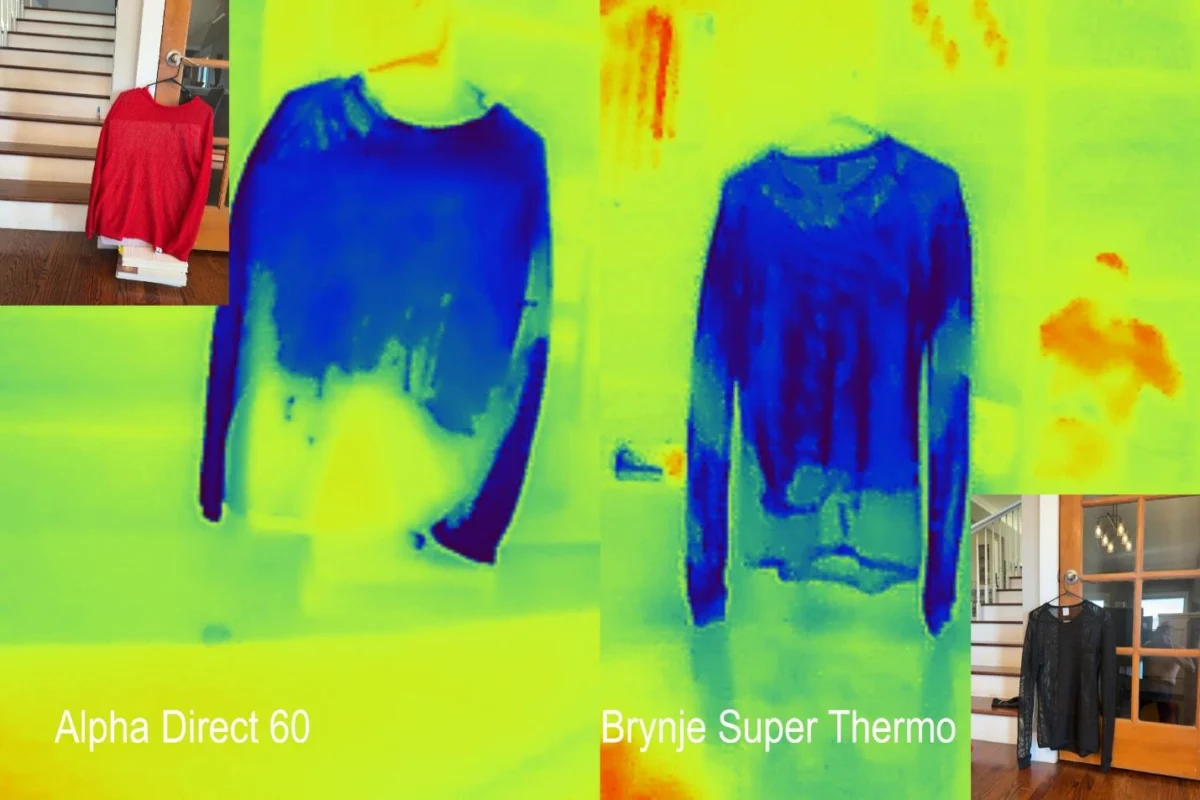
Infrared imaging of garments like the Brynje mesh shirt and Alpha Direct mid-layers revealed high-water-content regions appearing as dark blue zones. In one instance, a mesh shirt retained 87 grams of sweat, amounting to 65% of its dry weight. This proves that while the fibers remain dry, the garment becomes heavy, clammy, and insulating-impaired.
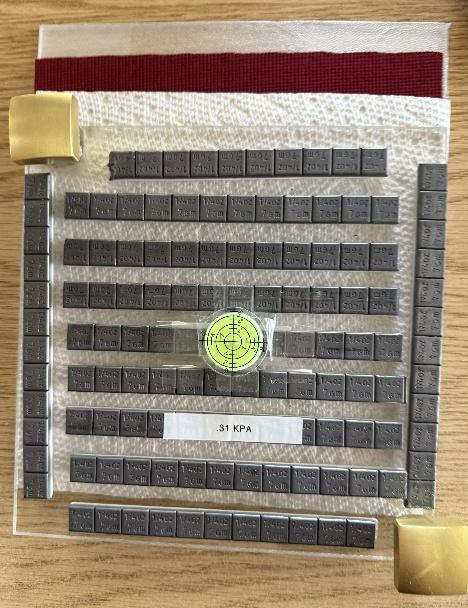
Crucially, our testing showed that hydrophobic fabrics do not initiate moisture transport through capillary action. They require "breakthrough pressure"—an external force—to move liquid from the skin to the outer layer. This pressure can be generated by pack straps, body movement, or the simple accumulation of liquid weight. If that pressure threshold isn’t met, the hydrophobic layer acts as a barrier, trapping sweat against the skin.
The Hydrophilic Limit
Conversely, hydrophilic fabrics excel at initial absorption. Their chemical structure creates hydrogen bonding sites that pull water into the fiber, effectively "wicking" it away from the skin. However, the data reveals a critical failure point: the same capillary forces that attract the water also act as a tether.
Once the hydrophilic fabric is saturated, it holds onto moisture with significant tenacity. Transferring that water to an outer layer becomes a competitive process. As the receiving layer reaches its own saturation limit, its ability to "pull" moisture from the base layer diminishes. In our testing, this often resulted in a performance plateau where the base layer remained saturated indefinitely, regardless of the outer layer’s potential to absorb more moisture.
Official Observations and Technical Analysis
The study identified three primary variables that dictate the efficiency of a base layer:
- Pore Structure: While larger pores generally reduce the "breakthrough pressure" required for hydrophobic fabrics, they also create more room for liquid retention.
- Contact Angle: This measurement of a fiber’s resistance to water (where >90° indicates hydrophobicity) is the primary determinant of how the fabric handles a bead of sweat. Our data shows a strong correlation between high contact angles and the fabric’s ability to resist internal wetting—provided the breakthrough pressure is managed correctly.
- Pathway Connectivity: Our microscopic analysis revealed that apparent pore size is not the only metric. The internal, three-dimensional geometry of the weave determines how easily water flows. A fabric with smaller pores may outperform a larger-pored one if the internal pathways are more efficiently connected.
Implications for Future Gear Selection
What does this mean for the backcountry user? The implications for gear selection are significant.
For high-exertion, cold-weather activities, the choice of base layer is not merely about comfort; it is a thermal management strategy. If a hiker is wearing a heavy pack, the constant compression of the shoulder straps and back panel provides the "breakthrough pressure" needed for a hydrophobic layer to function efficiently. In this scenario, a hydrophobic garment may be superior, as it will move sweat into the outer layer rather than holding it against the skin.
However, in activities involving less compression or lower intensity, a hydrophilic fabric may provide a more consistent "wicking" experience, provided the outer layer has sufficient capacity to accept the transferred moisture.
Summary of Key Takeaways
- Saturation is inevitable: Both hydrophobic and hydrophilic fabrics can become "wet." The difference lies in whether the water is stored in the pores (hydrophobic) or absorbed into the fibers (hydrophilic).
- Pressure is a factor: Hydrophobic fabrics are essentially "on/off" switches for moisture transport. They require pressure to move liquid; without it, they can trap sweat.
- Systemic Thinking: A base layer cannot be evaluated in isolation. Its performance is entirely dependent on the "receiving" layer’s ability to continue the moisture-transport chain. If your mid-layer or shell is not breathable, even the most advanced base layer will eventually fail.
This study underscores that there is no "magic bullet" fabric. Instead, hikers should choose base layers based on the specific mechanical stresses of their activity—considering the weight of their pack, the intensity of their movement, and the layering system as a whole. By understanding the physics of the "tug-of-water," users can optimize their gear for the realities of the mountain, rather than the promises of the marketing tag.