Responding to environmental emergencies is inherently challenging, but when hazardous material spills occur in freezing, winter conditions—particularly on ice-covered waterways—the risk profile shifts from "difficult" to "life-threatening." As climate patterns fluctuate and industrial activity persists through the winter months, spill responders are increasingly tasked with navigating the unforgiving terrain of frozen rivers and lakes.
The primary danger in these scenarios is not merely the cold; it is the volatile nature of moving water beneath a fragile surface. Unlike stagnant lake ice, river ice is subject to constant hydraulic pressure, variable current speeds, and structural instability caused by fluctuating water levels. For the professional responder, successful containment and cleanup require a rigorous adherence to specialized protocols, advanced risk assessment, and an unwavering commitment to site safety.
The Anatomy of the Risk: Why River Ice Defies Standard Protocol
When a spill occurs on a river, the environment is dynamic. The water beneath the ice is rarely static, and the integrity of the ice sheet is compromised by currents, eddies, and thermal variations. If a responder breaches the surface, they are not just dealing with hypothermia; they are dealing with a "sweeper" effect—the current can pull a victim under the ice shelf, making rescue nearly impossible.
The fundamental rule for any cold-weather spill response is simple: stay off the ice unless absolutely necessary. If operations must proceed, they should only be conducted under the umbrella of a meticulously drafted safety plan that has been vetted by senior site leads and ice rescue specialists.
Initial Size-Up and Risk Assessment
Before a single boot touches the ice, a comprehensive size-up must be performed. This is not a cursory glance; it is a scientific assessment of the operating environment. Responders must quantify:
- Current Velocity: Faster currents erode ice from beneath, creating "hollow" sections that may look solid but are paper-thin.
- Hydraulic Depth: Knowing the depth is critical for determining the potential for entrapment.
- Ice Quality and Integrity: Assessment must include thickness, crystal structure, and consistency.
- Load-Bearing Capacity: Utilizing the formula $P = 50 times T^2$ (where $T$ is thickness in inches), responders can estimate the capacity in pounds. However, this is a baseline calculation.
Crucial Adjustments: Industry standards dictate that for river ice, one must reduce these strength estimates by at least 15% to account for current-induced erosion. Furthermore, if the surface contains "snow ice"—an opaque, milky layer formed when snow saturates and refreezes—the strength capacity must be reduced by up to 50%.
A Chronology of Operational Deployment
To maintain safety, responders follow a systematic operational timeline during a winter spill event.
Phase 1: Preparation and Mobilization
Upon arrival, the immediate priority is the establishment of a command center and a warming station. A heated shelter, equipped with hypothermia-wrap kits, AEDs, oxygen, and dry emergency gear, is non-negotiable. No field work commences until this medical safety net is operational.
Phase 2: Systematic Assessment
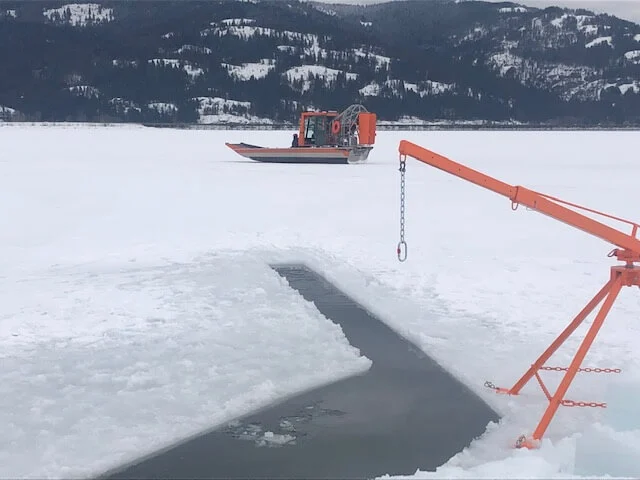
An ice rescue instructor should oversee the initial approach to the ice. Responders must be belayed at all times. Using augers, the team drills a series of test holes starting from the shore and working progressively outward, recording data at each point. To minimize risk, teams should utilize airboats or deploy 4×8 sheets of plywood to distribute their weight across the ice surface.
Phase 3: Mitigation and Containment
Once the "safe" zone is established, operations move toward containment. This often involves cutting slots in the ice to deploy booms or skimmers. Every cut site must be cordoned off with high-visibility fencing. If no open water is available downstream, responders must consider cutting a "rescue slot" to facilitate the retrieval of any personnel who might accidentally enter the water.
Phase 4: Continuous Monitoring
Weather is a variable that never stops changing. Site supervisors must monitor forecasts in real-time. A sudden drop in temperature can make ice brittle, while a mid-winter thaw can compromise structural integrity in minutes. Regular re-evaluation of the ice is mandatory.
Supporting Data: Understanding Ice Types and Hazards
Responders must be capable of identifying the "signature" of the ice they are working on, as appearance often dictates the level of risk.
- Lake Ice: Generally the strongest; clear and reflective, forming during rapid temperature drops.
- Frazil Ice: An early-phase, slushy, disk-shaped ice that lacks structural strength.
- Candled Ice: A deceptive, dangerous form of deterioration where the ice takes on a whitish-gray hue. It may appear thick but has zero load-bearing capacity.
- Anchor Ice: Forms on submerged objects and is notorious for creating ice jams in rivers, which can suddenly release and surge, trapping responders downstream.
PPE Requirements
The mandatory gear list for any responder operating on or near river ice includes:
- Drysuits: Essential for thermal protection in the event of immersion.
- PFDs: Specifically designed for cold-water rescue.
- Self-Rescue Tools: Ice awls worn on the chest for immediate extraction.
- Support Gear: Ice cleats, helmets, and protective eyewear/saw protection.
The Physiological Impact: Wind Chill and Hypothermia
In many northern spill environments, the ambient temperature is only half the story. The Wind Chill Temperature Index provides a sobering look at how fast the human body loses heat. As wind speed increases, the rate of heat loss accelerates, leading to frostbite in minutes.
For example, at a true air temperature of 15°F, a 30-mph wind creates a "feels like" temperature of -5°F. At this level, exposed skin can freeze in under 10 minutes.
The Survival Imperative: Self-Rescue
If a responder breaks through, the "1-10-1" rule applies:
- 1 Minute to get control of breathing (the cold shock response).
- 10 Minutes of meaningful movement to escape before cold incapacitation sets in.
- 1 Hour before consciousness is lost to hypothermia.
The self-rescue technique involves keeping the arms wide to prevent slipping under the ice shelf, kicking the legs to a horizontal position, and using ice awls to pull oneself back onto the solid surface. Panic is the primary killer; a pre-rehearsed plan is the primary savior.
Official Responses and Strategic Implications
Regulatory bodies and environmental agencies are increasingly emphasizing that "safety is the product of planning." The shift in industrial spill response has moved away from "get it done at all costs" toward a tiered, risk-averse approach.
The Implications for Future Operations
- Technological Integration: The use of drones for initial ice assessment and thermal imaging to detect thin spots is becoming the industry standard.
- Platform-Based Operations: There is a significant move toward using inflatable boat platforms or airboats as the primary working surface, reducing the need for personnel to walk directly on the ice.
- Training Standardization: The industry is pushing for mandatory "Fastwater Spill Response" certifications that specifically include a winter-module component.
Summary of Safety Protocols
The site safety plan must include, at a minimum:
- Communication Plan: Redundant systems (radio and cellular) to ensure contact with the shore.
- Evacuation Plan: Pre-cleared routes for medical transport, specifically factoring in winter road conditions.
- EMS Protocols: Dedicated personnel trained in cold-water immersion trauma and hypothermia rewarming.
Conclusion
Responding to a spill on a frozen river is a test of discipline. The environment is inherently hostile, and the margin for error is non-existent. By treating every ice sheet as a complex, shifting platform rather than a solid floor, and by strictly adhering to the established procedures for assessment, PPE, and buddy-system operations, responders can mitigate these extreme risks.
Ultimately, the goal of any winter spill response is not just the protection of the environment, but the assurance that every responder returns home at the end of the shift. In the world of cold-weather containment, preparation is the only barrier between a successful operation and a catastrophic secondary emergency. Always assess, always belay, and never underestimate the power of the water beneath the ice.