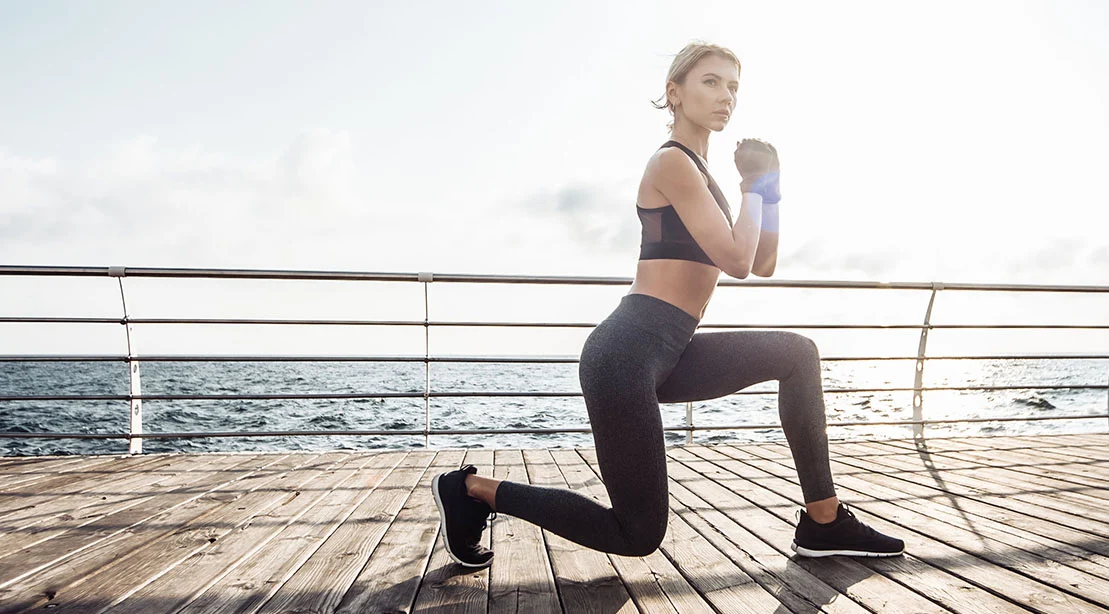
For most gym-goers, the lunge occupies a bittersweet space in their training regimen. It is universally acknowledged as a premier movement for building quad hypertrophy, sculpting the glutes, and correcting the strength imbalances that often plague those who rely exclusively on bilateral movements like the back squat. Whether your objective is aesthetic refinement, athletic performance, or simple functional longevity, the lunge is an indispensable tool.
However, there is a pervasive issue: for many lifters, the lunge ceases to be an exercise in strength and becomes a chaotic struggle against gravity. Instead of feeling the targeted muscle groups engage, the trainee finds themselves fighting to stay upright, cutting sets short due to frustration, or feeling the precarious “wobble” that signals a breakdown in form. When the brain is focused entirely on preventing a face-plant, the muscles fail to receive the necessary stimulus for growth.
The good news is that the lunge is not an inherently "bad" exercise; it is simply a movement that demands a high level of neuromuscular coordination and stability. If you are struggling, you aren’t necessarily destined to skip lunges forever. Balance is a trainable skill, and stability is a quality that can be systematically developed. By identifying the root cause of your instability and temporarily utilizing more supportive variations, you can bridge the gap between "wobbly" and "rock-solid."
The Mechanics of Instability: Why Do Lunges Feel So Funky?
To fix a shaky lunge, you must first understand the biomechanical requirements of the movement. When you step into a lunge, you are shifting your center of mass over a single point of support. If that support system is compromised, the entire kinetic chain falters.
1. Weak Hip Stability
The primary culprit in a shaky lunge is often the gluteus medius. While the gluteus maximus is responsible for hip extension, the medius—located on the outer surface of the pelvis—is the primary stabilizer. When this muscle is weak or underdeveloped, it fails to keep the pelvis level during single-leg movements. This results in the "hip hike" or, more commonly, the "knee cave" (medial knee collapse). When the knee caves in, the body loses its mechanical advantage, forcing the quads to compensate in an inefficient, dangerous manner.
2. The Foot as a Foundation
The kinetic chain begins at the ground. If your foot is not stable, the instability travels upward to the ankle, knee, and hip. Many people struggle because their feet roll excessively inward (pronation) or their weight shifts onto the toes, causing them to lose their center of gravity. Without a "tripod" base—maintaining pressure through the big toe, little toe, and heel—it is impossible to generate the necessary force to return to the starting position safely.
3. Neuromuscular Coordination
Lunges are a "timing" movement. You must lower your body with eccentric control, pause momentarily in a stable position, and drive upward through the front leg. If your nervous system lacks the coordination to sequence these movements, the exercise will feel disjointed. This lack of coordination often leads to over-reliance on momentum, which masks underlying strength deficits and increases the risk of injury.
Chronology of Progress: How to Rebuild Your Stability
If you find yourself constantly losing your balance, you should treat your training like a rehabilitation protocol. Do not force progress on a broken foundation. Follow this structured approach to regain your footing.
Phase I: The Warm-Up and Primer (Weeks 1–2)
Before attempting heavy loads, dedicate the first 10 minutes of your lower-body day to stability primers.
- Single-Leg Balance Drills: Stand barefoot. Hold a single-leg stance for 30 seconds per side. Once mastered, introduce head turns to challenge your vestibular system.
- Glute Activation: Prioritize lateral band walks and side-lying clamshells. These wake up the gluteus medius, ensuring it is firing before you step into your first lunge.
Phase II: Introducing Controlled Variations (Weeks 3–6)
Replace standard lunges with exercises that offer more stability (see below). Focus on "Time Under Tension" (TUT). Lower your body for a count of three seconds, pause for one second at the bottom, and rise with control. This tempo work forces your body to learn how to stabilize under load.
Phase III: Integration and Load (Weeks 7+)
Once you can perform 12–15 reps of a B-stance squat or controlled step-down without wobbling, return to the traditional lunge. Start with body weight or light goblet-style holds, slowly increasing the resistance as your confidence—and your stability—improves.
The "Bridge" Exercises: 5 Movements to Build Strength Without the Wobble
If you cannot perform a lunge with perfect form, use these five alternatives. They provide the necessary stimulus for growth while reducing the balance demand just enough to allow you to focus on the movement pattern.
1. Controlled Step-Down
By elevating one foot on a small box or plate and stepping down with the other, you remove the instability of the "step." This is an eccentric-focused exercise that teaches you how to own your weight on a single leg.
- Why it works: It forces you to control the knee tracking and hip alignment through the full range of motion.
- Protocol: 3–4 sets of 6–10 reps per leg, with a 3-second lowering tempo.
2. Mini-Band Side Plank Clamshell
This is a dual-purpose movement. By performing a clamshell while in a side plank, you are taxing the core and the hip stabilizers simultaneously.
- Why it works: It specifically targets the gluteus medius while teaching your core to resist lateral movement, which is essential for preventing the "hip sway" seen in lunges.
- Protocol: 2 sets of 10–15 reps per side.
3. Front-Foot Elevated Split Squat
By placing the front foot on a small platform (a weight plate or low step), you increase the range of motion for the hip and knee.
- Why it works: The elevation forces the lifter to keep the weight centered over the mid-foot, correcting the tendency to shift onto the toes. It builds immense quad and glute strength.
- Protocol: 3 sets of 12 reps per side.
4. Cossack Squat
This exercise moves in the frontal plane, which is often neglected in standard gym training.
- Why it works: It forces you to shift weight laterally, improving ankle mobility and hip control. It teaches the body to coordinate movement across multiple planes, which directly translates to a more stable forward lunge.
- Protocol: 3 sets of 10–12 reps per side.
5. B-Stance Goblet Squat
The B-stance is the "training wheels" of the lunge. By placing the non-working foot slightly behind you, you have a kickstand to assist with balance.
- Why it works: It allows you to load the front leg with significant weight while keeping the rear leg as a safety net. This is the ultimate bridge to the traditional lunge.
- Protocol: 3 sets of 8–12 reps per side.
Implications for Your Long-Term Training
The decision to pivot from "trying to survive" the lunge to "mastering" the lunge has significant implications for your physique and longevity.
Reduced Injury Risk: By strengthening the hip stabilizers and improving foot mechanics, you reduce the shear force placed on the knee joint. A stable lunge is a joint-friendly lunge.
Hypertrophy Efficiency: When you are no longer wobbling, your central nervous system can direct more "effort" toward motor unit recruitment in the target muscles. You will find that you can stimulate more growth with less weight, simply because your technique is more efficient.
Athletic Carryover: The skills developed through these variations—single-leg stability, lateral coordination, and eccentric control—are the same qualities required for sprinting, cutting, and jumping. By training your balance, you aren’t just getting better at gym exercises; you are becoming a more capable athlete.
In conclusion, do not view your instability as a failure. View it as data. If your lunge is wobbly, your body is telling you exactly where your weaknesses lie. Listen to that feedback, spend time in the "bridge" exercises, and rebuild your foundation. Your quads, glutes, and knees will thank you in the long run.