In the world of strength and conditioning, the "big three" movements—squats, deadlifts, and bench presses—often dominate the conversation. We spend countless hours perfecting planks, dead bugs, and standard Pallof presses, all of which prioritize the sagittal plane: the straight line. However, the human body is not a machine designed to function solely in two dimensions. In the real world, and particularly in athletic arenas, life happens in 360 degrees.
Whether you are a golfer launching a drive, a baseball player throwing a fast-pitch, or simply a weekend warrior lifting a heavy suitcase into an overhead bin, you are constantly tasked with producing and controlling rotational force. These dynamic movements require a complex, synchronized effort between the hips, core, and shoulders. If you are training only in straight lines, you are leaving a massive gap in your functional capability.
The solution? The Half-Kneeling Cable Chop. This movement is the gold standard for bridging the gap between static stability and dynamic, explosive power.
The Mechanics of Movement: Why Rotation Matters
For decades, core training was synonymous with sit-ups and crunches. We now understand that the primary function of the core is not necessarily to flex the spine, but to resist and control movement. The Half-Kneeling Cable Chop elevates this concept by forcing the body to generate, transfer, and decelerate force while moving diagonally.
By placing the body in a half-kneeling position, we effectively remove the lower body’s ability to use momentum. You cannot "cheat" the rep by swaying your legs or shifting your center of gravity. This isolation forces your core to generate force while keeping your hips and lumbar spine strictly stable. It is the ultimate test of "anti-rotation" meeting "controlled rotation."
Chronology of Execution: How to Perform the Half-Kneeling Cable Chop
To derive the maximum benefit from this exercise, form must be prioritized over weight. If you cannot maintain a rigid torso, you are not training your core—you are merely moving a weight with your shoulders.
Step-by-Step Execution:
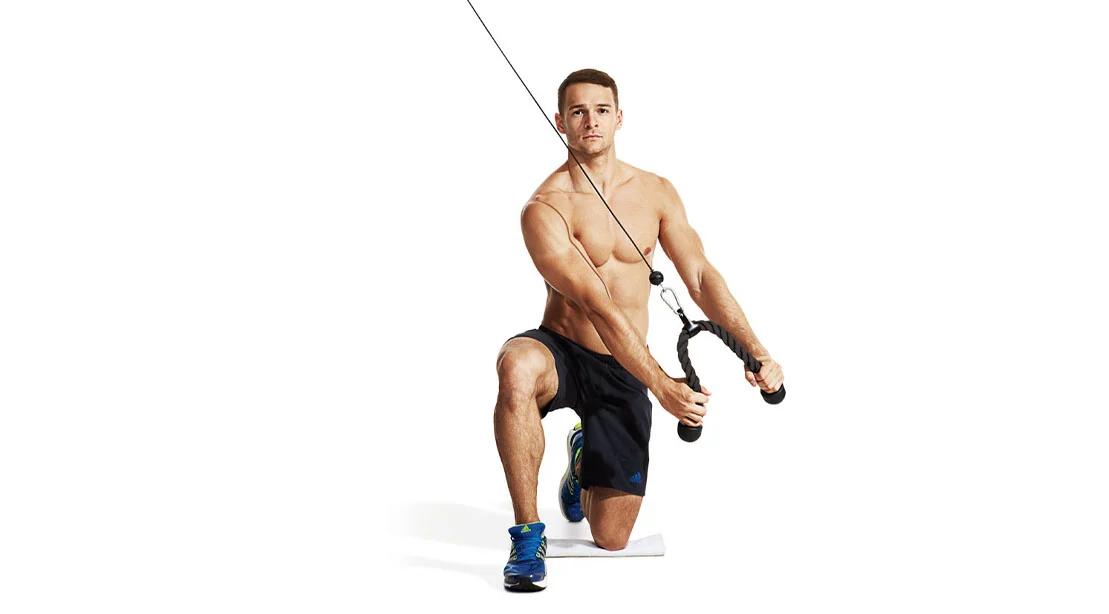
- The Setup: Set a cable pulley to its highest position. Kneel on one knee, with the knee on the ground being the one furthest from the cable stack. Your front foot should be flat, creating a 90-degree angle at both the front knee and the back knee.
- The Grip: Grasp the handle with both hands, arms extended but not locked. Your torso should be slightly rotated toward the anchor point.
- The Initiation: Engage your glutes and core simultaneously. Initiate the "chop" by pulling the cable down and across your body toward your opposite hip. The movement should be a diagonal arc.
- The Mid-Point: As you pull, keep your ribs stacked over your pelvis. Your chest should rotate, but your hips should remain perfectly square to the front.
- The Return: This is the most critical phase. Do not let the cable snap you back. Control the weight for a count of three as you return to the starting position. This eccentric phase is where the true core strengthening occurs.
Supporting Data: The Anatomy of the Chop
Understanding which muscles drive this movement is essential for the mind-muscle connection. When performed correctly, the Half-Kneeling Cable Chop is a full-body engagement exercise.
Primary Muscle Contributions:
- The Obliques: These are the stars of the show. The internal and external obliques are responsible for the diagonal rotation of the torso. They work concentrically to initiate the chop and eccentrically to slow the weight down on the return.
- The Transverse Abdominis (TA): As the deepest layer of the abdominal wall, the TA acts as a natural corset. It contracts to increase intra-abdominal pressure, providing the essential stiffness required to protect your lower back during the rotation.
- The Rectus Abdominis: Often misunderstood, the "six-pack" muscle here acts as a stabilizer. It prevents the lumbar spine from hyperextending and ensures your rib cage doesn’t "flare" out during the movement.
- The Glutes: Your glutes provide the stable foundation. The glute of the kneeling leg is the primary anchor point, preventing your hips from swaying, while the front leg glute maintains your balance.
- The Lats and Upper Back: The lats transfer the force generated by the core into the arms. Meanwhile, the thoracic spine provides the rotational range of motion, while the rotator cuff stabilizes the shoulders throughout the path of the handle.
Common Mistakes and Corrective Strategies
Even experienced lifters often fall victim to ego-lifting during this exercise. Because the chop requires such precise stability, adding too much weight usually leads to a breakdown in form.
The "Lower Back" Trap
Many trainees attempt to generate power by twisting at the lumbar spine. This is a recipe for injury.
- The Fix: Imagine your spine is a rigid rod. All rotation must come from the thoracic spine (the upper back). Keep your rib cage stacked over your pelvis at all times.
The "Loss of Foundation"
If your hips are shifting or your front knee is caving inward, your foundation is compromised.
- The Fix: Reduce the weight. If the problem persists, focus on "corkscrewing" your front foot into the floor and squeezing the glute of your kneeling leg as hard as possible to lock the pelvis in place.
The "Arm-Dominant" Pull
If your biceps are burning, you are doing it wrong. Your arms are merely hooks connecting your torso to the cable.
- The Fix: Initiate the movement from your chest and shoulders. The arms should follow the rotation of the trunk, not lead it.
The "Rushed Return"
Letting the weight stack pull you back to the start position is a missed opportunity.
- The Fix: Treat the return as a "negative" set. The eccentric control is where your obliques are forced to work the hardest. Slow it down.
Implications for Performance and Longevity
Integrating the Half-Kneeling Cable Chop into your routine offers benefits that extend far beyond aesthetics.
1. Superior Force Transfer
In sports, power is generated in the ground and travels up through the kinetic chain. If your core is "leaky"—meaning it cannot hold tension—that energy is lost before it reaches your limbs. This exercise trains the hips, core, and shoulders to act as a cohesive unit, plugging those energy leaks.
2. Separation of Mobility and Stability
The hallmark of a high-performance athlete is the ability to move through one segment of the body while keeping another segment perfectly still. The Half-Kneeling Cable Chop teaches your thoracic spine to be mobile while your lumbar spine remains stable. This "dissociation" is essential for preventing lower back pain and improving movement quality in everyday life.
3. Rotational Power Development
For athletes in golf, tennis, combat sports, or baseball, rotational power is the primary performance metric. By training the body to generate force along a diagonal path, you are specifically conditioning the nervous system to perform these athletic movements with greater efficiency and less risk of injury.
Programming Recommendations
To see results, consistency is key. The Half-Kneeling Cable Chop is versatile enough to fit into various stages of your workout.
- As a Warm-up: Use a light weight to prime the obliques and glutes and "wake up" the thoracic spine before heavy lifting.
- As Accessory Work: Place this movement after your primary heavy lifts (like squats or deadlifts). 2–3 sets of 8–12 reps per side is the sweet spot. Ensure you rest at least 60 seconds between sides to allow for full focus on each rep.
- Progression: Once you have mastered the movement with a standard cable handle, you can progress by using a rope attachment to increase the range of motion, or by performing the movement with a slight pause at the end of the concentric (pull) phase to maximize core engagement.
Conclusion: A Test of True Core Strength
A "strong" core is often misconstrued as the ability to endure a long plank. In reality, a strong core is one that understands exactly when to move, where to move, and—most importantly—where to stay perfectly still.
The Half-Kneeling Cable Chop puts your body to the test. It forces you to abandon the comfort of the sagittal plane and embrace the complexity of diagonal, rotational force. If you are looking to build a core that is not only visible but truly functional, this movement is non-negotiable. It is time to step up to the cable stack, square your hips, and start building the rotational power your body was designed to possess.