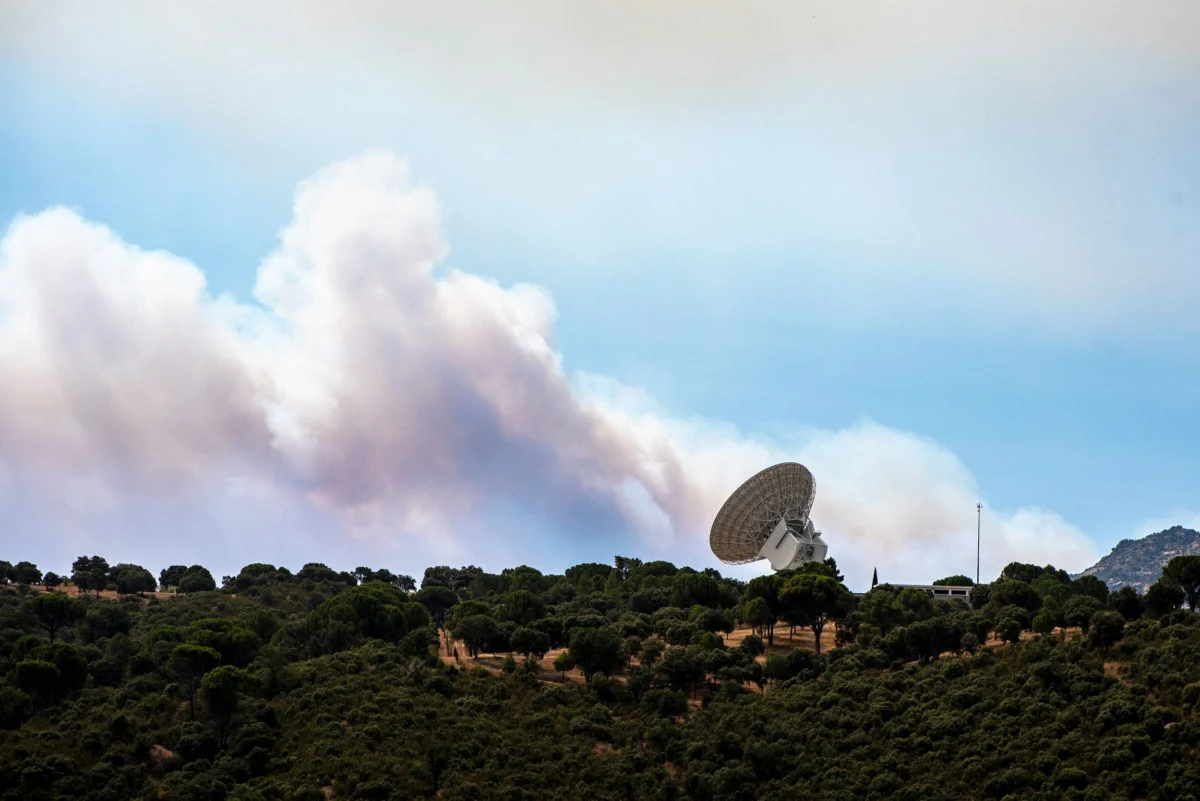
The escalating global climate crisis has transcended terrestrial boundaries, posing a tangible threat to humanity’s ability to communicate with the final frontier. On Friday, catastrophic wildfires in Spain breached the perimeter of the Madrid Deep Space Communications Complex, one of three critical nodes in NASA’s Deep Space Network (DSN)—the backbone of interplanetary exploration.
As record-breaking heatwaves and arid conditions transform the Mediterranean landscape into a tinderbox, the physical infrastructure supporting missions such as the Voyager probes, the James Webb Space Telescope (JWST), and the Artemis lunar program has been thrust into the center of a geopolitical and environmental emergency.
The Incident: A Near-Miss in the Spanish Highlands
The fires, which have forced the evacuation of approximately 60,000 people in the region surrounding Madrid, reached the municipality of Robledo de Chavela, where the NASA facility is situated. The complex, consisting of massive, high-gain radio antennas, is essential for maintaining contact with spacecraft millions of miles from Earth.
Dramatic photographic evidence captured by local news outlets depicted the site’s iconic radio dishes shrouded in thick, acrid smoke as flames licked the perimeter of the complex. The proximity of the fire to such sensitive, high-precision instrumentation has raised alarms within the scientific community regarding the long-term integrity of the site’s hardware.
Chronology of the Crisis
The unfolding disaster follows a pattern of extreme meteorological events that have plagued Europe throughout the summer:
- Mid-Week: A localized heatwave, characterized by "heat dome" conditions, descends upon the Iberian Peninsula, dropping humidity levels and desiccating the region’s vegetation.
- Friday Morning: Small, isolated fires in the Madrid region rapidly intensify due to shifting, high-velocity winds.
- Friday Afternoon: The fire front expands, triggering mass evacuation orders for the Robledo de Chavela area. NASA activates emergency protocols to secure the site.
- Friday Evening: The blaze penetrates the outer reaches of the Deep Space Communications Complex. NASA confirms that all personnel have been successfully evacuated to safety.
- Saturday Morning: As the fire front moves past the facility, ground teams prepare for the first formal damage assessment.
- Ongoing: Meteorologists warn of a temporary temperature dip followed by a renewed surge in heat, threatening to reignite smoldering hotspots.
The Global Network: Why the Madrid Complex Matters
The Madrid Deep Space Communications Complex is not merely a regional facility; it is a vital organ of global scientific progress. Along with its sister sites in Goldstone, California, and Canberra, Australia, the Madrid station forms the "Deep Space Network." This trio of sites is strategically positioned around the globe to ensure that as the Earth rotates, at least one station has an uninterrupted line of sight to deep-space missions.
The implications of a loss of functionality at this site are profound:
- Voyager 1 and 2: These historic probes, now in interstellar space, rely on the DSN to beam back data that is fundamentally changing our understanding of the heliosphere.
- The James Webb Space Telescope: The world’s most powerful space observatory uses this network to downlink high-resolution images of the early universe.
- Artemis Missions: As NASA pushes toward a sustainable human presence on the Moon, the DSN provides the command-and-control capabilities required to guide spacecraft through complex lunar maneuvers.
Without the Madrid station, the network loses its 120-degree coverage window, creating gaps in communication that could lead to data loss or delays in critical emergency commands for spacecraft.
Official Responses and Operational Continuity
NASA’s response to the crisis has been one of controlled, strategic migration. A spokesperson for the agency confirmed that the risk to operations was mitigated by the network’s inherent redundancy.
"We have seamlessly transitioned support for mission operations to the Goldstone Deep Space Communications Complex in California," the spokesperson stated. "This ensures continuity of service and uninterrupted support for spacecraft communications."
While the transition to California provides a temporary safety net, the long-term status of the Spanish hardware remains unknown. "Any potential damage will be assessed when it is safe to do so," the agency noted, signaling that while the immediate risk to personnel is over, the physical vulnerability of the dishes—which are susceptible to warping from extreme heat or damage from falling debris—remains a top priority for engineers.
A Continental Crisis: France and Beyond
The situation in Spain is part of a broader, more terrifying narrative of climate-induced instability across Europe. In France, the landscape has been similarly devastated. Beachgoers in the Bordeaux region have reported eerie, apocalyptic scenes as skies turned a bruised orange and ash rained down upon the coast.
French Interior Minister Laurent Nunez characterized the fire as a "self-sustaining" behemoth. "We learned in the middle of the afternoon that, following the wind shift, it had become a large, self-sustaining fire that is extremely difficult to bring under control," Nunez told the French broadcaster Tf1. The focus has shifted from containment to a defensive posture aimed at preventing the fire from consuming the Bordeaux metropolitan area.
Across France and Spain combined, over 200,000 people have been forced from their homes. These fires are not anomalous events; they are the consequence of a summer defined by record-shattering temperatures, driven by climate change and persistent high-pressure systems that lock heat over the continent.
Scientific Implications: The "New Normal"
The convergence of climate change and space infrastructure is a burgeoning field of concern for risk analysts. As global temperatures continue to climb—with forecasts predicting temperatures up to 10 degrees Celsius (18 degrees Fahrenheit) above the historical norm in the coming week—the "fire season" is no longer confined to the summer months.
The vulnerability of the Madrid complex serves as a stark reminder that even our most advanced technological achievements are tethered to a fragile, overheating planet. Experts argue that NASA and other space agencies must now treat climate-driven disasters as a primary threat vector in their risk management frameworks.
"We are seeing the convergence of two extremes," says Dr. Elena Vance, a climate resilience researcher. "On one hand, we are reaching out to the stars with unprecedented ambition. On the other, we are failing to secure the very ground we stand on. When the climate changes, it changes the conditions for everything—including the high-tech infrastructure we use to look into the void."
Looking Forward: Resilience in an Uncertain Future
As firefighters in the Mediterranean prepare for the next heatwave, the global scientific community is watching with bated breath. The resilience of the Deep Space Network has been tested, and while the "seamless transition" to California suggests a robust contingency plan, the threat of recurring, more intense fires remains.
The hope is that the damage to the Madrid antennas is minimal. However, the event serves as a chilling wake-up call. The climate crisis is not just a terrestrial issue; it is a fundamental challenge to the logistics of exploration. As humanity continues to gaze outward at the solar system, it must simultaneously reckon with the fact that the path to the stars begins on a planet that is becoming increasingly inhospitable.
For now, the antennas in Madrid remain standing, silent sentinels in a scorched landscape, waiting for the smoke to clear and for the assessment teams to arrive. The data from the Voyager probes continues to flow—rerouted through California—but the message is clear: the era of climate-proof infrastructure has come to an end. Every project, no matter how distant, is now part of the climate story.