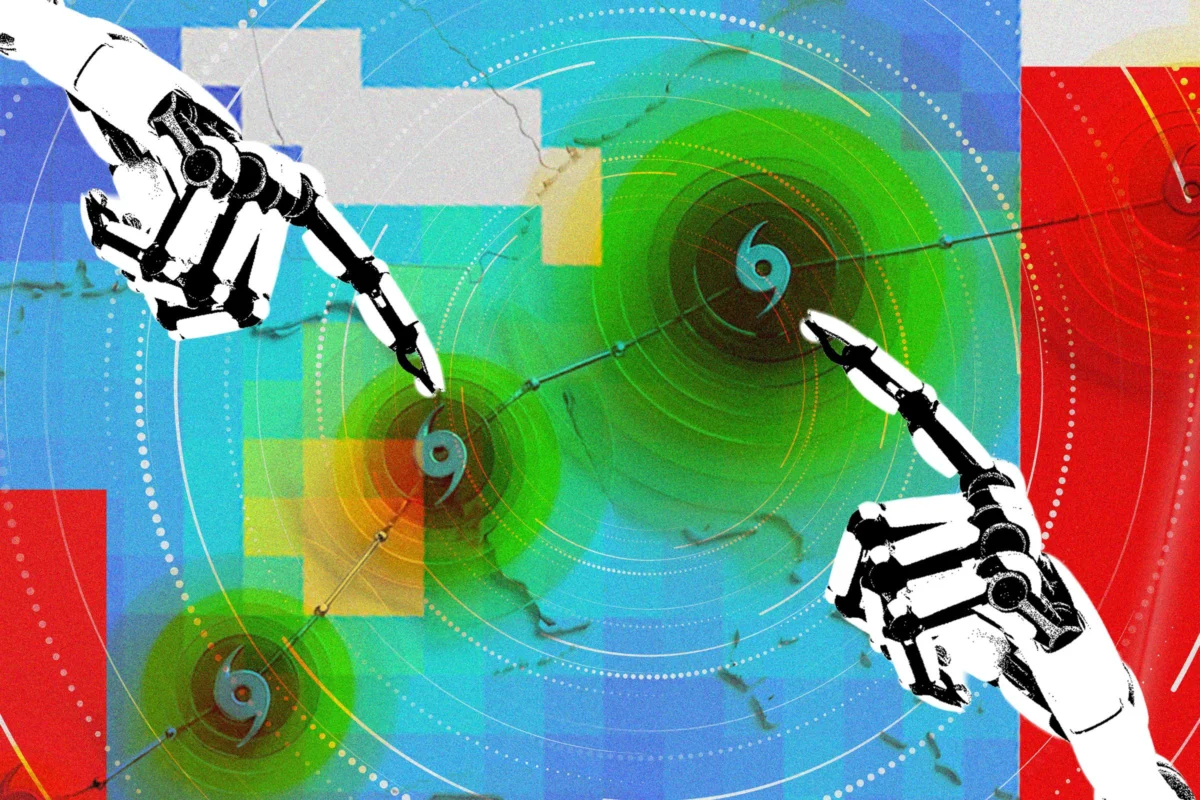
In the high-stakes world of emergency management, the difference between life and death is often measured in hours. For decades, meteorologists have relied on massive, computationally expensive numerical weather prediction (NWP) models to chart the paths of destructive tropical cyclones. However, a new player has entered the field, promising to bridge the gap between uncertainty and action.
WeatherNext, an artificial intelligence model developed by the researchers at Google DeepMind and Google Research, has demonstrated a transformative ability to forecast hurricane intensity and trajectory with unprecedented lead times. As detailed in a landmark paper published this Thursday in Nature, this AI tool is not merely an incremental upgrade; it represents a fundamental shift in how humanity anticipates the fury of the elements.
A Storm’s Tale: The Case of Hurricane Melissa
In October 2025, the Caribbean basin became the stage for a critical test of this nascent technology. A low-pressure system began to churn in the warm waters, and the meteorological community found itself at an impasse. Traditional weather models were conflicted: some suggested the system would remain a weak, disorganized cluster of clouds destined to drift harmlessly toward Haiti, while others warned of a potential intensification toward Jamaica.
As the system gathered steam, WeatherNext provided a decisive, high-confidence forecast. Five days before the storm was slated to reach land, the AI model predicted with 80 percent certainty that the system would evolve into a Category 5 monster—Hurricane Melissa—and make a direct, catastrophic landfall on Jamaica.
The subsequent reality was grim. Melissa lived up to the model’s dire warnings, unleashing torrential flooding and devastating landslides across the island. Yet, because the National Hurricane Center (NHC) had received this high-confidence warning days in advance, they were able to issue early evacuation orders and mobilize disaster response teams. This lead time provided local communities the "golden" window required to protect lives, transforming what could have been a scene of total chaos into a coordinated, albeit harrowing, survival effort.
The Chronology of a Breakthrough
The journey to this success was not overnight. Traditionally, improving the accuracy of a hurricane forecast by a single day has required roughly a decade of incremental advancements in satellite data, computing power, and atmospheric physics.
The development of WeatherNext circumvented this timeline by fundamentally changing the approach to training. Machine learning models are famously data-hungry, and extreme weather events—while frequent enough to be dangerous—are historically "rare" in the dataset of meteorological history.
"We don’t have that much cyclone data, but we have a lot of weather data," explains Ferran Alet, a research scientist at Google DeepMind and a lead author of the study. The team’s breakthrough was training the model to master global weather patterns first, and then fine-tuning it to interpret the specific, complex signatures of cyclones. This dual-purpose training allowed the model to leverage massive amounts of non-cyclonic data to inform its understanding of how tropical storms behave.
Deciphering the "Black Box" of Intensity
One of the most persistent challenges in meteorology is the disparity between tracking a storm and predicting its strength. Predicting a track is a macro-scale problem, involving global winds and cold fronts. Predicting intensity, however, is a micro-scale problem, requiring data on local ocean surface temperatures, pressure gradients, and small-scale atmospheric shifts.
"That’s something we just don’t get from these global models," notes Kate Musgrave, the tropical cyclone group lead at the Cooperative Institute for Research in the Atmosphere and a co-author on the paper. Historically, AI models have been competent at guessing where a storm would go, but they were notoriously poor at determining how intense it would become.
WeatherNext shattered this barrier. By analyzing the atmospheric conditions, the model correctly predicted Hurricane Melissa’s leap from a Category 1 storm to a Category 5 powerhouse while the storm was still in its infancy. Even more surprising to the scientific community is the "how." The model achieves this level of accuracy using relatively low-resolution atmospheric data.
When the researchers revealed that they were using "coarse" resolution inputs to achieve such high-precision results, the meteorological community was stunned. It suggests that the AI is identifying signals in the atmosphere that traditional physics-based models have either overlooked or been unable to resolve. "It’s a black box at the end of the day," Alet admits, "but that gives physicists a signal that something is happening that was not previously understood."
The Power of Probabilistic Modeling
Rather than providing a single, deterministic path, WeatherNext generates a vast array of potential scenarios. This methodology is designed to account for the "butterfly effect"—the phenomenon where a minor change in initial conditions can lead to vastly different outcomes.
Last year, the model was capable of generating 50 scenarios per storm. Today, it can churn out 1,000. "That’s something that, with our computing power, we simply can’t do with our existing numerical models," says Musgrave. By presenting a range of possibilities, the model allows forecasters to see the statistical probability of different outcomes, offering a much more nuanced view of the risks ahead.
Official Responses: A Tool, Not a Replacement
Despite the excitement surrounding WeatherNext, the leadership at the U.S. National Hurricane Center remains grounded. Mike Brennan, director of the NHC, emphasizes that AI is a powerful addition to the toolbox, but it does not replace the human expert.
"There’s no guarantee that one model, because it did well last year or really did well for this particular storm, is necessarily going to be the best model for the next season or the next storm," Brennan notes. He stresses that a hurricane forecast is not merely a line on a map or a wind-speed number; it is a complex social and logistical puzzle.
"A hurricane is not just a track or an intensity forecast," Brennan explains. "It requires experts to translate that into what the impacts are going to be—and it’s the impacts that kill people." Human judgment is still the vital final link in the chain, responsible for deciding when to shut down power grids, when to clear hospitals, and how to communicate effectively with the public.
Implications for the Future of Climate Science
The decision by Google DeepMind to open-source the WeatherNext models is a watershed moment for climate science. By inviting the global research community to inspect, stress-test, and improve upon the code, the developers hope to move beyond the "black box" limitations of the current iteration.
For the scientific community, this is about more than just predicting the next storm; it is about using AI to reverse-engineer the laws of the universe. If an AI can successfully predict a storm’s intensity using limited data, it suggests that the fundamental equations governing our atmosphere might be captured by deep learning in ways that traditional, rigid models have yet to master.
As climate change continues to increase the frequency and intensity of extreme weather, the ability to act with confidence becomes paramount. The marriage of human expertise and artificial intelligence may well be the defining alliance of the 21st century. While we may never fully tame the hurricane, we are, for the first time, gaining the ability to see the storm’s true face long before it reaches our shores.
"I’m very excited about scientific discovery," Alet says. "I think AI is giving us new tools to poke into the laws of the universe." As we look toward the next hurricane season, the presence of WeatherNext offers a flicker of hope—a digital sentinel watching the horizon, ready to provide the one thing that remains truly golden in the face of disaster: time.