The single-leg Romanian deadlift (RDL) is frequently misunderstood as a simple balance drill. In reality, it serves as the ultimate diagnostic tool for human movement. It is a rigorous, unforgiving assessment of lower-body mechanics, forcing the foot, ankle, hip, core, and neuromuscular system to synchronize as a single, cohesive unit. When one link in that chain falters, the exercise exposes the weakness immediately.
If you find yourself wobbling, struggling to find your center, or compensating with your lower back, you aren’t just "bad at balancing"—you are likely dealing with a structural or functional deficit. By mastering the single-leg RDL, you do more than build stronger hamstrings; you bulletproof your joints and optimize your athletic output.
The Science of the Hinge: Why Balance is a Symptom, Not the Root Cause
When lifters struggle with the single-leg RDL, the immediate reflex is to blame "poor balance." However, in the realm of biomechanics, balance is almost always a secondary symptom of a primary technical or physiological failure.
Common Root Causes of Instability
- The Collapsing Foot: If your arch caves inward (pronation), your entire kinetic chain shifts, destabilizing the knee and hip.
- Hip Asymmetry: A hip that rotates outward or drops during the descent suggests a lack of glute medius strength and pelvic control.
- Joint Restriction: A stiff ankle (dorsiflexion limitation) or tight hamstrings can force the spine to round, effectively "stealing" the movement from the hips and placing it on the lumbar discs.
- Neuromuscular Disconnect: Poor proprioception or lack of core/lat bracing prevents the body from moving as a unified structure.
The single-leg RDL is not just an exercise; it is a clinical-grade lower-body assessment. If you cannot perform a bodyweight RDL with total control, adding external load—such as kettlebells or dumbbells—is not only counterproductive; it is a recipe for injury.
Chronology of a Perfect Rep: How to Audit Your Form
To understand where your movement breaks down, you must first establish a baseline. Stand tall on one leg with a soft, "athletic" bend in the knee. Keep your pelvis square to the floor. As you push your hips backward, reach your free leg behind you. Lower yourself until you feel significant tension in the hamstring of the standing leg, then return to the start.
Look for these specific breakdown points:
- The "Hip Hike": Does your non-working hip rotate upward? This indicates a lack of pelvic stability.
- The Knee Drift: Does your standing knee cave inward (valgus)? This points to a weak glute medius.
- Spinal Rounding: Are you reaching with your shoulders rather than hinging with your hips? This signifies a lack of lat engagement and core bracing.
- The Eccentric Crash: If you cannot control the descent, you lack the eccentric strength required to stabilize your body weight.
Supporting Data: The Five Pillars of the Single-Leg Hinge
To excel at the single-leg RDL, your body must possess five distinct physical qualities. When these are balanced, the movement feels "smooth as butter."
1. Hip Flexion Mobility
Your hip joint must have the capacity to hinge through a full range of motion while maintaining a neutral spine. Without this, your lower back will inevitably compensate.
2. Hamstring Length and Tension
The hamstrings are the primary drivers of the hinge. They must be capable of lengthening under load without "locking out" or causing the pelvis to tilt posteriorly (tucking the tailbone).
3. Foot and Ankle Stability
The foot acts as the foundation of the entire movement. You must maintain a "tripod" contact point: pressure on the heel, the base of the big toe, and the base of the little toe.
4. Pelvic and Hip Control
The glute medius and deep rotators must work in concert to keep the pelvis level. Rotation is the enemy of the single-leg hinge.
5. Core and Lat Engagement
Your core is not just about six-pack abs; it is a pressurized cylinder that keeps the spine rigid. Engaging the lats (the largest muscles of the back) creates a bridge between your upper and lower body, allowing you to move as a unified, tensioned structure.
Expert Perspectives: Why Mobility Drills Change the Game
Leading physical therapists and strength coaches argue that performance is not just about raw strength, but about "accessing" the range of motion you already have. By implementing targeted mobility drills, you aren’t just stretching; you are recalibrating your nervous system.
The 5 Best Mobility Exercises to Improve Your Single-Leg RDL
1. Hip Airplanes
The hip airplane is the "gold standard" for single-leg stability. It forces you to rotate the pelvis over a fixed leg while maintaining balance.
- Why it works: It trains the glute medius and deep rotators to stabilize the pelvis during rotation.
- Programming: 2 sets of 4–6 slow, controlled reps per side before your deadlift sessions.
2. Hip Controlled Articular Rotations (CARs)
These are slow, purposeful circles that take the hip joint through its absolute end-range.
- Why it works: It improves the "quality" of movement, ensuring your hip joint is lubricated and functional before you add weight.
- Programming: 1–2 sets of 3 slow circles in each direction per side.
3. Mini-Band Marches
By placing a mini-band around your knees or feet, you create constant tension that requires the hips to fire constantly to keep the pelvis level.
- Why it works: It is an activation drill that cures the "wobbles" by strengthening the lateral hip stabilizers.
- Programming: 2 sets of 10–12 marches per side.
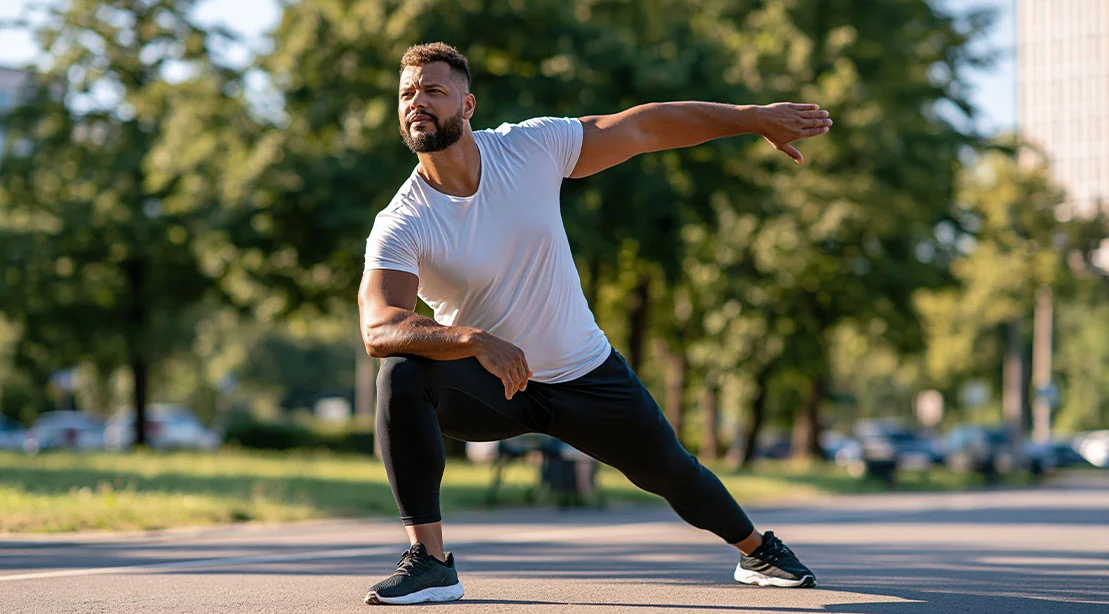
4. Hamstring Scoop Stretch
Unlike static stretching, the "scoop" is dynamic. You essentially "scoop" your hands toward the floor while keeping one leg straight and the other bent.
- Why it works: It mimics the hinge pattern while actively lengthening the hamstring under controlled conditions.
- Programming: 1–2 sets of 8–10 reps per side.
5. Foam Roller Single-Leg RDL
Hold a foam roller vertically between your hands or place it against your thigh. By maintaining constant contact, you force your lats to stay engaged and your spine to remain neutral.
- Why it works: It provides immediate tactile feedback. If you lose the hinge, the roller falls.
- Programming: 2 sets of 8–10 reps per side as a warm-up.
Implications for Athletic Longevity and Strength
The implications of mastering these movements extend far beyond the weight room. A high-performing single-leg RDL translates directly to improved athletic performance in sports involving running, jumping, and rapid changes of direction. By correcting side-to-side strength imbalances, you drastically reduce the risk of common injuries, such as ACL tears and lower back strain.
Furthermore, the "Carry-Over Effect" is profound. When you master the coordination required to move with one leg, your ability to generate force with two legs increases exponentially. You stop leaking energy through unstable hips and start transferring power from the ground up with maximum efficiency.
Final Thoughts
The single-leg RDL is a journey of refinement. It is a movement that demands patience, precision, and a commitment to mobility. If you are struggling, view it as an opportunity to upgrade your movement architecture. Do not skip the warm-ups, do not ignore the technical cues, and do not rush the load.
By prioritizing the stability and mobility of the hip-ankle complex, you will find that the "curse words" under your breath during a failed rep are replaced by the quiet confidence of a perfect, stable, and powerful hinge. Remember: when you can own the movement on one leg, you will be nearly unstoppable on two.