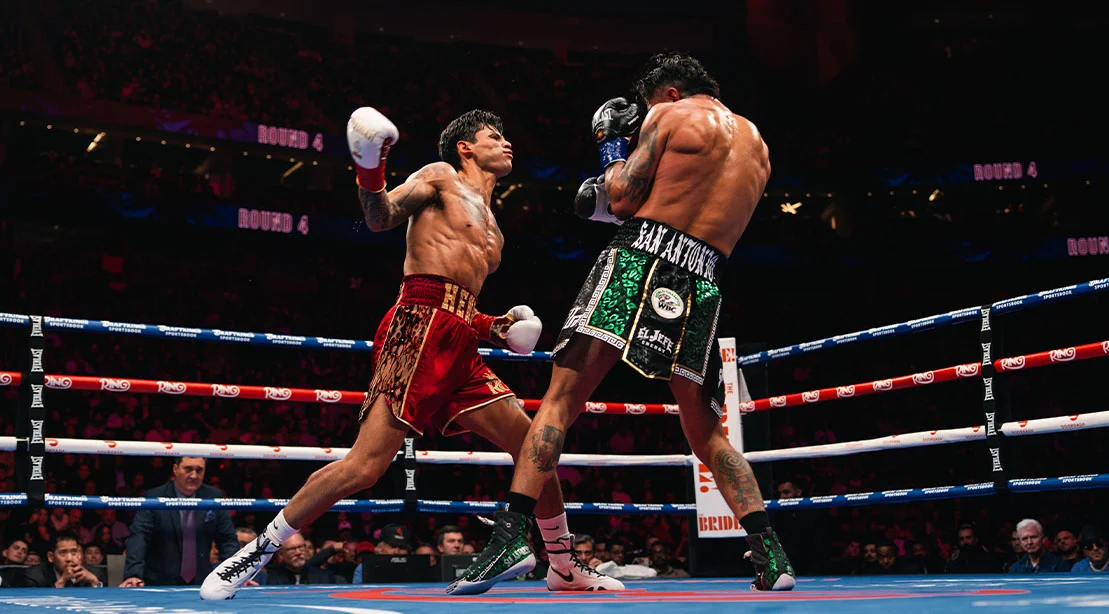
Ryan Garcia has never been a man defined by hesitation. Throughout his career, the 27-year-old superstar has worn his confidence like armor, often broadcasting his intentions as loudly as he delivers his signature left hook. Yet, as he prepares for his September 12th title defense against Conor Benn, those who have followed the trajectory of the WBC welterweight champion are noticing a fundamental shift. It is no longer just about the raw, blistering speed that once made him a social media phenom; it is about a calculated, surgical approach to the craft of pugilism.
Following his February triumph over Mario Barrios, Garcia (24-2-1) finds himself in a rare position: he is not rebuilding. He is refining. By choosing to capitalize on the momentum of his previous camp rather than allowing his conditioning to lapse, Garcia has ushered in a new phase of his professional life—one centered on the philosophy that true greatness is found not in doing more, but in knowing exactly how much is enough.
The Chronology of a Champion’s Maturation
The arc of Ryan Garcia’s career has been anything but linear. From his early days as a viral sensation to the intense scrutiny of the world stage, Garcia has had to endure the public dissection of his personal life, his mental health battles, and a challenging one-year suspension that sidelined him through 2024 and 2025.
However, the period away from the ring proved to be a crucible. Rather than letting the silence consume him, Garcia used the time to recalibrate his relationship with the sport. Upon his return, the version of Garcia that defeated Mario Barrios in February displayed a level of discipline that had previously been overshadowed by his natural gifts.
The current timeline, leading into the clash with Benn, is a testament to this newfound maturity. By maintaining a tight, professional rhythm between fights, Garcia has avoided the "yo-yo" effect of extreme weight fluctuations and the grueling, multi-week process of "getting back into shape." He has transformed the time between bouts into an active maintenance phase, ensuring that his body remains primed for competition. As he told Muscle and Fitness, the transition from his last win to this current camp has been "smoother" and significantly "less stressful," allowing him to bypass the traditional "reset" phase and jump directly into high-level tactical preparation.
The Architecture of a Modern Training Camp
Garcia’s daily routine is a grueling testament to his dedication, yet it is now balanced by a newfound respect for physiological limits. A typical day in camp is a symphony of high-volume output followed by meticulous recovery.
His mornings often begin with 90 to 120 minutes of dedicated strength and conditioning. This is followed by a five- to seven-mile run, a staple of his cardiovascular foundation. The afternoon session is reserved for the ring—another 90 to 120 minutes of sparring, mitt work, and technical drills—before capping the day with high-intensity sprints.
However, the "new" Ryan Garcia is quick to point out that the grind is not blind. "Every day varies," he explains. "You have to make adjustments. It’s not just ‘go, go, go.’ You’ve got to find your spots—the time to pull it back a little, or push it, or take a day off." This nuanced understanding of his own biology is what separates a fighter who burns out from one who reaches their prime.
Supporting Data: The Science of Recovery
Perhaps the most significant departure from his younger self is Garcia’s full-throated embrace of recovery science. In the past, the mindset was simple: train until you drop, then repeat. Today, that approach has been replaced by a sophisticated recovery regimen that would make a sports scientist proud.
Garcia now integrates a comprehensive suite of recovery tools:
- Red-light therapy: To assist in cellular repair and reduce inflammation.
- Sauna and Cryotherapy: Alternating between heat and extreme cold to manage muscle soreness and boost blood flow.
- Physical Therapy: Regular, proactive work to address imbalances before they become injuries.
This shift signifies a transition from treating fatigue as an obstacle to be "pushed through" to viewing it as a data point to be managed. "It’s being more efficient," Garcia notes. "That’s basically what it is. You’re more efficient in your training, the way you punch, recover, and everything. Everything becomes more efficient, sharper, and more to the point."
Official Responses and Tactical Outlook
Regarding the upcoming fight against Conor Benn, Garcia remains professionally guarded, offering little in the way of specific tactical blueprints. He acknowledges that Benn is a fighter who will "try real hard," but he maintains a calm, almost detached confidence.
When asked about the pressure of defending his WBC welterweight title, Garcia flips the script. He argues that pressure is an external construct that only affects those who are unprepared. "You only feel pressure when you don’t think you’re prepared for what’s coming," he asserts. For Garcia, his confidence is built on the foundation of his preparation. Having been in the ring with elite competition for years, he views his performance as "second nature."
Moreover, the belt itself has changed his internal drive. Rather than inducing complacency, being the champion has acted as a catalyst for increased aggression. "Now that I have it, I’m even more inclined to be hungrier, more ferocious, and more defensive of not losing my title," he says.
Implications for the Welterweight Division
The implications of a "prime" Ryan Garcia are significant for the boxing world. If his assertion that he is hitting his peak is accurate, the division is facing a fighter who has finally married his elite speed with structural durability and tactical efficiency.
The mental shift—from someone seeking validation to someone who is "mastering himself"—suggests a level of focus that may make him nearly impossible to disrupt. He is no longer susceptible to the "noise" of social media or public opinion. By letting "the noise be the noise," he has freed up the mental bandwidth required to maintain the focus necessary for high-level championship bouts.
As he looks toward September 12th, Garcia’s message to his detractors and his fans alike is one of inevitability. He isn’t just looking to win; he is looking to showcase a "complete" version of himself. "They’re going to be like, ‘Damn, he’s gotten to his prime,’" he predicts. And as for the outcome? He keeps it brief: "I’m going to beat him very easy. Well, make it look easy."
Training for Explosiveness: The Garcia Method
To achieve the level of conditioning Garcia describes, he utilizes a multifaceted workout regimen. This protocol, designed to be performed once or twice weekly, focuses on the core principles of his success: speed, power, and core stability.
The Protocol
Warmup (6 Minutes):
Two rounds of shadowboxing and dynamic stretching to raise core temperature and prime the central nervous system.
Block 1: Strength and Explosiveness (3 Rounds):
- Med Ball Slams: 15 reps (Power generation).
- Box Jumps: 10 reps (Explosive lower body).
- Plyometric Push-ups: 10 reps (Fast-twitch upper body).
- Rest 60-90 seconds between rounds.
Block 2: Fight Conditioning (6 Rounds):
- Heavy Bag Rounds: 3 minutes of high-speed, light-power combinations.
- Jump Rope: 3 minutes at a high, consistent pace.
- After round 6, recover for two minutes.
- Follow with 30-second burnout sessions of alternating straight punches.
Block 3: The Core Finisher (3 Rounds, minimal rest):
- Bicycle Crunches: 30 reps.
- Scissor Kicks: 30 reps.
- Plank to Push-up: 15 reps.
Optional Sprint Finisher:
- 4-6 rounds of 50-yard sprints. Maintain 90% intensity, focusing on perfect mechanics rather than raw speed. If form breaks down, the session is over.
By adhering to this regimen, Garcia ensures that his body remains a finely tuned machine, capable of sustaining explosive bursts while maintaining the defensive and offensive sharpness that has defined his rise to the top. As the fight date approaches, all eyes will be on him to see if this "new" Ryan Garcia truly represents the most dangerous version of the fighter we have ever seen.