The Men’s Physique division has long been defined by its aesthetic balance, athletic conditioning, and a "beach-ready" look that prioritizes symmetry over the extreme mass found in traditional bodybuilding. As the division continues to evolve, so too do the standards by which its athletes are judged. Following the conclusion of the 2026 Olympia, where Ryan Terry solidified his legacy by capturing his fourth title in a highly competitive field, the International Federation of Bodybuilding and Fitness (IFBB) has announced a significant shift in the competitive criteria.
Beginning in 2027, all competitors in the Men’s Physique category will be required to execute a new, mandatory pose. This adjustment represents the first major structural change to the division’s judging criteria in years, signaling a shift toward emphasizing greater muscular detail and postural control.
Main Facts: The Transition to a New Aesthetic
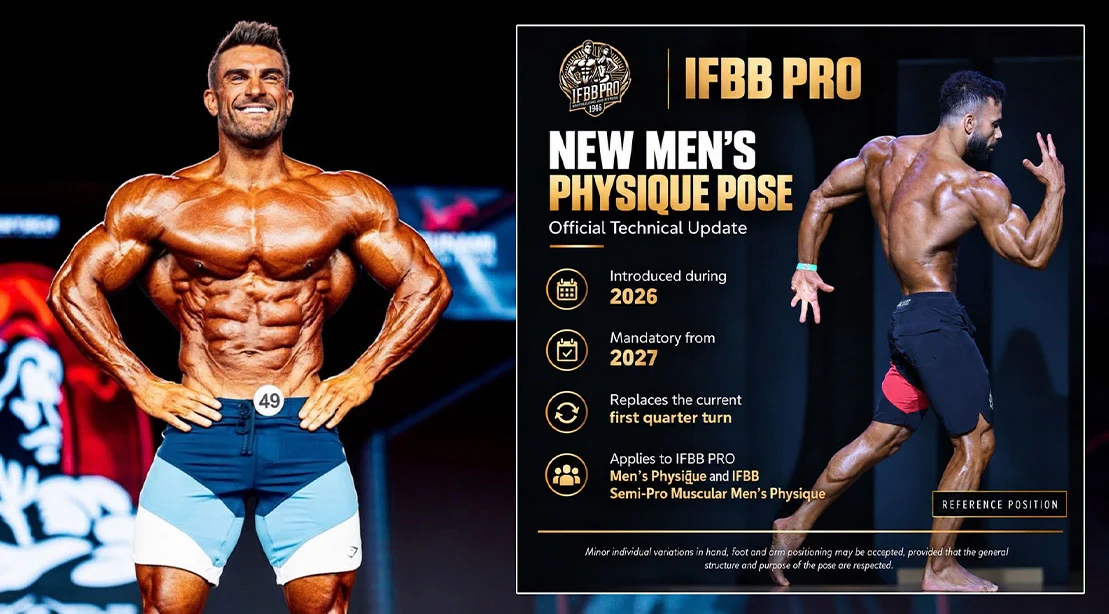
On October 8, 2026, the official IFBB Pro Instagram account alerted the fitness community to an upcoming change in the rulebook for both Pro and Semi-pro Men’s Physique divisions. While the new requirement is currently being phased in to allow athletes ample time to integrate the movement into their routines, it will become an obligatory component of the mandatory poses for all sanctioned events by 2027.
The change essentially reconfigures the opening sequence of the posing routine. The new, unnamed three-quarter turn will replace the traditional first quarter turn, fundamentally altering how judges evaluate an athlete’s transition from the moment they step onto the stage. By replacing a standard, static turn with a more dynamic, back-focused posture, the IFBB is clearly signaling a desire to see more comprehensive muscular development, particularly in the posterior chain.
Chronology of the Men’s Physique Evolution
Since its inception, the Men’s Physique division has served as a bridge between high-level fitness modeling and professional bodybuilding. Initially criticized by some traditionalists as being "too easy" compared to the Open division, the category has undergone rapid professionalization.
- 2013-2015: The division found its footing, focusing heavily on the "V-taper" and the aesthetic "board short" look.
- 2016-2020: The standard of conditioning rose significantly. Athletes began to display higher levels of stage presence and tighter, more refined midsections.
- 2021-2025: A period of massive growth in popularity, led by icons like Ryan Terry and Jeremy Buendia. The level of detail required to place in the top five became razor-thin.
- 2026: The Olympia performance proved that the division had reached an "all-time high" in terms of depth and quality.
- October 2026: The official announcement of the new mandatory pose, setting the stage for a new era of technical proficiency in 2027.
Supporting Data: Understanding the New Pose
While the IFBB has yet to assign a formal technical name to the new pose, visual documentation provided by the federation reveals a highly technical, three-quarter rear-focused stance. The pose requires a departure from the front-facing, "hands-on-hips" aesthetic that has defined the category for a decade.
Biomechanics and Aesthetics
In this new position, the athlete stands with their back to the judges at a three-quarter angle, introducing a level of depth that was previously underutilized. The body is twisted, creating a diagonal line from the floor to the shoulders.
- Upper Body: One arm is extended downward with fingers splayed, while the opposite arm is bent upward with the hand raised. This creates a striking visual contrast, forcing the latissimus dorsi to flare while simultaneously engaging the rear deltoids and triceps.
- Lower Body: The legs are staggered, with one foot positioned behind the other. This stance is specifically designed to highlight hamstring separation and glute-ham tie-ins, an area that has often been overlooked in board shorts.
- Core and Obliques: The twisting motion engages the obliques in a way that static, front-facing poses do not, providing judges with a better view of the athlete’s midsection integrity.
Official Responses and Industry Reaction
The announcement has sent shockwaves through the professional circuit. Coaches, who have spent years perfecting the traditional "hands on hips" posing style, are now scrambling to adjust their clients’ routines. However, the initial reception from the fan base has been overwhelmingly positive.
On social media, the consensus appears to be that the sport needed a technical refresh. One prominent observer commented, "I like that. It shows the lat sweep better than any of the current poses." Another user noted, "It’s an interesting change. It’s great to see posing getting more attention, as it’s a vital part of the performance."
Many analysts believe this change is a direct response to the level of conditioning displayed by top-tier athletes in 2026. Because the current roster is so evenly matched in terms of muscle size and definition, the IFBB is introducing a more difficult, technical pose to create a greater margin for differentiation. Athletes who lack mobility or who have neglected their rear-chain development will likely struggle, providing a natural filter for the judges to identify the most well-rounded competitors.
Implications for the Future of Men’s Physique
The introduction of this mandatory pose has far-reaching implications for the future of the sport.
1. The Death of the "Static" Athlete
For years, Men’s Physique was mocked by some as being a "fitness model" category. By demanding a more dynamic, twisting pose, the IFBB is forcing athletes to act more like bodybuilders. The requirement for flexibility, core control, and the ability to hold tension while twisted will likely raise the bar for what is considered an "elite" physique.
2. Strategic Posing Training
Athletes will now need to invest significant time with posing coaches to master the transition into this new position. A clunky transition could cost an athlete a placing. We are likely to see a shift in training methodology, where exercises that promote spinal mobility and posterior chain definition become as important as traditional hypertrophy work.
3. A Shift in Judging Criteria
Judges will now be looking for "flow." A contestant who can move seamlessly from the standard front pose into the new three-quarter back pose without losing their posture will be rewarded. This puts a premium on stage presence, fluidity, and cardiovascular endurance—as holding such a tense pose for an extended period during a call-out is physically demanding.
4. Encouraging Diversity in Physiques
By requiring a pose that highlights the lats, triceps, and hamstrings, the IFBB is subtly encouraging athletes to bring more "meat" to their frames. While the "aesthetic" look will always be the priority, the new pose makes it impossible to hide a lack of back width or leg development.
Conclusion
The 2027 season will undoubtedly be a year of transition. As the IFBB continues to refine the standards of the Men’s Physique division, athletes are faced with a new challenge that demands both artistic grace and raw muscularity. While some may find the change daunting, the consensus is clear: the sport is growing, and with this new mandatory pose, it is evolving into a more demanding, more impressive, and more technical discipline.
For the fans, the change promises a more engaging viewing experience. For the competitors, it marks a new chapter where only those who are willing to master every angle of their physique will reach the top of the podium. As we look toward 2027, one thing is certain: the bar has been raised, and the stage is ready for a new level of excellence.