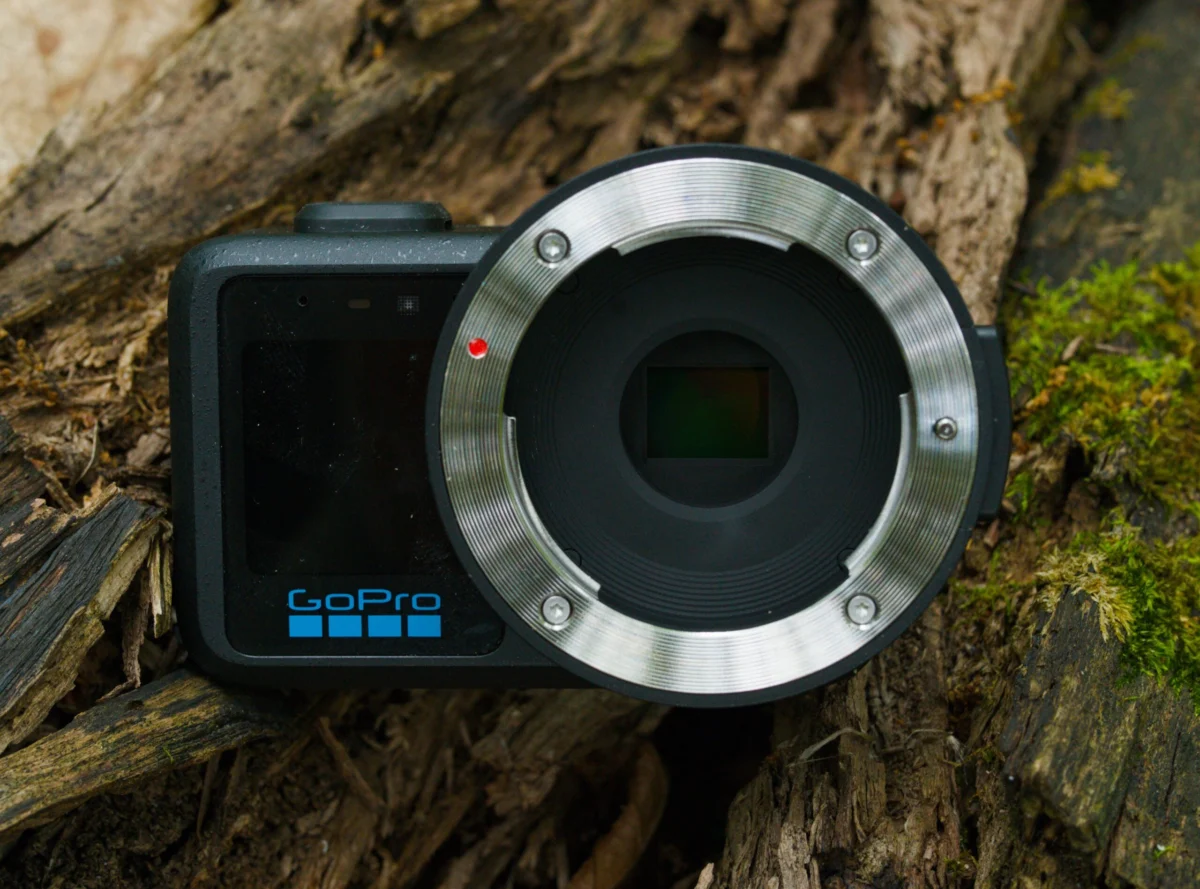
The world of compact, high-performance filmmaking is currently undergoing a radical shift, and at the center of this transformation is the GoPro Mission 1 Pro ILS. For years, GoPro has been synonymous with the rugged, set-it-and-forget-it action camera—the device you strap to a helmet or a surfboard. However, the Mission 1 Pro ILS represents a departure from that philosophy, offering a body-only, interchangeable lens system (ILS) that demands more from the operator than any device in the company’s history.
For the filmmaker willing to navigate the complexities of a fully manual workflow, the results are startling, yielding image quality that challenges the legacy of professional cinema cameras. Yet, this power comes with significant trade-offs that potential users must weigh carefully.
The Technical Reality: Optics and Sensor Performance
To understand the Mission 1 Pro ILS, one must first understand its relationship with glass. In my testing, I utilized the Laowa 7.5-mm lens, which provides a dramatic, wide-angle perspective. The interaction between the sensor and these lenses is heavily influenced by the camera’s internal processing—specifically the HyperSmooth stabilization.
When HyperSmooth is engaged, the camera applies a crop factor that brings the field of view to the equivalent of a 23-mm lens on a full-frame sensor. When disabled, you gain a wider, more natural 20-mm perspective. This dynamic range of focal lengths is critical because, unlike traditional GoPro cameras with fixed wide-angle lenses, the ILS requires the user to curate their own optics. If you are aiming for that iconic, immersive "GoPro" ultra-wide aesthetic, you will find yourself leaning heavily toward high-quality fisheye lenses.
The Connectivity Bottleneck
The most glaring limitation of the Mission 1 Pro ILS is the complete absence of electronic contacts on the lens mount. This is not merely an inconvenience; it is a structural barrier to modern workflow. Because there is no communication between the lens and the camera body, any glass relying on electronic focus-by-wire or electronic aperture control is rendered useless.
My personal favorite Micro Four-Thirds lens, the Panasonic 20-mm pancake, is effectively a paperweight on this system because it lacks a physical, mechanical aperture ring. This forces the operator to rely exclusively on fully manual lenses. While there is a boutique market for high-quality manual glass, the limitation is stark: you are locked out of the vast majority of modern, auto-focus-enabled, and electronically controlled lenses. For those looking to build a kit, Abe Kislevitz has curated an essential guide to compatible glass, but even then, the pool of choices remains significantly smaller than that of standard mirrorless systems.
Chronology: The Evolution of the "Pro" GoPro
To appreciate the Mission 1 Pro ILS, one must look at the trajectory of GoPro’s R&D over the last decade.
- 2014–2018: The era of the "Hero" dominance. GoPro focused almost entirely on computational photography, electronic stabilization, and waterproofing. The goal was simplicity: capture everything, worry about nothing.
- 2019–2022: The pivot toward the professional creator. With the introduction of the Media Mod and external microphone support, GoPro began acknowledging that their users were not just thrill-seekers, but vloggers and content creators who required higher audio fidelity and better production value.
- 2024: The introduction of the Mission 1 Pro ILS. This marks the transition from "Action Camera" to "Cinema Tool." By removing the lens, GoPro has effectively invited the filmmaker to treat the device as a digital sensor block, similar to the modularity seen in professional cinema rigs like the RED or Blackmagic ecosystem.
Supporting Data: The Manual Focus Struggle
The shift to a manual-only workflow on the Mission 1 Pro ILS is not for the faint of heart. While I am a seasoned user of vintage manual-focus glass on high-end systems like the Sony A7R II, the Mission 1 Pro ILS presented a unique set of challenges that even experienced shooters will find daunting.
The Screen Real Estate Problem
The primary obstacle is the physical display. The screen is remarkably small, making it difficult to verify focus, especially in high-contrast or bright outdoor environments. While the camera includes "focus peaking"—a feature that highlights edges in focus with colored banding—it is not a panacea. Relying solely on peaking is a dangerous game for the filmmaker; I have learned through years of Sony usage that peaking can often provide a false sense of security, showing a broad swath of the frame as "in focus" when the critical plane of sharpness is slightly off.
To achieve surgical focus, one must zoom into the image, but the small screen resolution makes this a tedious, if not impossible, task. For filmmakers, this creates a secondary issue: you are forced to hold the camera at eye level to stand any chance of nailing the shot. This restricts creative angles, as you are essentially tethered to the camera’s position.
The Mobile App Paradox
GoPro’s standard solution is to leverage the companion app for remote monitoring. While this provides a larger, clearer screen on your smartphone, it introduces a logistical nightmare. To use a phone as a monitor, you essentially need a cage to mount both devices, a handle for stability, and a way to balance the weight. By the time you have assembled this "Frankenstein" rig, the primary advantage of the Mission 1 Pro ILS—its extreme portability—has evaporated. At that point, a filmmaker would be better served by the Panasonic GH7, which offers a larger sensor and a more ergonomic, integrated ecosystem.
Official Responses and Industry Outlook
GoPro has maintained that the Mission 1 Pro ILS is a niche product intended for "prosumers" who already possess a collection of vintage manual lenses and a specific vision for their cinematography. They have not yet released an official statement regarding potential updates to the lens mount, such as the inclusion of electrical contacts for aperture control.
Industry analysts suggest that GoPro is currently testing the waters. If the demand for the ILS format proves high enough among professional cinematographers, a "Mark II" version—perhaps featuring a tilting screen or an electronic-enabled mount—could become a reality. However, for now, the product is sold as a body-only unit, and potential buyers should be prepared to source their own lenses, adapters, and monitoring solutions independently.
Implications: A New Benchmark for Quality
Despite the logistical hurdles, the footage produced by the Mission 1 Pro ILS is, quite simply, transformative. When you manage to nail the focus and match the glass to the sensor, the resulting image quality is staggering.
During my testing, the output reminded me of the early days of the Blackmagic Pocket Cinema Camera. There is a "filmic" quality to the footage that standard action cameras simply cannot replicate. The dynamic range, color science, and overall resolution are high enough that this tiny device can genuinely hold its own on a professional set.
Is it for you?
The implications of the Mission 1 Pro ILS are clear: it is a camera that rewards patience and penalizes speed.
- For the Solo Filmmaker: If you are shooting cinematic B-roll, controlled interviews, or artistic projects where you have the time to set your shot, the ILS is a revelation. The size-to-quality ratio is unmatched in the current market.
- For the Action Enthusiast: If you are looking for a "point and shoot" experience for mountain biking or skydiving, this is not the camera for you. The lack of autofocus and the requirement for manual aperture control will result in frustration and missed moments.
The Mission 1 Pro ILS is a bold, albeit flawed, step forward. It strips away the "smart" features that have defined GoPro for a decade and returns to the fundamentals of photography: light, glass, and the human eye. It is an imperfect tool, but in the right hands, it is capable of producing imagery that transcends the limits of its size. For those of us who have long waited for a "GoPro with a real sensor," the wait is over—though we have traded the ease of the past for the high-stakes, manual artistry of the future.