When outdoor enthusiasts shop for a new backpacking pack, the conversation is almost always dominated by technical specifications. We obsess over denier ratings, specialized laminates like Dyneema or X-Pac, and the promise of "weather-resistant" coatings. But as any seasoned thru-hiker knows, there is a profound disconnect between the lab-tested performance of a piece of fabric and the reality of a torrential downpour in the backcountry.
A pack’s ability to keep your gear dry is not merely a function of its material’s hydrostatic head; it is a complex architecture of seams, zippers, roll-top closures, and hydration ports. To address the gap between marketing specs and real-world performance, a new standardized, yet accessible, testing methodology is emerging. This method moves away from theoretical material analysis and toward a pragmatic "shower test"—a rigorous, controlled evaluation designed to determine exactly how much water enters a pack during a sustained, high-intensity deluge.
The Myth of the Waterproof Pack
The outdoor industry is often guilty of using the term "waterproof" as a loose descriptor. The reality is that almost no standard backpacking pack is truly waterproof in the literal sense. While a pack might be constructed from a non-porous material, the assembly process is inherently prone to water ingress.
Every stitch hole creates a potential pathway for moisture. Every zipper—even those labeled as "water-resistant"—acts as a funnel for water under pressure. Hydration ports are essentially open windows, and roll-top closures, while effective, rely entirely on the user’s ability to fold and secure them perfectly every single time.
In the field, the failure points are rarely the fabric panels themselves. Instead, water migrates through the points of construction: the seams where the suspension system attaches to the packbag, the stress points around drawcord collars, and the interfaces between different panel materials. When a hiker faces sustained heavy rain, the "pack system" often fails long before the fabric becomes saturated.
The Anatomy of the Shower Test: A New Protocol
Recognizing that field tests are inconsistent and impossible to replicate, testers have developed a controlled, shower-based methodology. The objective is not to recreate the chaos of a mountain thunderstorm—which involves wind-driven rain, body heat, and constant abrasion—but to establish a baseline for comparative screening.
The Methodology
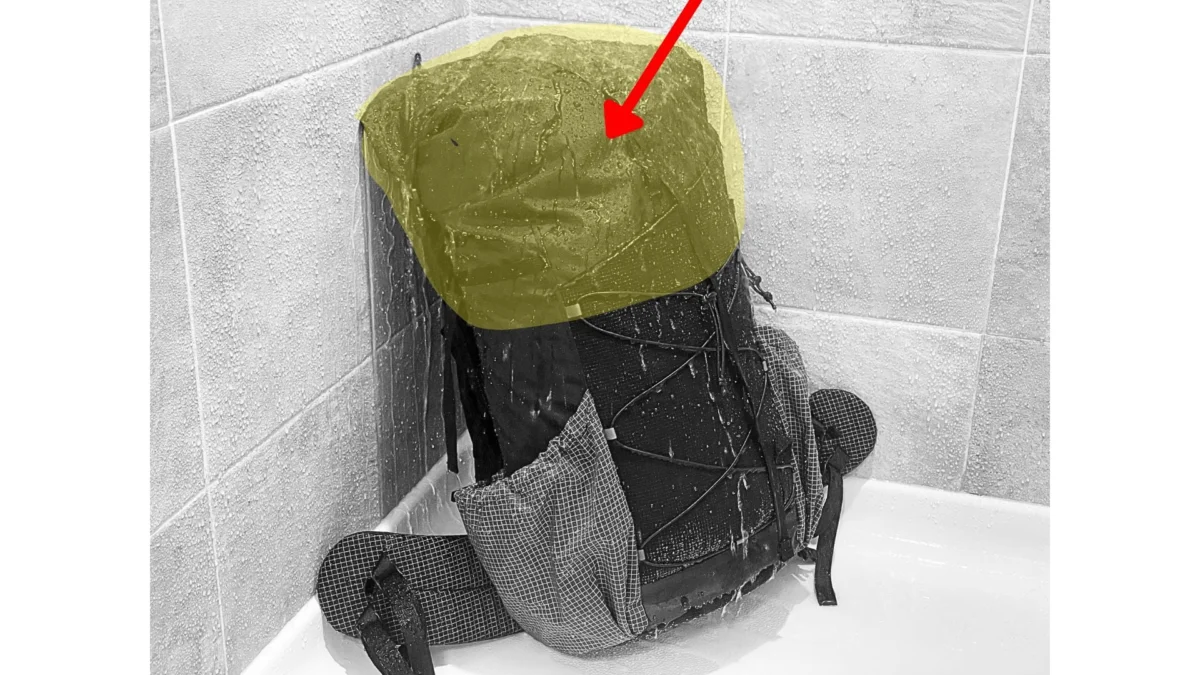
The protocol is deceptively simple, designed to be reproducible by anyone with a shower and a desire for data.
- The Witness Material: A large, dry cotton pillowcase is placed inside the main compartment of the empty or lightly packed backpack. Cotton is chosen specifically because it is highly absorbent and changes color when wet, providing an unmistakable visual indicator of moisture ingress.
- The Preparation: The pack is loaded to maintain its structural shape, ensuring that closures and zippers are under the same tension they would be in the field.
- The Exposure: The pack is placed in a shower stall under a consistent spray for a duration of exactly 30 minutes. The spray is adjusted to mimic high-intensity rainfall.
- The Assessment: After 30 minutes, the pack is removed, wiped down externally, and the witness material is carefully inspected. The weight of the pillowcase is measured (or qualitatively assessed for dampness) to determine the volume of water ingress.
This method provides a "minimum viable condition" test. It differentiates between packs that are merely splash-resistant and those that offer a genuine barrier against sustained saturation.
Chronology of Moisture Ingress: What Happens During the 30 Minutes
Understanding the chronology of failure is critical for designers and users alike. During the 30-minute test, water follows a predictable path of least resistance.
- 0–5 Minutes (Surface Saturation): During the initial phase, the pack’s DWR (Durable Water Repellent) coating or outer laminate performs its primary job, causing water to bead and roll off.
- 5–15 Minutes (The Seam Test): As the fabric reaches its capacity, water begins to pool at the seams. If the seam tape is improperly applied or if the stitch density is too high, capillary action pulls water through the needle holes. This is typically where the first signs of dampness appear on the witness pillowcase.
- 15–25 Minutes (Closure Compromise): Even with a perfect roll-top, water often finds its way into the fold. If the closure is not tightened or if the top of the bag is not perfectly aligned, the pressure of the spray begins to force droplets into the main compartment.
- 25–30 Minutes (Structural Saturation): By the final phase, high-stress areas—specifically where shoulder straps attach to the frame—become the primary points of failure. These areas are often reinforced with heavy webbing, which can act as a wick, pulling moisture through the back panel and into the packbag.
Supporting Data: Why Fabric Specs Don’t Tell the Whole Story
In laboratory settings, fabrics are often tested using a hydrostatic head test, which measures the pressure of water required to penetrate the material. A material with a 20,000mm rating is technically "waterproof." However, this data is often misleading.
In the shower test, a pack made from 20,000mm-rated fabric often fails just as quickly as a pack made from less expensive 5,000mm fabric if the construction is poor. For instance, a seam that is not taped or welded will allow water entry regardless of the fabric’s hydrostatic rating.
Data gathered from these comparative tests shows that:
- Construction matters more than material: Packs with welded seams and fewer overall panels consistently outperform high-spec sewn packs.
- Zippers are the Achilles’ heel: In almost every instance, YKK AquaGuard or similar water-resistant zippers show signs of leakage within 15 minutes of direct spray.
- Back panel architecture: Packs with integrated frames that require multiple attachment points through the packbag are significantly more prone to leakage than those with external, suspended frames.
Implications for Manufacturers and Consumers
The shift toward these practical, comparative tests has profound implications for the outdoor industry.
For the Consumer
The primary takeaway is a move away from "spec-sheet shopping." Hikers should stop assuming that a pack made of "waterproof fabric" is safe to leave exposed in a storm. The shower test highlights the necessity of internal organization—using dry bags or pack liners is not a luxury, but a requirement. If your pack fails the 30-minute shower test, it will almost certainly fail a three-hour storm on the Appalachian Trail.
For the Manufacturer
This testing methodology forces designers to consider the "system" rather than the "material." We are beginning to see a trend toward:
- Simplified panel design: Reducing the number of seams to reduce potential leak points.
- Increased use of RF (Radio Frequency) welding: Replacing traditional sewing with welding, which creates a hermetic seal.
- Improved closure mechanisms: Moving away from standard zippers toward double-roll-top or magnetic, sealed closures.
Official Responses and Industry Standards
While there is no universal ISO standard for "backpack water resistance," the adoption of informal shower testing by gear reviewers and boutique manufacturers is pressuring larger brands to be more transparent.
Industry representatives often argue that "waterproofing" a pack adds significant weight and cost. They contend that a pack is designed to carry gear, while a rain cover or pack liner is the appropriate tool for water protection. However, critics of this stance argue that in the modern era of lightweight gear, a "system-integrated" waterproof design is the next frontier of innovation.
"We aren’t trying to build a submarine," one lead designer noted in a recent industry forum. "But we are trying to stop the ‘slow bleed’ of moisture that ruins a trip. If we can keep a pack dry for 30 minutes in a heavy downpour, we give the user enough time to get their gear into a shelter or deploy a cover without the contents already being compromised."
Conclusion: The Path Forward
The quest for a truly dry pack is ongoing, but the methodology described here provides a much-needed reality check. By moving away from the abstract performance of individual fabrics and focusing on the holistic performance of the construction, we can better understand the limitations of our equipment.
The 30-minute shower test is not meant to be a pass/fail certification. Instead, it serves as a valuable diagnostic tool for both the enthusiast and the engineer. It reminds us that while we cannot control the weather, we can certainly control the integrity of the gear we carry into it. As you prepare for your next trek, consider subjecting your own gear to this simple test. You might be surprised—and perhaps a bit concerned—by what you find inside.