Introduction
During periods of high-intensity exertion, the human body functions as a biological radiator, producing sweat to regulate core temperature. Under ideal conditions, this moisture evaporates directly from the skin. However, when sweat production exceeds the rate of evaporation, liquid accumulates. To maintain comfort and thermal regulation, our clothing system must act as a bridge, transporting that liquid away from the skin and into outer layers.
For decades, outdoor enthusiasts have relied on the marketing promise of "moisture-wicking" technology. Yet, many hikers and athletes have experienced a frustrating reality: two garments, both labeled as advanced moisture managers, can perform vastly differently in the field. One keeps the wearer dry and comfortable, while the other becomes a saturated, clammy weight. To demystify this performance gap, I conducted a rigorous, multi-fabric study designed to track the mechanical movement of liquid sweat. By moving beyond marketing claims and into the realm of capillary physics, this analysis reveals the hidden "tug-of-war" occurring between our skin and our gear.
The Chronology of Research: Developing the Liquid Transfer Test
The impetus for this study was a persistent unanswered question: When skin is wet, where does the water actually go? My previous evaluation of three base layers provided a baseline, but the data lacked the granularity required to explain the mechanics of failure.
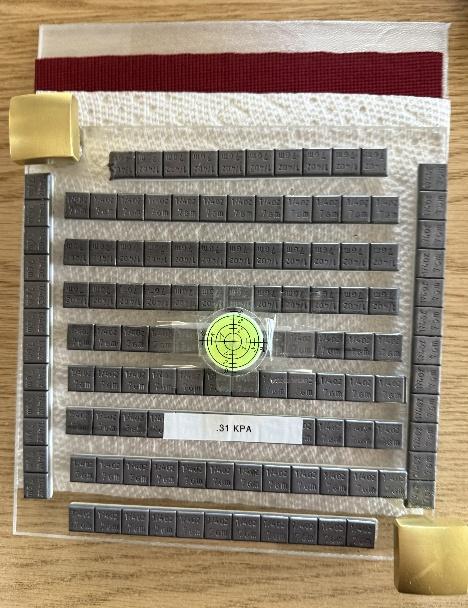
To address this, I developed a proprietary "Liquid Transfer Test" device. The methodology was designed to simulate a simplified clothing system, utilizing a grid of stacked metal plates to track the movement of liquid across three distinct zones: the "skin" (the source), the base layer (the conduit), and the receiving layer (the destination).
Over the course of several months, the scope of the testing expanded from three initial garments to eight, representing a diverse cross-section of current textile engineering—from traditional synthetics to modern lofted fibers. As the data accumulated, consistent patterns emerged, confirming that the distinction between "hydrophobic" and "hydrophilic" fibers is only the beginning of a much more complex story involving pore structure, surface tension, and pressure gradients.
Supporting Data: Understanding the Physics of Moisture
To interpret the findings, we must return to the foundational science of fluid dynamics. The behaviors observed in this study align with the classic principles established by Young and Laplace (1805) and later formalized by Washburn (1921). These studies describe the capillary physics that govern how liquid moves through fibrous materials.
The Hydrophobic Paradox
Hydrophobic base layers are often marketed as "staying dry" because their fibers do not absorb moisture. While technically true at the molecular level, this creates a false sense of security. Because textiles are composed primarily of empty space (pores), hydrophobic garments can—and do—hold significant amounts of liquid sweat.
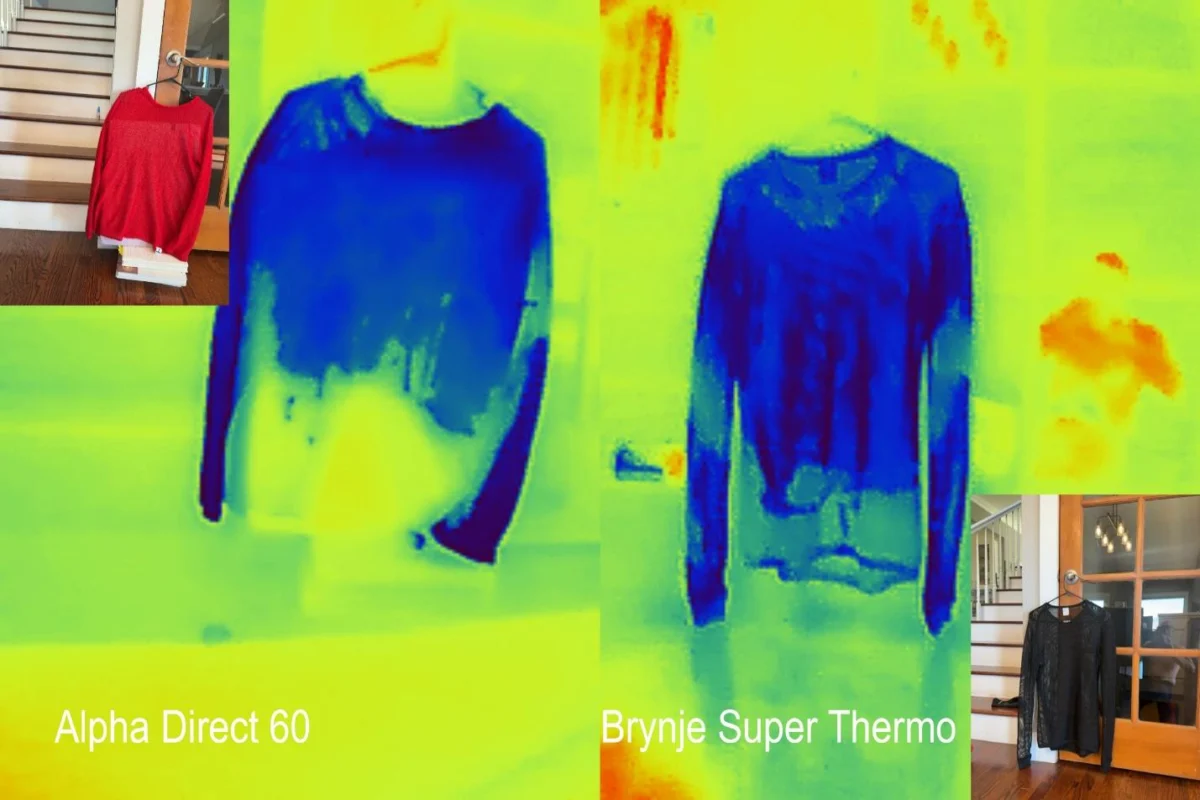
In my testing, two hydrophobic garments—a mesh shirt and a lofted insulation layer—demonstrated this clearly. Using infrared imaging to visualize moisture content, I found that despite the fibers’ water-repellent nature, these garments trapped substantial liquid sweat. The mesh shirt retained 87 grams (65% of its dry weight), while the lofted shirt trapped 62 grams (55% of its dry weight).
The takeaway is that hydrophobic fabrics do not absorb water; they store it in the interstitial spaces between fibers. For this water to move, it requires "breakthrough pressure"—an external force generated by pack straps, body movement, or the simple weight of accumulated sweat. Without sufficient pressure to force liquid through the pores, a hydrophobic garment can effectively act as a moisture trap, leaving the wearer clammy despite the material’s hydrophobic rating.
The Hydrophilic Trap
Conversely, hydrophilic fabrics—materials designed to attract and absorb water—utilize capillary action to pull sweat away from the skin. While highly effective at initiation, these fabrics suffer from a significant limitation: they are prone to holding onto what they capture.
In a hydrophilic system, once water is drawn into the fiber structure, it is not "free" to move. It is held by hydrogen bonding sites. Consequently, the transfer of moisture to the next layer becomes a competition. If the receiving layer is already damp, it loses its ability to draw moisture away from the base layer. My data confirms that as receiving layers reach saturation, the transfer from hydrophilic base layers slows significantly or ceases entirely, leading to a "wet-out" condition that is notoriously difficult to reverse during high-exertion activity.
Implications for Outdoor Gear Selection
The implications of this research for the outdoor industry are profound. We can no longer categorize base layers solely by their fiber chemistry. Instead, performance must be evaluated through the lens of pore geometry and the ability to maintain a pressure gradient.
Why Some Layers Fail
The most significant finding is that "wicking" is not a static property of a fabric; it is a dynamic system. A garment that performs brilliantly while standing still may fail under the pressure of a heavy backpack or in high-humidity conditions.
- Pore Structure: Larger pore openings generally lower the breakthrough pressure, allowing sweat to pass through more easily. However, if the internal pathways are constricted or poorly connected, even a "porous" fabric can stall.
- Contact Angle: This measures a fiber’s resistance to water. A contact angle above 90° indicates hydrophobic behavior. My research shows that materials with an optimal balance of pore size and high contact angles provide the most efficient moisture transport, as they resist saturation while allowing for directional flow.
- The Saturation Threshold: We have identified that all base layers have a capacity limit. Once the "receiving layer" (your mid-layer or shell) is compromised by external moisture or internal saturation, the base layer’s performance becomes irrelevant.
Conclusion: A New Framework for Performance
The results of this study serve as a wake-up call to both manufacturers and consumers. The goal of a base layer is not merely to be "hydrophobic" or "hydrophilic," but to manage the pressure-driven movement of liquid sweat.
For the hiker or climber, the practical application of this data is clear:
- For high-intensity, short-duration activities: Hydrophobic mesh layers excel because they require little pressure to initiate transfer, provided there is a pathway for that moisture to escape.
- For sustained, multi-day efforts: The system must be viewed in its entirety. If your mid-layer is not capable of accepting the moisture your base layer is moving, the entire system will fail, regardless of the quality of the base layer.
By understanding the "tug-of-war" between fiber chemistry and capillary pressure, we can better select gear that matches the intensity of our exertion. The science of moisture management is no longer a matter of marketing jargon; it is a matter of fluid dynamics. As we move forward, the industry must prioritize the design of interconnected, high-pressure-transfer systems that allow sweat to move from the skin to the atmosphere without meeting a bottleneck at the interface of our layers.
Author’s Note: The findings presented here are based on the testing of eight specific textile samples. While the physical principles of Washburn and Laplace remain the standard for the industry, individual garment construction and weave patterns may yield variations in performance. Future iterations of this test will continue to explore the impact of compression and varying environmental humidity on these results.