While headlamps remain the go-to solution for hands-free utility, there is no substitute for the raw power, reach, and versatility of a dedicated handheld flashlight. Whether you are a professional tradesman working in dimly lit crawlspaces, a search-and-rescue volunteer scanning vast nighttime landscapes, or a weekend camper looking for reliable illumination, the best flashlights offer performance that your head-mounted gear simply cannot match.

After five years of rigorous testing—during which I have put over 65 different models through the ringer—I have identified the standout performers of 2026. This guide is designed to cut through the marketing noise and get you the tool that actually performs when the sun goes down.

Main Facts: The Current State of Illumination
The flashlight market has undergone a significant transformation over the last decade. Gone are the days of dim, flickering incandescent bulbs and unreliable proprietary battery systems. Today’s market is dominated by high-efficiency LEDs, precision-machined aluminum bodies, and the universal convenience of USB-C charging.

My top overall pick for 2026 is the Fenix PD36R ACE. It represents the perfect equilibrium between portable size and tactical performance. For those on a budget, the Acebeam TAC 2AA offers incredible value, while the NITECORE P27iX remains the undisputed king for those who prioritize tactical versatility and "retina-melting" bursts of power.

Chronology: The Evolution of GearJunkie’s Testing
My relationship with lighting gear began over 13 years ago at GearJunkie. Since the inception of this guide in 2018, the landscape has shifted toward specialized, high-drain batteries and smarter user interfaces.

- 2018-2020: The focus was primarily on transitioning from standard AA/AAA alkaline battery lights to the early wave of rechargeable lithium-ion models.
- 2021-2023: The "Lumen Wars" saw manufacturers pushing outputs into the thousands. We began focusing more on "useable" light—color rendering index (CRI) and beam pattern—rather than just peak output numbers.
- 2024-2026: We have entered the era of the "smart" flashlight. Features like UV light integration, laser pointers, and advanced programmable output modes (as seen in the Fenix ACE series) have become the new standard for the high-end consumer.
Supporting Data: Our Top Selections
1. Best Overall: Fenix PD36R ACE
The PD36R ACE is the latest evolution of my favorite platform. With a maximum output of 3,000 lumens and a throw distance of 1,362 feet, it is a powerhouse.

- Battery: V2 21700 Li-ion
- Runtime: Up to 63 hours (Eco mode)
- Why it wins: The new "SET" button allows for custom user-defined output levels, making it the most versatile light I have ever tested.
2. Best Value: Acebeam TAC 2AA
Retailing around $50 (and often found for $30), this light is the perfect "junk drawer" or glovebox companion.

- Dual-Fuel: Runs on the included USB-C rechargeable battery or standard AA cells.
- Performance: 1,600 lumens on turbo, which is truly impressive for a light the size of a large pen.
3. Best EDC: Olight ArkPro
The ArkPro is a flat, pocket-friendly light that carries like a folding knife.

- Utility: Features a white spot, white flood, UV light for verifying currency, and a built-in green laser.
- Interface: A rotary dial that allows for tactile, one-handed operation.
4. Best Tactical: NITECORE P27iX
When you need to turn night into day, this is the tool.

- Output: 5,000 lumens in a "Lumin Shield" burst mode.
- Durability: IP68-rated, submersible to 2 meters, and features a hardened steel glass-breaker bezel.
Official Performance Metrics and Testing Methodology
A flashlight is only as good as its weakest component. My testing regimen is designed to simulate the worst-case scenarios a user might face in the field:

- Controlled Environment Testing: I verify manufacturer claims regarding lumens and runtime using a calibrated integrating sphere.
- The Drop Test: Every light is dropped from 3-foot and 6-foot heights onto concrete. If the internal electronics fail or the lens cracks, the light is disqualified.
- Water Submersion: Lights are left in one foot of water for one hour. I specifically check for seal integrity at the tail cap and charging port.
- Field Durability: I carry these lights in my truck console and backpack for weeks. If a switch feels mushy or the anodizing wears off prematurely, it loses points in "build quality."
Understanding the Ratings
I rate each light on a scale of 1 to 10 across four categories: User Interface, Durability, Build Quality, and Performance. Note that the "Overall Rating" is not a mathematical average; it is a holistic assessment of how the product serves its intended user compared to competitors at the same price point.

Implications: Why You Need to Move Beyond AA Batteries
One of the most common questions I receive is, "Why should I buy a $100 rechargeable light when a $10 AA light works fine?"

The implication for the user is simple: Cost of ownership and reliability.
Alkaline batteries are notorious for leaking, which can destroy the internal contacts of a flashlight. Furthermore, the performance drop-off in disposable batteries is drastic—they lose power almost immediately as they drain. Conversely, the high-end 21700 lithium-ion cells used in our top picks provide consistent, regulated voltage. You get the same brightness at 50% battery as you do at 99%.

Furthermore, the environmental impact of thousands of disposable batteries over the life of a product is non-trivial. USB-C charging is now the industry standard, and carrying a single power bank allows you to keep your light—and your phone—topped up on multi-day backcountry excursions.

Buyer’s Guide: Choosing the Right Tool
When you begin your search for the right flashlight, do not just look at the "Max Lumens" sticker. Consider these three pillars:

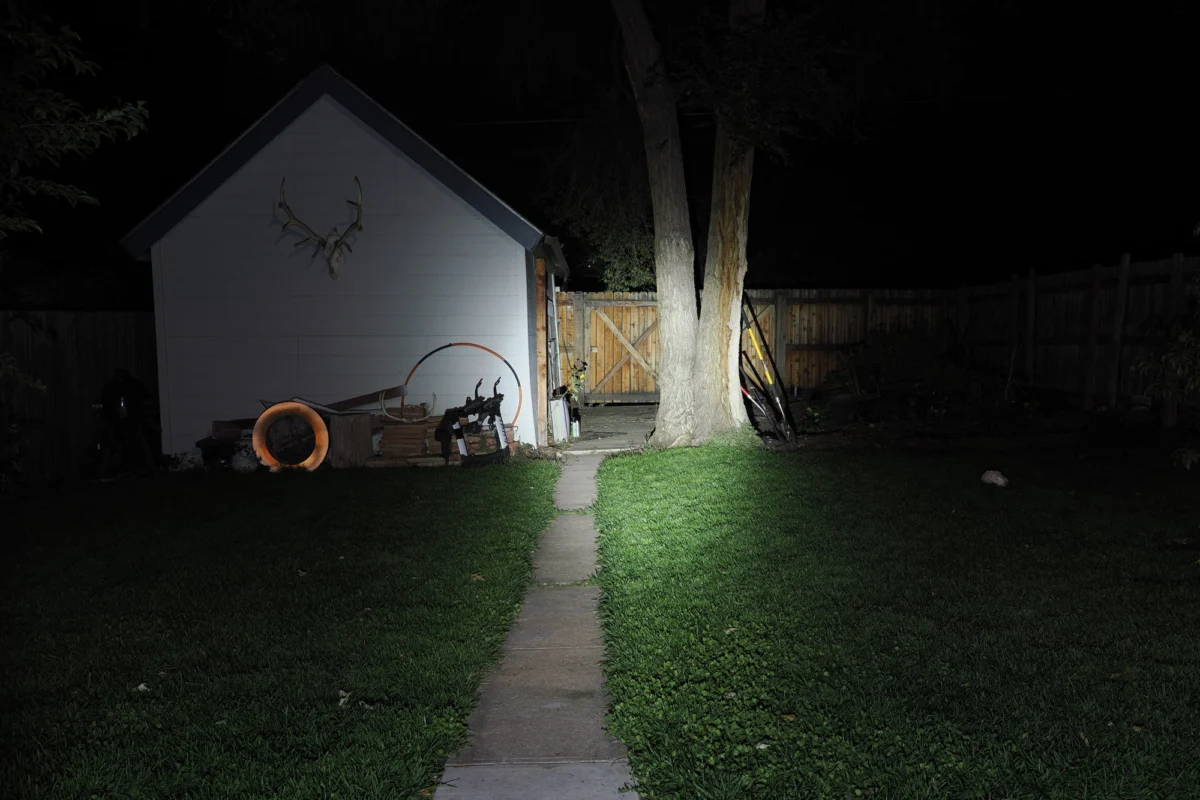
- Beam Profile: Do you need a "thrower" (a tight, focused beam for seeing long distances) or a "flooder" (a wide, soft beam for working on a car or campsite)? Most of our top picks offer a "mixed" beam, which provides a bright hotspot with sufficient peripheral spill.
- The User Interface (UI): Does the light require you to cycle through strobe every time you turn it on? That is a dealbreaker. Look for lights with memory modes or dedicated tail switches for momentary-on functionality.
- The "Firefly" Factor: A light that only has "High" and "Turbo" is useless for reading a map in a tent at 2:00 AM. Always ensure your light has a sub-10-lumen "low" or "moonlight" mode to preserve your night vision and battery life.
Final Thoughts
If you are looking for a single recommendation, start with the Fenix PD36R ACE. It is the most "grown-up" flashlight on the market—refined, powerful, and built to last a lifetime. However, if your needs are specific—like the tactical requirements of a professional or the EDC utility of a contractor—the NITECORE and Olight entries offer specialized features that make them unparalleled in their niches.

The dark is no longer an excuse for being unprepared. Invest in quality, keep your cells charged, and you will find that the right light is one of the most empowering tools in your outdoor kit.