Varese, Italy – The serene waters of Lake Varese, typically a picturesque backdrop, became the battleground for Europe’s elite rowers from July 31st to August 2nd, as the European Rowing Championships unfolded with intense competition and dramatic turns. Representing Finland, Maiju Kainlauri and Kasper Hirvilampi showcased both promising potential and the challenging realities of top-tier international sport, notably securing a spot in the A-final of the newly introduced mixed double sculls. Their performances, characterized by moments of brilliance and unexpected hurdles, now serve as a crucial stepping stone towards the upcoming World Championships in Amsterdam.
Main Facts: Finnish Crew Makes History in Varese
Finland’s two-person contingent, Maiju Kainlauri and Kasper Hirvilampi, made their mark at the European Rowing Championships in Varese, Italy. The event, held between July 31st and August 2nd, saw both athletes compete in their respective single sculls categories – Kainlauri in the women’s single (W1x) and Hirvilampi in the men’s single (M1x). However, the most significant highlight for the Finnish team was their exceptional performance in the inaugural mixed double sculls (Mix2x) event. Defying expectations, the Finnish duo powered through their heats to secure a coveted spot in the A-final, ultimately finishing sixth in a highly competitive field.
While the mixed double yielded a historic A-final appearance, their individual races presented a more complex picture, leaving both athletes with "mixed feelings" about their overall Varese campaign. Romania emerged as the dominant force of the championships, sweeping an impressive six gold medals and solidifying its position as the most successful nation. Despite the varied outcomes, the Varese championships provided invaluable experience and critical insights as Kainlauri and Hirvilampi now recalibrate their training for the upcoming Finnish National Championships in Tampere and the ultimate challenge: the World Championships in Amsterdam.
Chronology of Events: From Heats to High Stakes Finals
The three-day European Championships at Varese offered a condensed yet comprehensive test of skill, endurance, and tactical acumen. For the Finnish athletes, the journey began with individual heats, followed by the groundbreaking mixed double sculls, culminating in a series of finals across all categories.
The Inaugural Mixed Double Sculls: A Glimmer of Future Potential
The introduction of the mixed double sculls (Mix2x) at the European Championships marked a significant moment for the sport, signaling a potential new Olympic discipline and offering athletes a fresh challenge. For Maiju Kainlauri and Kasper Hirvilampi, this novelty became an arena for notable success.
From the outset, the Finnish pair demonstrated strong synergy and determination. In their preliminary heats, they executed a well-drilled race plan, navigating the demanding course with precision and power. Their seamless coordination and sustained effort paid off handsomely, as they earned a direct qualification to the A-final – a testament to their preparation and inherent talent. This achievement was particularly significant given the event’s inaugural status, indicating a promising future for mixed crews in international rowing.
The A-final itself was a spectacle of raw power and strategic racing, featuring the continent’s top mixed crews. The Finnish duo, buoyed by their strong heat performance, approached the final with an aggressive strategy, as Hirvilampi later recounted. "The double was truly a great team effort. A huge thanks to Maiju, a young athlete. Our preparatory training went well, we trusted ourselves, and we managed to improve from the Luzern World Cup at the right moment. The reward was an A-final spot."
In the high-stakes environment of the final, Kainlauri and Hirvilampi knew they had to push their limits. "An A-final is an A-final, so we went for it with a risk," Hirvilampi explained. "We couldn’t quite keep up with the pace, but we did what we could. We faded, but we knew this was a possibility when considering the tactics. Either the row would hold, or we would fade. We had our own row and strategy. The position wouldn’t likely have changed, and you don’t go to an A-final to play it safe; you fight and see what happens. Someday, it will pay off. This time we rowed as a team, and that was great."
Their sixth-place finish, while not a medal, represented a strong debut for Finland in this exciting new event. The race was ultimately dominated by Romania, who claimed the gold medal, underscoring their exceptional form throughout the championships and adding to their impressive medal haul.
Kainlauri’s Campaign in the Women’s Single Sculls: Highs and Learning Curves
Maiju Kainlauri, who trains in Italy, faced a robust field in the women’s single sculls (W1x). Her performance mirrored the "mixed feelings" she articulated post-event. She started her individual campaign strongly, demonstrating good form and competitive speed in the preliminary heats. These initial races showcased her potential, with clean strokes and strategic pacing that allowed her to advance.
However, the latter stages of her individual event proved more challenging. In the C-final, where she ultimately placed 14th overall, Kainlauri felt she couldn’t fully replicate her earlier successes. Reflecting on her Varese experience, she commented: "The home European Championships in Varese left me with mixed feelings. The starts included successes and many positives, such as the single sculls heats and the mixed double’s A-final spot at the championships. However, the races also included missed strokes, such as my own performance in the single sculls C-final. From here, we continue to put the puzzle together towards the Tampere SM and Amsterdam World Championships."
Her candid assessment highlights the fine margins in elite rowing, where even minor errors can impact results significantly. Despite the personal disappointment in the C-final, her strong heats and the A-final achievement in the mixed double provided ample evidence of her capability and resilience. The women’s single sculls gold medal was claimed by Great Britain’s Lauren Henry, with Viktorija Senkute of Lithuania taking silver and Jovana Arsic of Serbia securing bronze, showcasing the high standard of competition.
Hirvilampi’s Turbulent Journey in the Men’s Single Sculls: Battling Heat and Unfair Waves
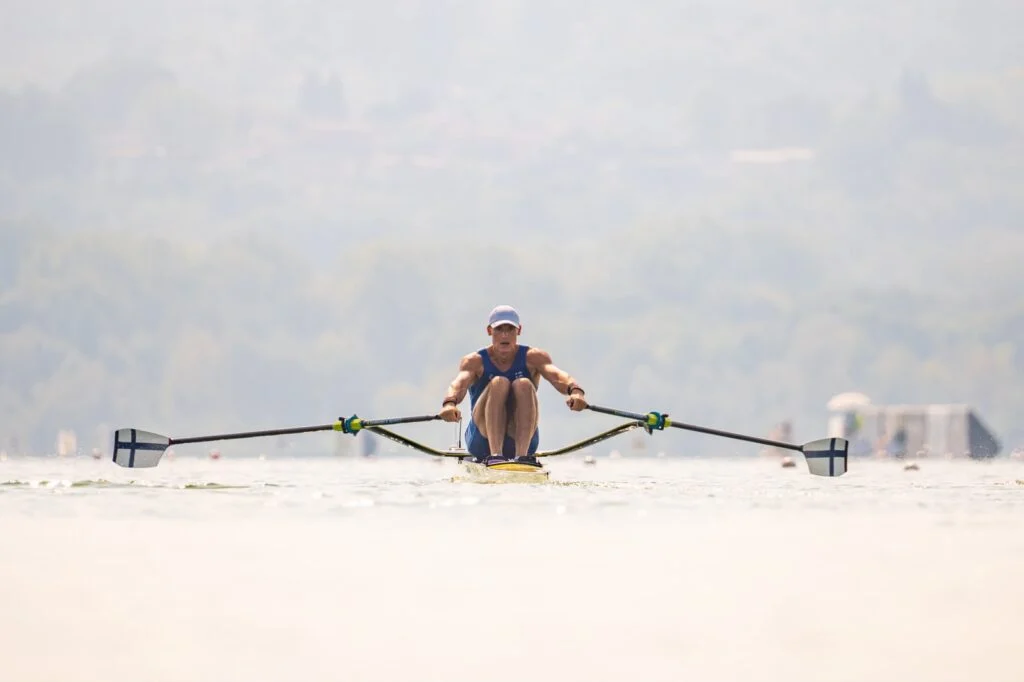
Kasper Hirvilampi’s campaign in the men’s single sculls (M1x) was a narrative of battling both the elements and unforeseen circumstances. He finished 18th overall, a result that belied the dramatic events that unfolded during his races.
His initial heats were significantly impacted by the intense Italian summer heat, a factor that affected many athletes but particularly hampered Hirvilampi’s performance. "A bit of mixed feelings, but positive overall," Hirvilampi began, echoing Kainlauri’s sentiment. "The clearest memory from the weekend is the A-final spot in the double. With the single, I didn’t have a clean race this time. In the heat, I faded badly in the severe heat, and the stroke remained lackluster. It wasn’t my usual standard, but the conditions were the same for everyone."
The most controversial moment of his individual competition occurred in the C-final. Despite the earlier heat-induced setback, Hirvilampi found a new gear, demonstrating impressive speed and a renewed competitive spirit. "In the C-final, I had completely different legs, and I was a different man, having learned from my mistakes," he explained. "The level was what it should be at major championships, and there were really strong names on every lane. I had a really good race all the way up to the last 900 meters."
However, his strong comeback was abruptly interrupted by an external factor. "Unfortunately, even here, it wasn’t a clean race. Disruptive waves came from the organizers’ catamaran in the middle of the race, and the race essentially went downhill from there. We all rocked in the waves in turn." This unexpected disturbance, caused by the wake of an official vessel, severely compromised the fairness of the race, causing instability for multiple competitors.
Immediately following the race, Hirvilampi and several other affected competitors jointly filed a protest. The initial response from the race judge was positive, signaling a recognition of the unfair conditions by issuing a "red flag," indicating a potential nullification or re-run of the race. However, in a controversial decision, the jury ultimately opted to let the results stand. "After the race, we collectively filed a protest among the competitors, and the judge ruled this with a red flag. However, the jury decided to let the result stand."
Despite the frustrating outcome and the jury’s decision, Hirvilampi remained optimistic about his underlying speed. "Still, it was a promising run, and it’s good to continue from here. The speed is clearly there." This incident underscored the unpredictable nature of open-water racing and the occasional challenges posed by race management. The men’s single sculls gold medal was won by Germany’s Oliver Zeidler, followed by Yauheni Zalaty (AIN) in second, and Stefanos Ntouskos of Greece in third.
Supporting Data and Broader European Context
The 2026 European Rowing Championships in Varese served as a significant barometer for the state of European rowing. The sheer depth of talent and the intensity of competition across all categories were evident, particularly in the single sculls events where Olympic and World Champions regularly clash.
Romania’s exceptional performance, securing six gold medals, was the standout statistic of the championships. This dominance across various boat classes highlights a robust national rowing program capable of consistently producing top-tier athletes. Their success, including the gold in the mixed double sculls, set a high benchmark for other nations.
For Finland, the results, while not yielding medals, offered valuable data. The performances of Kainlauri and Hirvilampi, particularly their A-final appearance in the mixed double, demonstrate that Finnish rowing has the capacity to compete at the highest levels, even in new and evolving disciplines. The caliber of the medalists – including Olympic medalists and seasoned international competitors – further emphasizes the challenging environment in which the Finnish athletes were operating. Their ability to make an A-final and show competitive speed against such formidable opposition is a testament to their dedication and potential.
Official Responses: Athletes Reflect on Varese’s Lessons
Both Maiju Kainlauri and Kasper Hirvilampi offered candid reflections on their Varese experience, providing insight into the mental and physical demands of elite rowing. Their "mixed feelings" encapsulated the reality of competitive sports – celebrating successes while acknowledging areas for improvement.
Kainlauri’s quote, "The home European Championships in Varese left me with mixed feelings. The starts included successes and many positives, such as the single sculls heats and the mixed double’s A-final spot at the championships. However, the races also included missed strokes, such as my own performance in the single sculls C-final. From here, we continue to put the puzzle together towards the Tampere SM and Amsterdam World Championships," illustrates her analytical approach. She clearly separates the achievements (strong heats, A-final) from the disappointments (C-final execution), signaling a proactive mindset focused on continuous improvement. Her reference to "putting the puzzle together" highlights the ongoing process of refining technique, strategy, and mental fortitude.
Hirvilampi’s detailed account of the C-final incident, while expressing frustration, also conveyed a resilient spirit. His acknowledgement of "good speed" despite the adverse conditions is crucial. His eloquent praise for Kainlauri and their teamwork in the mixed double underscores the importance of partnership and shared goals. "We had our own row and strategy. The position wouldn’t likely have changed, and you don’t go to an A-final to play it safe; you fight and see what happens. Someday, it will pay off. This time we rowed as a team, and that was great." This quote perfectly encapsulates the mindset of an elite athlete: taking calculated risks, giving maximum effort, and trusting the process for long-term gains.
These responses collectively paint a picture of athletes who are self-aware, driven, and committed to learning from every race, irrespective of the outcome.
Implications and Future Outlook for Finnish Rowing
The European Championships in Varese provided crucial insights and implications for Finnish rowing, shaping the immediate future for Kainlauri, Hirvilampi, and the broader national team. The performances offer a blend of encouragement and areas for strategic focus as they head into the most critical part of their season.
Immediate Steps: Tampere SM
Before confronting the global elite in Amsterdam, the Finnish rowers will participate in their domestic championship. The Tampere SM (Suomen Mestaruus – Finnish Championships) on August 15-16 serves as a vital tune-up and a final opportunity to refine their race pace and technique in a competitive setting. For Kainlauri, it’s a chance to consolidate her individual sculls performance, especially after the C-final disappointment in Varese. For Hirvilampi, it offers an opportunity to demonstrate his "good speed" without external interference and build confidence. These national championships are not merely about winning domestic titles but about honing racecraft and ensuring peak condition for the international stage.
The Ultimate Test: Amsterdam World Championships
The primary focus now shifts to the World Championships, scheduled for August 24-30 in Amsterdam. This event is the pinnacle of the international rowing calendar, bringing together the best crews from around the globe. For Kainlauri and Hirvilampi, their Varese experiences will be instrumental. They are slated to compete in the same boat classes – women’s single sculls and men’s single sculls, respectively, alongside the mixed double sculls. The Amsterdam World Championships will be a significantly tougher challenge, with a deeper field and higher stakes, potentially including Olympic qualification pathways in certain events.
Adding to the Finnish contingent in Amsterdam will be Juho-Pekka Petäjäniemi, who will compete in the men’s lightweight single sculls. His inclusion broadens Finland’s representation and offers another medal prospect in a highly competitive category. The presence of three athletes across different disciplines signals a multi-pronged approach by the Finnish Rowing Federation to maximize their international exposure and competitive potential.
Hirvilampi’s concluding remarks on the Varese experience encapsulate the team’s forward momentum: "This is a good direction towards the Amsterdam World Championships. Now is a good time to start the final hard training block." This indicates a clear plan for the coming weeks, involving intensive physical preparation and mental conditioning to ensure they are at their absolute best for the World Championships.
Broader Implications for Finnish Rowing
The performance in Varese carries several broader implications for Finnish rowing:
- Mixed Double Potential: The successful A-final appearance in the mixed double sculls is a significant development. If this event gains Olympic status, Finland has demonstrated early potential to be a contender. It also highlights the adaptability and teamwork capabilities of their athletes.
- Individual Resilience: Both Kainlauri and Hirvilampi, despite facing setbacks (personal performance, external interference), exhibited resilience and a commitment to learning. This mental toughness is crucial for sustained success in elite sports.
- Development Pathway: The participation of these athletes in major championships provides invaluable experience that will contribute to their long-term development and inspire younger generations of Finnish rowers.
- Resource Allocation: The results will likely inform future decisions regarding coaching, training camps, and resource allocation by the Finnish Rowing Federation, focusing on areas that show the most promise.
In conclusion, the European Rowing Championships in Varese, while presenting a spectrum of emotions and outcomes for the Finnish team, unequivocally marked a period of significant learning and growth. The historic A-final in the mixed double, coupled with the individual athletes’ demonstrated speed and resilience, sets a promising trajectory. As Maiju Kainlauri, Kasper Hirvilampi, and Juho-Pekka Petäjäniemi prepare for the World Championships in Amsterdam, the lessons from Varese will undoubtedly fuel their ambition to not just compete, but to truly contend on the global stage, continuing the pursuit of excellence for Finnish rowing.
Results and competition videos from the Varese European Championships can be found at worldrowing.com.
Photos: Balint Czucz