In the high-stakes world of ultralight backpacking and alpine mountaineering, gear manufacturers often lean heavily on the "spec sheet" to justify premium pricing. Consumers are frequently inundated with impressive data points: denier counts, hydrostatic head ratings, and the latest proprietary coatings like Dyneema Composite Fabric (DCF) or high-tenacity CORDURA. However, there is a recurring disconnect between the laboratory performance of a textile and the real-world utility of the finished product.
As outdoor enthusiasts know all too well, a pack made of the most advanced, waterproof material on the planet can still leave your spare base layers soaked after a sustained downpour. The failure rarely lies in the fabric itself, but rather in the architecture of the pack: the seams, the zippers, the hydration ports, and the roll-top closures. To bridge this gap, we must move beyond marketing claims and adopt rigorous, practical testing methodologies.
The Myth of the "Waterproof" Pack
To understand the necessity of specialized testing, one must first dismantle the misconception that a backpack can be truly waterproof. While dry bags exist, a functional backpacking pack is a complex assembly of disparate components.
The primary culprit in moisture ingress is the assembly process. Every stitch hole created during manufacturing is a potential capillary for water. Even when seams are taped, the integrity of that tape can fail over time due to friction, temperature fluctuations, and chemical degradation from sunscreen or insect repellent. Furthermore, zippers—even those marketed as "water-resistant" or "aquaguard"—are inherently porous. Hydration ports, meant to accommodate drinking tubes, often act as funnels for rainwater, and the very straps that hold the pack together provide paths for water to travel along webbing and into the pack body.
In the field, these variables interact in complex ways. Body heat creates a microclimate inside the pack, while the mechanical stress of movement causes the pack’s frame and fabric to flex, potentially opening microscopic gaps in construction seams. A fabric might boast a 20,000mm hydrostatic head rating, but if the water finds a path through a loose drawcord collar or a poorly sealed seam, that rating becomes irrelevant.
The Methodology: A Controlled Shower Test
To address this, we have developed a standardized, repeatable "Shower Exposure Method." The objective is not to replicate the chaotic reality of a mountain storm, which involves shifting winds and prolonged saturation, but to create a baseline performance metric.
The Testing Protocol
The test is designed for simplicity and repeatability, allowing any backpacker to assess their own gear.
- The Preparation: The pack is stuffed to its full, intended volume. Because the volume of the pack affects how the fabric stretches and how seams are tensioned, it is crucial to pack it as one would for a multi-day trek.
- The Witness Material: A large, dry cotton pillowcase is placed inside the main compartment. Cotton is chosen specifically for its high visibility when wet; it darkens significantly upon contact with water, making it an ideal "witness" for moisture ingress.
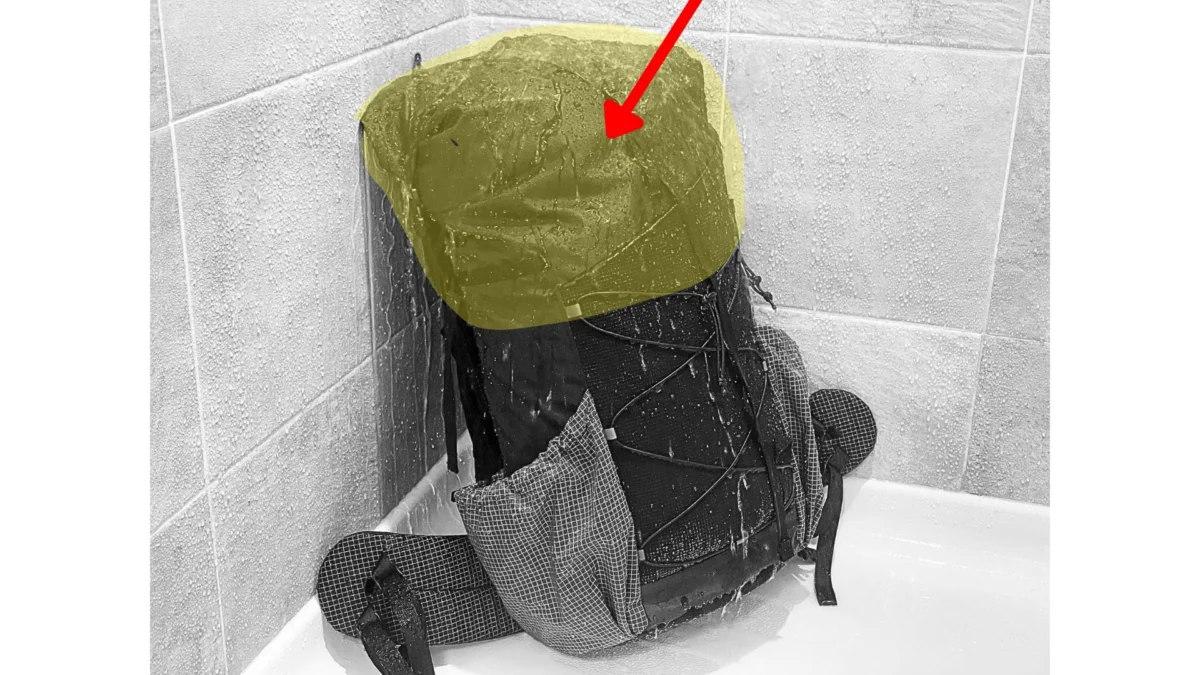
- The Exposure: The pack is suspended in a standard household shower. A 30-minute high-intensity exposure is maintained. This duration is long enough to identify "wicking" through seams or zippers, but short enough to keep the test practical.
- The Assessment: After 30 minutes, the pack is removed, the exterior is wiped dry, and the witness material is carefully inspected.
This method serves as a comparative screening tool. It does not certify a pack for expedition use in the Pacific Northwest, nor does it replace the need for pack liners or dry bags. Instead, it exposes the "low-hanging fruit" of design flaws—such as a poorly positioned zipper flap or a seam that lacks sufficient tension—that would otherwise remain hidden until the first catastrophic failure in the backcountry.
Chronology of Moisture Failure
When evaluating gear, it is helpful to categorize how moisture ingress typically progresses over time. By observing these stages, manufacturers can better pinpoint where engineering improvements are needed.
- T+0 to T+5 Minutes (Surface Saturation): In the first five minutes, the exterior DWR (Durable Water Repellent) is tested. If the fabric "wets out" immediately, the outer shell becomes a reservoir for water, increasing the hydrostatic pressure against the interior seams.
- T+5 to T+15 Minutes (Seam Migration): As the fabric saturates, water begins to track along the stitch lines. This is the stage where most "water-resistant" packs begin to leak. If a pack lacks seam tape or has poorly sealed bar-tacks, the cotton witness material will begin to show localized damp spots near the base or side panels.
- T+15 to T+30 Minutes (Structural Breach): At this stage, failures in zippers or hydration ports become apparent. If the roll-top closure is not folded correctly, or if the drawcord collar allows water to pool in the "throat" of the pack, the witness material will transition from damp to soaked.
Supporting Data: Why Fabric Specs Aren’t Enough
In our comparative tests, we have observed a startling lack of correlation between fabric price and water resistance. In one instance, a $400 pack utilizing high-end laminated textiles performed significantly worse than a $150 budget pack. The difference? The budget pack featured fewer zippers and a more robust, albeit heavier, roll-top closure system.
The data suggests that construction geometry outweighs material science. For instance, packs with "floating" lids often allow water to pool in the gap between the lid and the pack body. Without a secure, integrated seal, that water eventually gravity-feeds into the main compartment. Our testing shows that packs with simple, top-loading designs and minimal external hardware consistently outperform "feature-rich" packs with multiple external pockets and complex zippered access points.
Industry Implications and Official Perspectives
The outdoor industry is currently at a crossroads. As consumers become more sophisticated, the "waterproof" label is being scrutinized. Major brands are increasingly moving toward a "systems-based" approach, acknowledging that the pack is only one layer of a moisture-management strategy.
Manufacturer Response
In recent interviews, product designers from leading gear companies have noted a shift in priorities. "We are moving away from the term ‘waterproof’ in our marketing materials," says a lead designer at a major technical pack brand. "It sets an impossible expectation. We are instead focusing on ‘weather resistance’ and encouraging users to utilize internal liners. It is safer to assume the pack will eventually leak and design it to dry out quickly, rather than trying to build a hermetically sealed bag that would be too heavy and expensive for the average user."
This sentiment reflects a growing trend: "modular protection." By designing packs to be compatible with internal waterproof liners or modular dry-bag inserts, manufacturers can build lighter, more durable packs without the weight penalty of extensive seam-taping and heavy-duty zippers.
Practical Implications for the Consumer
For the average hiker or climber, the implications of these findings are clear:
- Prioritize Geometry: When shopping, look for packs with fewer external zippers and clean lines. Every zipper is a potential point of failure.
- Trust the Liner, Not the Pack: No matter how much you pay for a pack, treat it as a structural skeleton. Use a dedicated pack liner (like a trash compactor bag or a lightweight dry bag) for critical items like sleeping bags and down jackets.
- Perform Your Own Test: Use the 30-minute shower test described above. It is the only way to know how your specific pack—with your specific load and gear—handles moisture.
- Maintenance is Key: Seam tape and DWR coatings degrade. Periodic re-application of DWR and the occasional touch-up of seam sealer can extend the life and performance of your pack significantly.
Conclusion
The pursuit of the perfectly waterproof backpack is a chase for a phantom. By shifting our focus from the lab-grown specs of fabrics to the functional reality of construction, we can make more informed purchasing decisions and prepare more effectively for the backcountry. The shower test is a humble tool, but it provides a necessary dose of reality in an industry often clouded by marketing hyperbole. Ultimately, the best gear is not the one that claims to be invincible, but the one that allows you to manage the inevitable realities of the environment with competence and foresight.