The containment and cleanup of oil spills in fast-moving inland waterways represent one of the most complex challenges in environmental emergency management. Unlike static oceanic spills, fastwater environments—such as rivers, streams, and irrigation canals—present dynamic, high-energy conditions that complicate containment and expose responders to unique hazards. Recent operational assessments of inland spill responses have highlighted a critical, often neglected pillar of safety: the rigorous decontamination of personnel and equipment.
As regulatory bodies and environmental safety agencies tighten their guidelines, the industry is shifting toward a more proactive, assertive approach to decontamination. This article explores the essential protocols, zoning, and procedural mandates required to ensure that the cleanup process does not exacerbate the environmental impact or compromise the health of the response teams on the ground.
The Strategic Importance of Work Zones
The foundational requirement for any effective spill response is the clear delineation of work zones. Without strict spatial management, the risk of cross-contamination—where clean areas are inadvertently polluted by agents from the spill site—increases exponentially. Responders must be proactive and assertive in the early phases of the incident to prevent this.
Defining the Triad of Safety
Standard industry practice, supported by the Occupational Safety and Health Administration (OSHA) and similar international bodies, mandates the establishment of three distinct areas:
- Exclusion Zone (Hot Zone): This is the area where the spill is actively occurring or where contamination levels are highest. It requires the highest level of personal protective equipment (PPE).
- Contamination Reduction Zone (CRZ/Warm Zone): This area serves as the transition corridor. It is here that the critical work of decontamination takes place. It is a buffer designed to ensure that no contaminants leave the Hot Zone.
- Support Zone (Cold Zone): This is the clean, safe area where command centers, medical support, and administrative personnel operate.
A site map is not merely a suggestion; it is a legal and operational necessity. A detailed map must identify these zones in direct relation to site features such as riverbanks, prevailing currents, access roads, and staging areas. Responders must be fully briefed on these boundaries; confusion at the perimeter is often the first step toward a failure in the response chain.
Personnel Decontamination: A Non-Negotiable Standard
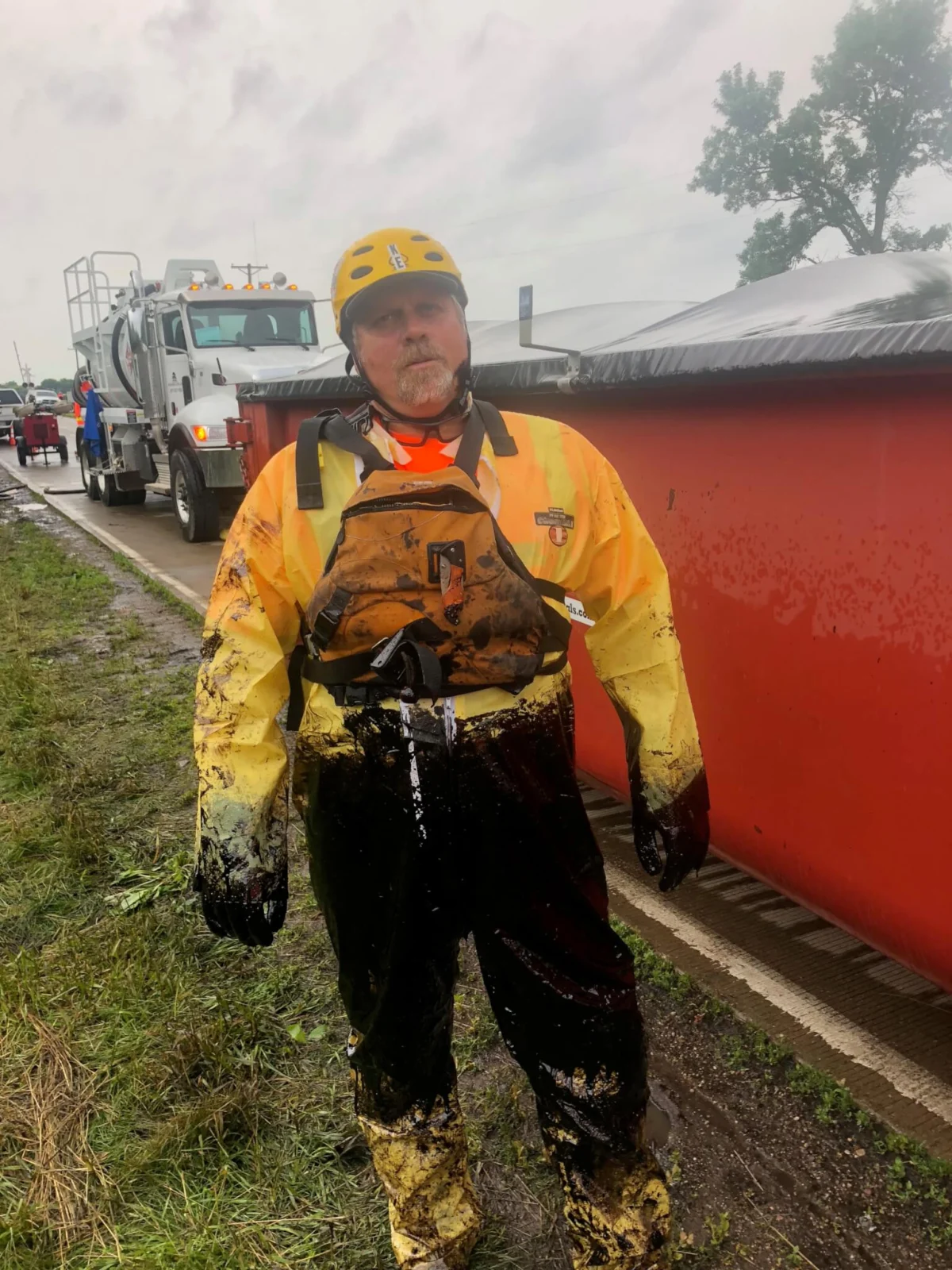
The most common failure in inland spill response is the inadequate decontamination of field personnel. When individuals move from the Exclusion Zone to the Support Zone, they carry the potential to track toxic hydrocarbons into clean environments, causing secondary exposure to support staff and the public.
The Three-Station Minimum
Responders utilizing Modified Level D or Level C protective gear must undergo a structured decontamination process before exiting the CRZ. At a minimum, this process must follow a three-station protocol:
- Station 1: Gross Decontamination: Personnel must remove the primary, heavy layer of contamination. This involves scrubbing outer clothing and boots with brushes and approved aqueous cleaning solutions to ensure no loose crude or chemical debris is carried forward.
- Station 2: Outer Layer Removal: Responders remove outer garments and gloves, which are then placed into properly labeled hazardous waste containers. Hard hats and boots are further sanitized using a detergent solution, ensuring that these items—which are often kept for the next shift—are thoroughly cleaned.
- Station 3: Final Hygiene: Before leaving the CRZ, personnel must perform a thorough wash of the hands and face. If respirators were used, they must be sanitized and sealed in clean, designated plastic bags to prevent any remaining residue from becoming airborne.
PPE and Equipment Protocols
The logistics of decontamination extend beyond the human element to the gear and machinery used in the riverbed. The principle is simple: if it touched the oil, it must be cleaned before it moves.
Managing Protective Gear
Wherever possible, single-use, external protective clothing should be the standard for work within the Hot and Warm zones. These materials are cost-effective to dispose of and eliminate the risk of residual contamination associated with laundering. When reusable gear is deemed necessary, it must be rinsed thoroughly at the site with detergent and water. Crucially, the rinsate—the liquid runoff from this cleaning process—cannot be allowed to flow back into the water body. It must be collected and treated as hazardous waste.

Vehicle and Equipment Rinsing
Heavy equipment and vehicles are high-risk vectors for spreading oil across a response site. Every vehicle that has entered the Exclusion Zone must be processed at a decontamination pad before returning to the Support Zone.
- Low-Level Contamination: If the vehicle has only traversed the periphery of the zone, rinsing tires and wheel wells with pressurized water may suffice.
- High-Level Contamination: If the vehicle has been submerged or covered in heavy crude, steam cleaning or high-pressure power washing is required. These procedures must be conducted on a lined, bermed pad to ensure all waste liquids are captured.
Chronology of an Inland Spill Response
To understand how these decontamination protocols fit into the broader narrative of a spill, it is helpful to look at the timeline of a typical fastwater incident.
- Phase 1: Detection and Immediate Zoning (Hours 0-4): Upon notification, the primary focus is to secure the area. The Incident Commander defines the Hot, Warm, and Cold zones. Early responders arrive, and the decontamination station is established before the first cleanup team enters the water.
- Phase 2: Containment and Stabilization (Hours 4-24): Booms are deployed to divert or contain the oil. During this phase, teams rotate in and out of the river. The decontamination stations become high-traffic areas, requiring constant oversight to ensure compliance.
- Phase 3: Cleanup and Remediation (Days 1-7): Heavy equipment enters the riverbanks. This is where equipment decontamination protocols are tested. Regular maintenance of the decon pads is required to prevent them from becoming sources of secondary contamination.
- Phase 4: Site Restoration and Demobilization (Ongoing): As the site is cleared, the zones are systematically dismantled. The decontamination areas are usually the last to be decommissioned, ensuring that even the cleanup equipment is scrubbed before being transported off-site.
Supporting Data and Risk Factors
Environmental studies conducted in the wake of major inland pipeline leaks suggest that the viscosity and composition of the oil play a significant role in the difficulty of decontamination. Light crudes evaporate faster, creating inhalation risks in the Hot Zone, while heavy crudes adhere to surfaces, necessitating more aggressive detergent-based cleaning.
Furthermore, data from recent response efforts indicate that nearly 40% of secondary contamination incidents at spill sites were caused by improper handling of contaminated PPE. This underscores why the "assertive" approach to decon is not just a safety recommendation—it is a quantitative necessity for maintaining a clean work environment.
Official Responses and Industry Shifts
Federal agencies, including the EPA and the Coast Guard, have increasingly emphasized the "decon-first" mentality in their recent Incident Command System (ICS) training. There is a concerted push to move away from ad-hoc decontamination setups toward modular, pre-fabricated decon units that can be deployed at a moment’s notice.
Experts in the field of whitewater rescue and environmental response have noted that the "fastwater" element is the most overlooked factor. The turbulence of a river creates a mist of oil and water, which settles on all surfaces. Consequently, the standard for decontamination in a river setting is arguably higher than in a static spill, as the aerosolized contaminants can reach areas that would otherwise remain clean.
Implications for Future Operations
As the industry looks to the future, several implications arise:
- Training: Decontamination is not a "side task" for the least experienced member of the team. It is a specialized role that requires rigorous training in hazardous materials handling.
- Technology: We are likely to see the integration of better water-filtration technology at decon stations to minimize the volume of hazardous waste produced during the cleaning process.
- Standardization: The adoption of unified, site-specific mapping and zoning protocols will reduce the friction between different agencies and private contractors working on the same incident.
The response to a fastwater oil spill is a race against the current. However, the speed of the cleanup must never be allowed to override the integrity of the decontamination process. By maintaining clear work zones, strictly enforcing the three-station decon rule, and treating equipment hygiene with the same urgency as the containment itself, responders can protect the river, the public, and, most importantly, each other. The goal is a successful recovery—one that ensures the water is restored without leaving a trail of secondary contamination in the wake of the response.