Espoo, Finland – The annual SM-viikko (Finnish Championship Week) once again played host to the pinnacle of stand-up paddling competition, as the Finnish SUP Federation orchestrated the national championships for both Sprint and Technical Race disciplines. Held at the scenic Oittaa Outdoor Centre in Espoo, the event showcased the nation’s top paddlers, delivering intense competition, dramatic finishes, and sparking crucial discussions about the future of the sport’s infrastructure. Despite logistical hurdles and a dramatic thunderstorm delay, the championships provided significant visibility for SUP, culminating in a memorable display of athleticism and strategic prowess, especially lauded for its Technical Race format.
The event, a collaborative effort with other SM-viikko sports organizers, aimed not only for seamless execution but also to create visually spectacular venues for YLE’s extensive television coverage. While this goal was largely met, particularly with the thrilling Technical Race, the Sprint competition faced unique challenges that underscored the evolving landscape of competitive stand-up paddling in Finland.
A Detailed Chronology of the Races
The SM-viikko SUP championships unfolded across two distinct and challenging formats: the high-octane Sprint and the tactically demanding Technical Race. Each event brought its own set of conditions, drama, and ultimately, its champions.
Sprint Race: Navigating Unconventional Waters
The 200-meter sprint race, a test of raw power and explosive speed, was the first discipline on the agenda. However, its execution was immediately complicated by an unforeseen logistical constraint: the absence of a dedicated, purpose-built SUP sprint track. Organizers from the Finnish SUP Federation were compelled to adapt, utilizing a modified version of the coastal rowing beach sprint track. This improvisation, while facilitating the competition, introduced several significant deviations from standard SUP sprint course requirements. The track proved to be somewhat overlong, narrower than ideal, and crucially, lacked the central buoys that typically delineate clear lanes for competitors.
These non-standard conditions had a tangible impact on the racing dynamics. Without clear lane markers, paddlers found themselves contending not only with their rivals but also with the wash and wakes generated by faster competitors in adjacent, unmarked lanes. This often forced paddlers to expend extra energy or adjust their lines, potentially compromising their optimal performance.
Women’s Sprint Final: Väisälä’s Dominance, a Photo Finish for Bronze
The women’s sprint final was a direct showdown, featuring a field of top contenders. From the starting gun, pre-race favourite Hanna Väisälä asserted her dominance, exploding off the line to secure the best start. Close on her heels was Kukka Kirjavainen, maintaining tight contact in the initial acceleration phase. However, as the race progressed, Kirjavainen found herself inadvertently drifting into Väisälä’s line, forcing her to make corrective manoeuvres to keep her board on a clear path towards the finish. This extra effort proved costly.
Meanwhile, Isa Merikallio executed a remarkably consistent and error-free performance, steadily climbing through the field to secure a well-deserved silver medal. The battle for bronze, however, was nothing short of breathtaking. Kukka Kirjavainen, despite her earlier line struggles, engaged in a fierce, stroke-for-stroke duel with Nina Into right up to the final meters. The intensity of this fight necessitated a thorough review of the photo finish images by race officials. After careful deliberation, Nina Into was declared the narrow victor, claiming the bronze medal, while Kirjavainen had to settle for a commendable fourth place. Vellamo Viitanen and Tytti Kuusi rounded out the top six, finishing fifth and sixth respectively, in a fiercely contested final.
Men’s Sprint Final: Lelovits Senior Reigns Supreme
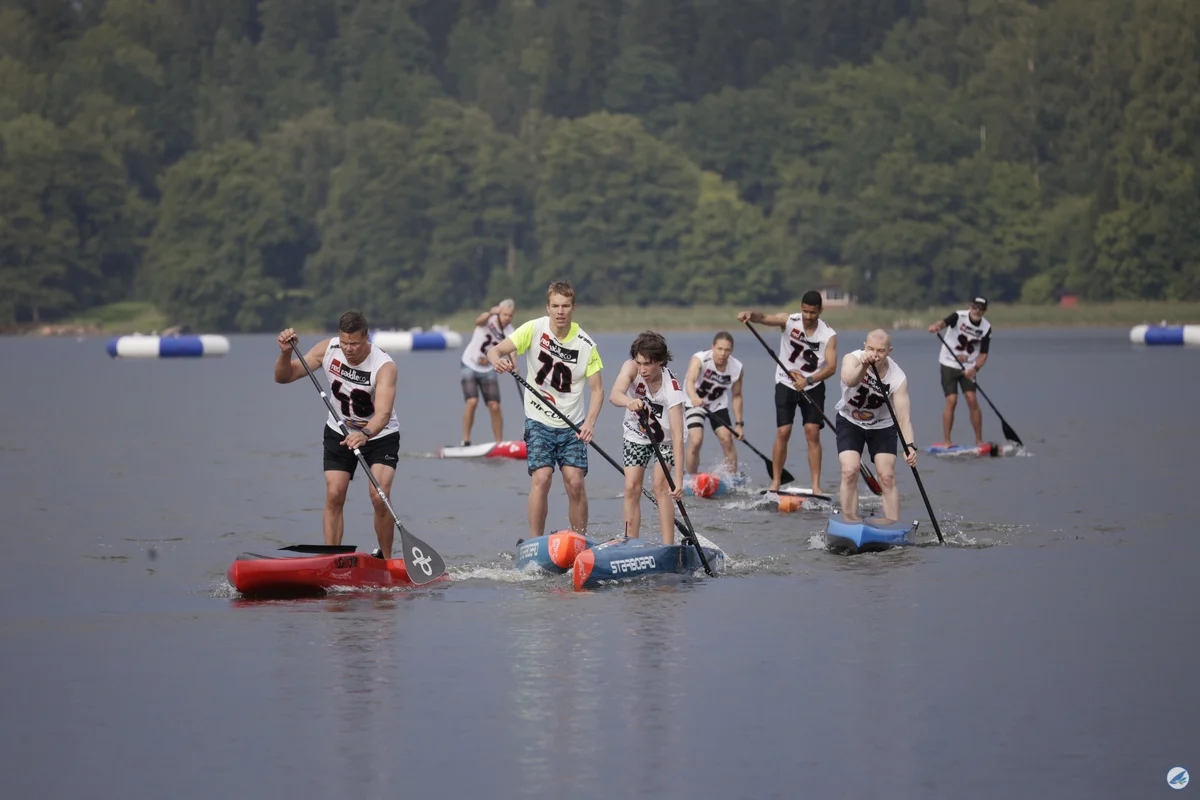
The men’s sprint final, following two competitive heats, brought together six of Finland’s fastest paddlers. As the starting signal echoed across the water, Tõmas Lelovits, Thomas Fagerström, and Lauri Palmroth immediately surged to the front, establishing a clear leading trio. An unfortunate turn of events saw Sami Lelovits, Tõmas’s son, caught in the turbulent wake of his father’s board during the critical initial acceleration. This momentary disadvantage allowed the leading three to break away early in the race.
Thomas Fagerström mounted a formidable challenge to Tõmas Lelovits, pushing the former world champion hard for approximately 150 meters. However, Tõmas Lelovits, drawing on his vast experience and formidable power, demonstrated his superior strength in the closing stages, paddling decisively to claim a convincing victory and the Finnish Championship title. Lauri Palmroth maintained a solid performance to secure a clear third place. Sami Lelovits, despite his challenging start, fought back to finish fourth, followed by Janne Laine in fifth and Hormoz Zarei in sixth, completing a high-calibre men’s final.
Technical Race: The Thunderstorm Interlude and Tactical Masterclass
The Technical Race, renowned for its dynamic course design incorporating multiple turns and transitions, was set to be a highlight of the championships. The course, an M-shaped, two-lap circuit, featured a thrilling beach start and finish, strategically utilizing coastal rowing buoys and including a unique land-based flag turn between laps.
However, just as anticipation for the Technical Race reached its peak, the weather took a dramatic turn. A fierce thunderstorm descended upon Oittaa, forcing a significant delay in the competition schedule. Safety concerns for both athletes and spectators, as well as the need to ensure optimal conditions for YLE’s aerial drone footage, necessitated the pause. Only when the rain subsided and the gusting winds lessened sufficiently was the green light given for the races to commence, starting with the women’s event.
Women’s Technical Race: Väisälä’s Unchallenged Reign, Merikallio’s Strategic Comeback
As in the sprint, Hanna Väisälä entered the Technical Race as the overwhelming favourite, and she lived up to expectations with a masterful performance. From the very start, Väisälä seized control of the race, quickly establishing a commanding lead that she would not relinquish.
For Isa Merikallio, the Technical Race presented a strategic dilemma regarding equipment. Having used a rigid board for the sprint, she opted for a more technically agile inflatable board for the multi-turn Technical Race. This decision, however, seemed to initially hinder her in the frantic beach start acceleration, as the sprint silver medalist found herself at the back of the pack. Despite this early setback, Merikallio demonstrated remarkable composure and skill. Through a combination of consistent paddling speed and flawlessly executed turns, she steadily worked her way through the field, ascending to second place by the end of the first lap and holding that position all the way to the finish line, securing another silver medal.
The battle for the bronze medal was another captivating spectacle, featuring Tytti Kuusi and Nina Into locked in a relentless struggle from the very first turn buoy. Their duel continued throughout both laps, with positions exchanging and tactics evolving. In a thrilling climax on the final straight, Tytti Kuusi found an extra burst of energy, managing to squeeze past Nina Into just before the finish line to claim the bronze, leaving Into in a hard-fought fourth place.
Men’s Technical Race: Lelovits’s Masterclass and a Podium Shake-up
The men’s Technical Race commenced with a tight formation, but it wasn’t long before Tõmas Lelovits once again asserted his authority. He quickly broke away from the pack on the initial leg, arriving at the first turn buoy with a clear lead. Behind him, the fight for the podium was intense. Lauri Palmroth, who arrived at the first buoy in second, made a slight error, taking the turn a little too wide. This momentary lapse was expertly capitalized on by the younger challengers, Elias Rantala and Sami Lelovits, who executed nimble inside-line turns to surge ahead of Palmroth.
On the second turn, Palmroth demonstrated his experience and technical skill, executing a much cleaner maneuver to reclaim second place. He was closely pursued by Sami Lelovits, Elias Rantala, and Thomas Fagerström, forming a tight chase group. Further back, Hormoz Zarei and Janne Laine were engaged in their own private battle for fifth position.
As the second lap began, Tõmas Lelovits had extended his lead significantly, paddling towards an almost certain victory. However, the fight for the remaining medals intensified, with positions fluctuating at nearly every turn buoy. Elias Rantala, who had been mounting a strong challenge for a podium spot, suffered an unfortunate fall at the penultimate buoy, dashing his medal hopes.
Palmroth approached the final buoy in second place, but Sami Lelovits, known for his exceptional turning ability, executed yet another superb, fast inside turn, drawing level with Palmroth. In a powerful surge on the final sprint to the beach, Sami Lelovits unleashed a decisive attack, pushing ahead to claim a hard-earned silver medal, leaving Lauri Palmroth with the bronze. Thomas Fagerström finished fourth, Elias Rantala recovered to take fifth, Hormoz Zarei was sixth, and Janne Laine completed the top seven.
Supporting Data and Athlete Insights
The 2023 Finnish SUP Championships in Espoo provided rich material for discussion, particularly regarding the Sprint event’s setup and the universally praised Technical Race.
The sprint track, adapted from a coastal rowing course, proved to be a significant talking point among competitors. Its characteristics—being slightly overlong, unusually narrow, and crucially, lacking buoyed centerlines—created a less-than-ideal competitive environment. The absence of clear lane demarcation meant that paddlers frequently found themselves contending with the turbulent wakes created by faster opponents in adjacent, undefined lines. This situation, as many athletes voiced, could unfairly impact performance, forcing paddlers to make unexpected course corrections and expend additional energy simply to maintain a clean line. For organizers, constructing a compliant 200-meter sprint track is a "significant undertaking," highlighting the logistical and financial investment required for standard setups.
This led to considerable debate among the paddling community about the future of the sprint discipline within the Finnish Championships. A prevailing sentiment was that it might be more advantageous to host the SM sprint race in locations that already possess existing, standard-compliant track conditions. A frequently cited example was the possibility of integrating SUP sprint championships with national sprint canoeing championships, which typically take place on dedicated, buoyed courses perfectly suited for fair and comparable competition. Such an approach would ensure standard track dimensions, allow for more accurate time comparisons, and provide each competitor with a clearly defined, personal racing line, eliminating the issues encountered at Oittaa.
Adding another layer to the discussion was the international context of sprint distances. While the Finnish Championships currently utilize a 200-meter sprint, the International Canoe Federation (ICF), the global governing body for paddle sports, has adopted a 100-meter sprint distance for its World and European Championships. This disparity raises questions about alignment with international standards and how Finnish athletes prepare for global competitions. Adopting the 100-meter format domestically could better prepare national talent for international success, but would also necessitate a shift in event planning and athlete training focus.
In stark contrast to the sprint, the Technical Race received widespread acclaim. Competitors and observers alike described it as "the best technical race in a long time." This enthusiastic feedback was attributed to several key factors: the M-shaped course design fostered continuous overtaking opportunities, demanding strategic decision-making at every turn. The layout allowed for successful tactical maneuvers and showcased athletes’ ability to execute rapid, precise turns, leading to frequent and exciting changes in position from start to finish. The success of this format underscored its potential as a thrilling and spectator-friendly discipline, providing a blueprint for future technical race designs.
Athlete-specific insights further enriched the narrative. Isa Merikallio’s strategic decision to switch from a hard board to a more agile inflatable for the Technical Race, despite an initial slower start, highlighted the tactical considerations involved in equipment choice for different race formats. Sami Lelovits’s exceptional turning ability and powerful final sprint in the men’s Technical Race demonstrated how specific skills could dramatically alter podium outcomes. The unfortunate fall of Elias Rantala, a strong medal contender, at a critical juncture in the men’s Technical Race underscored the fine margins and inherent risks in such a dynamic discipline.
Official Responses and Organisational Perspective
The Finnish SUP Federation, as the primary organizer, played a pivotal role in bringing the championships to fruition as part of SM-viikko. Their mandate included not only managing the competitive aspects but also collaborating closely with other sports federations and the broader SM-viikko organizing committee to ensure a cohesive multi-sport event. This intricate coordination was essential for the successful overall execution, particularly given the shared resources and media attention.
The Federation acknowledged the significant challenges associated with establishing a suitable sprint track. The construction of a standard 200-meter sprint course, complete with proper buoyage and lane delineation, represents a considerable logistical and resource-intensive undertaking. The decision to utilize the adapted coastal rowing track was a pragmatic one, born out of necessity to ensure the sprint event could proceed within the framework of SM-viikko. This compromise, while enabling the competition, highlighted a key area for future improvement and strategic planning.
Regarding the discussions about the future of sprint events, the Federation is likely to take the athlete feedback seriously. The suggestions for potentially co-hosting sprint championships with other paddle sports that already possess standard infrastructure offer a viable path forward for ensuring fair, consistent, and internationally comparable racing conditions. Such a move would alleviate the burden on individual organizers to construct bespoke tracks annually and ensure a higher quality competitive environment for the athletes.
The broader context of SM-viikko itself provides an invaluable platform for stand-up paddling. The event’s consistent inclusion in the national championship week, coupled with the extensive YLE television coverage, has been instrumental in raising the profile of SUP in Finland. It offers unparalleled visibility for the sport, showcasing its dynamism and the skill of its top athletes to a national audience. This exposure is crucial for attracting new participants, fostering grassroots development, and securing future partnerships. The Federation explicitly extended its gratitude to all involved parties—the dedicated competitors, the tireless officials, the various organizing bodies, and key partners like Foodin and Laguuni—emphasizing the collaborative spirit that underpins such a large-scale event.
Implications and Future Outlook for Finnish SUP
The 2023 Finnish SUP Championships at Oittaa, while celebrating new champions and thrilling races, also cast a spotlight on critical implications for the sport’s future in Finland.
The Future of SM-viikko and SUP’s Visibility
One of the most significant announcements affecting Finnish sports is that the current format of SM-viikko is set to conclude this year, at least for the foreseeable future. This news carries substantial weight for stand-up paddling. SM-viikko has been an invaluable vehicle for SUP, offering it prime-time exposure through national broadcaster YLE. This level of media visibility is a rare commodity for many emerging sports, and its potential loss could impact SUP’s growth trajectory. The YLE broadcasts have been instrumental in demystifying the sport, showcasing its excitement, and inspiring new participants. Moving forward, the Finnish SUP Federation will need to strategize on alternative avenues to maintain and enhance this crucial visibility, whether through dedicated events, alternative media partnerships, or innovative promotional campaigns. The event has undeniably served as an excellent stage for both established champions and burgeoning talents to gain recognition, and preserving such a platform will be paramount.
Standardisation and Evolution of Race Formats
The discussions surrounding the sprint race track and distance highlight a pivotal moment for standardisation within Finnish SUP. The challenges faced at Oittaa, with the modified, non-standard track, underscore the need for dedicated, consistent infrastructure for competitive sprints. The call from athletes to align the national championships with international standards, particularly regarding the 100-meter sprint distance adopted by ICF, is a logical step towards fostering international competitiveness. Implementing standard track conditions and distances would not only ensure fairness and comparability of results but also better prepare Finnish athletes for success on the global stage. This strategic shift could involve closer collaboration with other paddle sports federations to utilize existing, compliant venues.
Conversely, the overwhelming positive feedback for the Technical Race offers a clear blueprint for success. Its dynamic course, which facilitated continuous overtakes and strategic maneuvering, exemplifies what a high-quality technical race can and should be. The Federation can leverage this success by actively promoting and developing similar course designs in future events, ensuring that the Technical Race continues to be a highlight of the competitive calendar. The balance between sprint and technical disciplines, each with its unique demands, will continue to shape the skill set of Finnish paddlers.
Recognising Emerging Talent and Established Champions
The championships unequivocally cemented the status of Hanna Väisälä and Tõmas Lelovits as the undisputed dominant forces in Finnish SUP, each claiming dual national titles. Their consistent excellence provides a benchmark for all aspiring paddlers. However, the event also showcased the rising tide of talent within the sport. Isa Merikallio’s dual silver medals, Thomas Fagerström’s strong challenge in the men’s sprint, and Sami Lelovits’s impressive surge to silver in the Technical Race highlight a deepening pool of competitive athletes. Young talents like Elias Rantala, despite his unfortunate fall, demonstrated significant potential, indicating a bright future for Finnish SUP. The fierce battles for bronze medals in both women’s races, involving athletes like Nina Into, Kukka Kirjavainen, and Tytti Kuusi, attest to the increasing competitive depth across the board.
Community and Collaboration
Beyond the competition, the championships reinforced the vibrant and supportive community within Finnish SUP. The acknowledgments extended to competitors, officials, organizers, and partners underscore the collaborative spirit essential for hosting such events. The dedication of volunteers and the crucial support from commercial partners like Foodin and Laguuni are the backbone of the sport’s development. This strong sense of community and shared passion will be vital in navigating the upcoming changes, particularly with the conclusion of SM-viikko’s current format. The event served as a testament to the collective effort to promote and grow stand-up paddling in Finland.
Acknowledgements and Conclusion
The 2023 Finnish SUP Championships at Oittaa, Espoo, concluded as a vibrant celebration of competitive stand-up paddling, successfully showcasing the nation’s top talent. Despite the inherent challenges of adapting race infrastructure and contending with unpredictable weather, the event delivered compelling narratives, thrilling finishes, and memorable performances.
The Finnish SUP Federation extends its deepest gratitude to all the athletes who pushed their limits, the dedicated officials and volunteers whose tireless efforts ensured smooth execution, the collaborative organizing bodies of SM-viikko, and our invaluable partners, Foodin and Laguuni, for their unwavering support.
While the future landscape of SM-viikko may be changing, the spirit of competition and the passion for stand-up paddling in Finland remain stronger than ever. The discussions initiated at Oittaa about race standardisation and future event formats will undoubtedly pave the way for an even more robust and internationally competitive future for Finnish SUP.
(For full detailed results of all races, please refer to the official publications by the Finnish SUP Federation.)