For most collegiate athletes, the path to greatness is paved with familiar markers: the crack of the starting pistol, the rhythmic thud of spikes against a synthetic track, and the singular focus of a finish line. For Anna Keefer, that path was paved with record-breaking performances. A five-time NCAA All-American, Keefer spent over a decade dominating the track and field circuit, leaping into history books with a 20-foot-1.25-inch state record in Minnesota and a staggering 21-foot-6-inch UNC record at the 2022 ACC Indoor Long Jump championships.
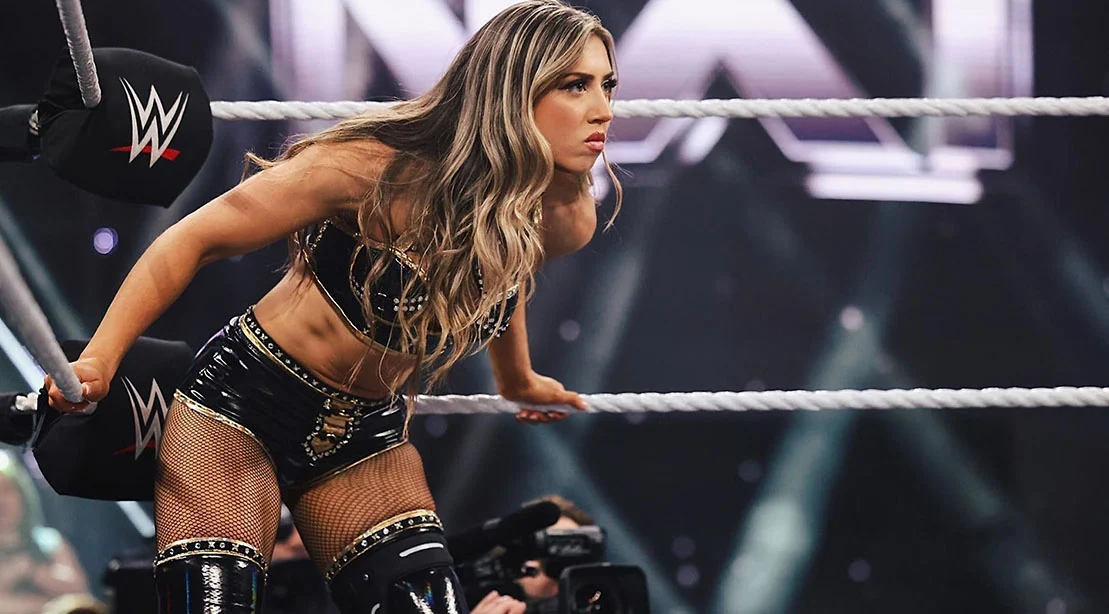
However, life has a way of throwing curveballs—or in the case of WWE’s newest powerhouse, throwing her into the ropes. Today, the world knows her as "Adriana Rizzo." But the transition from a Division I track star to a professional wrestler has been anything but a smooth sprint. In an exclusive interview with Muscle & Fitness, Rizzo opens up about the brutal physical toll of the squared circle, the mental fortitude required to pivot from athlete to entertainer, and why her "breakout" moment is finally within reach.
The Genesis of a Superstar: Who is Adriana Rizzo?
The journey from Albertville, Minnesota, to the global stage of World Wrestling Entertainment is a testament to raw, transferable athleticism. Before she was learning to sell a clothesline or master the psychology of a heel, Keefer was a blur of motion. With personal bests of 11.29 seconds in the 100-meter dash and 22.83 seconds in the 200-meter event, she possessed the explosive power required for elite sprinting.
When the call from WWE came, it presented a fork in the road. She had spent 12 years training for linear speed and vertical lift. Entering the Performance Center in Orlando, Florida, was an exercise in humility.
"I didn’t know, physically, how much contact there really was," Rizzo admits. "The first two days of hitting the ropes, I had a huge welt. The stiffness of the ropes was shocking to me."
For a track athlete, the body is a finely tuned machine built for efficiency. In wrestling, the body is a weapon that must also withstand the impact of an opponent’s kinetic energy. Despite the steep learning curve, Rizzo’s athletic pedigree was impossible to ignore. She signed with WWE in 2022 and immediately began the arduous process of transitioning her skillset to the NXT brand.
Chronology of a Career: The Highs and The Hard Knocks
The path to the main roster is rarely linear, but for Rizzo, it has been punctuated by severe physical setbacks that would have ended the careers of less resilient individuals.
The Rookie Trial by Fire (2022)
After impressing coaches at her initial tryout, Rizzo debuted in NXT with high expectations. However, the unique geometry of a wrestling ring proved dangerous for someone accustomed to the flat surface of a track. While executing a routine clothesline, the canvas—designed to absorb impact—shifted unexpectedly. "That’s when my Achilles tendon went," she recalls. The injury sidelined her for six months, forcing a grueling rehabilitation process that tested her commitment to a sport she had only just begun to understand.
The Comeback and the "D’Angelo Family" (2023)
By October 2023, Rizzo had returned to the ring with a renewed sense of purpose. It was during this period that she found her footing, aligning herself with the D’Angelo family stable and officially adopting the moniker "Adriana Rizzo." Fans began to respond to her presence, sensing a natural charisma that had been dormant during her track days.
The ACL Crisis (2024)
Just as momentum began to build, disaster struck again. During a match, an opponent’s maneuver placed extreme pressure on Rizzo’s knee, resulting in a partial ACL tear. In a display of pure grit, she finished the match and even competed at NXT Vengeance Day 2024. She spent months in a brace, hoping to heal, only for the injury to worsen during training—leading to a full-blown crisis: a torn meniscus, a sprained MCL, and the previously injured ACL. It was, as she puts it, a "left-side nightmare."
Beyond the Ring: Cultivating Character and Creativity
Perhaps the most compelling aspect of Adriana Rizzo’s story is not how she handled the wins, but how she handled the months spent on the sidelines. In many sports, an injury means a total cessation of professional development. In WWE, it provided a rare window to develop the one thing she lacked: a character.
"At my tryout, I think somebody told me that they wrote down, ‘No Personality, No Character,’" she says with a laugh. She took that criticism to heart. During her recovery from the Achilles injury, Rizzo pivoted to media production—a field she had studied in college—and began crafting her persona in front of the camera.
She didn’t stop there. Rizzo channeled her creative energy into entrepreneurship, founding Salt & Daughters, a vintage-inspired swimwear label. By modeling the collection alongside her mother and sister, she began to curate a public image that was authentic, fashion-forward, and entirely her own. This move not only kept her relevant with fans on social media but allowed her to practice the "art of the promo" in a low-stakes environment.
The Science of Success: Multidirectional Training
During our interview, Rizzo highlighted a critical realization shared by the WWE medical staff: her background as a track athlete was, ironically, a liability.
"The medical staff, and all our hypotheses, are that these injuries could be attributed to a lack of multidirectional work," she explains. "I was very linear: run straight, jump straight, and that was for 12 years, basically."
To survive in the world of professional wrestling, Rizzo had to fundamentally rewire her body. She began implementing rigorous lateral movement drills, reactive crossover runs, and chaotic stimulus training—such as having coaches throw objects at her while she runs—to force her body to adapt to the unpredictable nature of the ring.
"When I started these lateral runs or changes of direction, I wasn’t as crisp," she reflects. "Now, I feel like I’m kind of good at this now!" This evolution from a one-dimensional sprinter to a multidimensional performer is the secret weapon that separates the hopefuls from the stars.
Implications: The Road to the Top
On July 24, 2026, the long-awaited return finally materialized. During an NXT live event, Rizzo stepped back into the ring against Myka Lockwood. The anxiety was palpable, but as the bell rang, the instincts took over.
"I was just kind of neutral, and then a little nervous right before I went out," she admits. But the trust built with her opponent allowed the action to flow, marking the official beginning of what she hopes will be a title-contending career.
Rizzo has her sights set high. She speaks with reverence about veterans like Chelsea Green and Rhea Ripley, acknowledging that they are the benchmarks for the level of performance she aims to achieve. "Chelsea Green, I think she’s a lot of fun both with her character and her personality," Rizzo says. "Rhea Ripley has also been one of my favorites. She would be a really cool match to have."
The Verdict
The narrative of Adriana Rizzo is one of radical transformation. She has moved from the isolation of the track lane to the collaborative, high-stakes environment of the squared circle. While the injuries were significant, they served as a forge, burning away the "track star" identity and replacing it with something more dangerous, more charismatic, and infinitely more durable.
The road to championship gold is rarely a straight line—a fact Rizzo knows better than anyone. But for a woman who has spent her life shattering records and overcoming catastrophic physical failures, the "breakout" is no longer a question of if, but when. As NXT continues to air on The CW and internationally on Netflix, the world is watching to see if this former All-American can finally stick the landing on the biggest stage in wrestling.
For those looking to follow the next chapter of this journey, her social media presence remains a primary touchpoint for her growing fanbase. If the last two years are any indication, Adriana Rizzo is just getting warmed up.