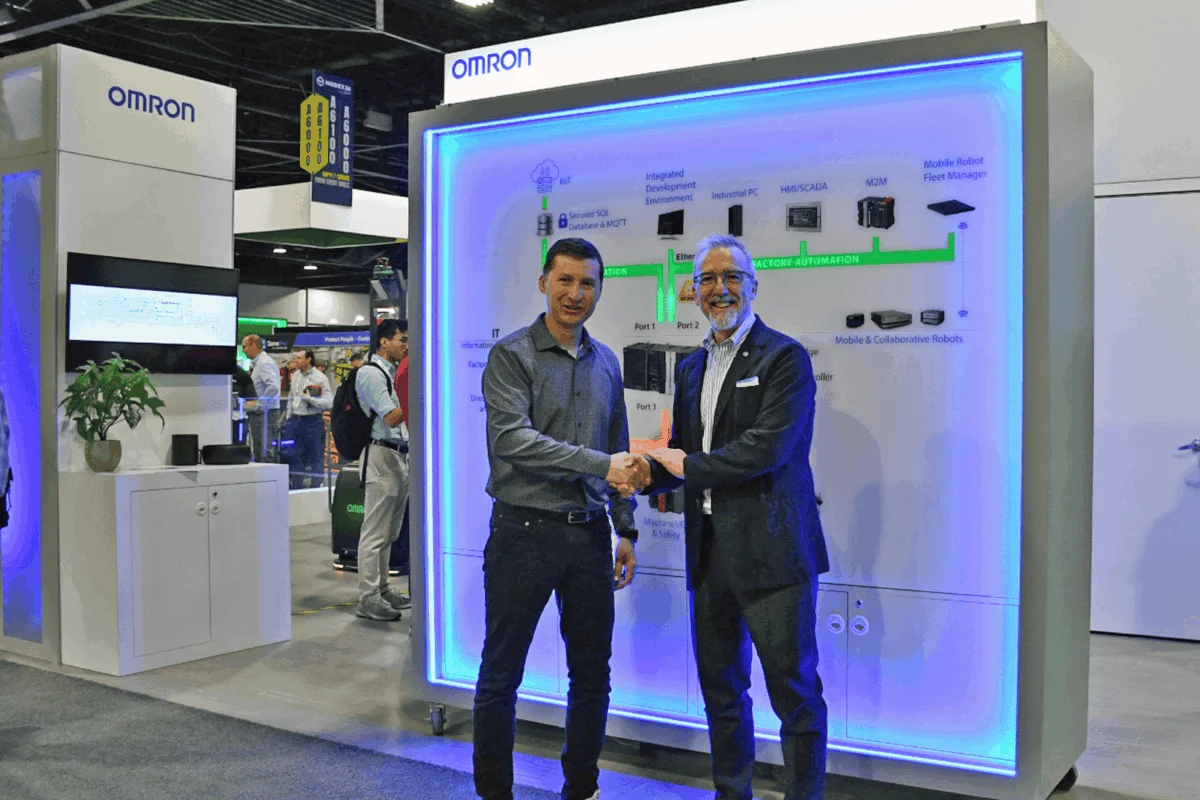
TURIN, Italy, and PLEASANTON, Calif. — May 11, 2026 — In a move poised to reshape the landscape of the global industrial automation sector, Comau, a Stellantis company and leader in advanced industrial automation, and OMRON Robotics, a titan in sensing and control technology, have officially announced a strategic partnership. The collaboration aims to accelerate the deployment of cutting-edge, flexible manufacturing solutions across the globe, addressing a critical pivot point in industrial evolution: the need for systems that are as adaptable as they are powerful.
This alliance brings together two industry heavyweights with distinct but highly complementary technological footprints. By integrating Comau’s robust robotics engineering with OMRON’s sophisticated suite of control and sensing technologies, the companies seek to solve the "complexity paradox" currently facing manufacturers: the requirement to produce highly customized goods at mass-production speeds while navigating increasingly volatile supply chains.
The Core Mandate: Bridging Automation and Agility
The primary objective of the partnership is to streamline the adoption of automation in sectors where precision and flexibility are non-negotiable. Specifically, the collaboration targets high-growth industries including electronics manufacturing, semiconductor fabrication, medical device production, and the rapidly evolving field of light industrial intralogistics.
As global manufacturing shifts away from rigid, single-purpose assembly lines toward modular, software-defined production, companies are finding that legacy hardware often struggles to keep pace. The Comau-OMRON partnership is designed to bridge this gap by providing an ecosystem where robotics hardware, advanced control algorithms, and intelligent software communicate seamlessly.
Chronology of the Strategic Alignment
While the formal announcement occurred on May 11, 2026, industry analysts suggest the groundwork for this collaboration has been developing over the past eighteen months.
- Q4 2024: Initial exploratory discussions between Comau and OMRON leadership regarding the convergence of robotics and AI-driven control systems.
- Q2 2025: Feasibility studies conducted in European and North American testbeds to determine the interoperability of Comau’s articulated robots with OMRON’s autonomous mobile robots (AMRs) and PLC-based controllers.
- Q1 2026: Finalization of the strategic partnership agreement, defining cross-selling channels and joint research and development (R&D) protocols.
- May 11, 2026: Public unveiling of the partnership, signaling an immediate shift in the competitive landscape of industrial automation.
This timeline reflects a deliberate, phased approach to integration, ensuring that the technology delivered to the market is not merely a "cobbled-together" solution but a unified, validated platform capable of meeting the stringent uptime requirements of modern factories.
Supporting Data: Why This Partnership Matters Now
The timing of this announcement is underscored by critical market trends. According to recent industrial automation research, the global market for smart manufacturing is expected to grow at a Compound Annual Growth Rate (CAGR) of over 12% through 2030. Several key factors drive this, all of which the Comau-OMRON partnership directly addresses:
- The Labor Gap: With an aging workforce and a shortage of skilled labor, manufacturers are under pressure to automate not just high-volume tasks, but also intricate, non-repetitive processes.
- Product Proliferation: Consumers demand higher levels of product personalization. This forces manufacturers to reduce batch sizes—a feat impossible without the kind of rapid-reconfiguration capabilities this partnership promises.
- Supply Chain Resiliency: The move toward "near-shoring" production means that factories are being built in regions where they previously did not exist. These new facilities require "plug-and-play" automation that can be deployed rapidly without the need for an army of external systems integrators.
By pooling their resources, Comau and OMRON are positioned to offer a "single-source" value proposition. Comau provides the mechanical strength and kinematic expertise for heavy-duty assembly, while OMRON provides the "nervous system"—the vision sensors, safety controllers, and mobile platforms that allow the robot to perceive and navigate its environment in real-time.
Official Perspectives: Aligning Vision with Execution
The leadership at both firms has emphasized that this is not merely a distribution agreement but a deep technical integration.
The Comau Perspective
Pietro Gorlier, CEO of Comau, framed the partnership as a critical component of the company’s long-term transformation. "This initiative is fully aligned with our strategy to expand Comau’s solution portfolio through high-impact partnerships," Gorlier stated. "By combining Comau’s robotics expertise with Omron’s complementary technologies and software capabilities, we enable the delivery of solutions that are easier to deploy, highly adaptable, and future-ready. This collaboration also strengthens Comau’s presence in high-growth sectors and new geographies, helping customers effectively manage increasing industrial complexity through reliable, safe, and scalable automation."
The OMRON Perspective
Olivier Welker, CEO of OMRON Robotics, echoed these sentiments, highlighting the shared culture of innovation. "Through this collaboration, we are bringing together two complementary portfolios with a shared focus on customer success," Welker remarked. "By aligning our expertise in robotics, applications, advanced control, and intelligent automation technologies, we can help manufacturers respond faster to changing market demands. Together, this new collaboration will allow us to deliver more flexible, connected, and sustainable production systems that support long-term growth for our customers."
Implications: A New Standard for Manufacturing?
The implications of this partnership extend far beyond the immediate product rollout. The industry is currently watching three specific areas where this synergy could shift market dynamics:
1. The Convergence of Hardware and Intelligence
Historically, manufacturers have had to buy "best-of-breed" components from disparate suppliers, leading to "integration hell"—where engineers spend more time debugging communication protocols between different brands than they do optimizing production. By co-engineering a unified interface between Comau’s robotics and OMRON’s control systems, the companies are essentially promising a "pre-validated" integration. This reduces the Total Cost of Ownership (TCO) for manufacturers and significantly shortens time-to-market for new production lines.
2. Deepening the Footprint in Semiconductors and Electronics
The semiconductor industry is currently undergoing massive expansion due to the global demand for AI-capable chips. These environments are notoriously difficult to automate due to the need for extreme clean-room standards and microscopic precision. OMRON’s leadership in sensing and Comau’s heritage in high-speed, high-accuracy robotics create a compelling argument for chip manufacturers looking to upgrade their facilities.
3. Sustainability and Resource Efficiency
Modern manufacturing is no longer just about speed; it is about energy efficiency and material waste reduction. Intelligent automation allows for "right-first-time" manufacturing, where sensors detect quality deviations in real-time, preventing the production of defective parts that consume raw materials and energy. The combined software-driven automation proposed by the partnership aims to provide the granular data necessary to track and minimize the carbon footprint of individual production cells.
Looking Ahead: The Future of the Partnership
As the partnership matures, industry observers expect the two firms to move toward "Software-as-a-Service" (SaaS) models for industrial maintenance and predictive analytics. By leveraging the data streams generated by the combined hardware, Comau and OMRON can provide their customers with deep insights into equipment health, potential bottlenecks, and throughput optimization.
Furthermore, the partnership serves as a platform for future joint initiatives. Both companies have signaled that this is the beginning of a broader roadmap. As artificial intelligence and machine learning become increasingly embedded in factory-floor hardware, the integration of OMRON’s sensing intelligence with Comau’s physical execution will likely become a benchmark for the industry.
For the manufacturer, the message is clear: the era of "dumb" automation is over. We have entered the age of the intelligent, adaptive, and highly connected factory. By joining forces, Comau and OMRON are not just keeping pace with this transition—they are setting the tempo. As global markets continue to face uncertainty, the ability to rapidly deploy, scale, and pivot production will be the defining trait of the next generation of industrial leaders. Through this alliance, the two companies have ensured that their clients are equipped with the tools necessary to thrive in this new, complex, and highly competitive landscape.