The deadlift is widely regarded as the "king of lifts." It is a fundamental movement pattern—a hinge—that serves as the ultimate litmus test for human strength. When performed correctly, it recruits the entire posterior chain, including the glutes, hamstrings, and erector spinae, while simultaneously engaging the lats, traps, core, and forearms. However, despite its apparent simplicity—picking an object up from the floor—the deadlift is a biomechanical puzzle that frequently leads to frustration, diminished returns, and, in the worst cases, debilitating injury.
For those looking to move past the plateau of mediocre performance, salvation has arrived in the form of world-class expertise. Sebastian Oreb, globally renowned as "The Australian Strength Coach," has opened his vault of technical secrets. Oreb is the architect behind the monumental success of Hafþór "Thor" Björnsson, the Icelandic colossus who has shattered world deadlift records under Oreb’s meticulous guidance.
Oreb’s philosophy is simple yet revolutionary: elite performance is not reserved for 400-pound giants. Whether you are an office worker looking to improve your posture or an aspiring powerlifter aiming for a new personal best (PR), the mechanical laws of the deadlift remain constant.
The Science of Efficiency: Why Technique Trumps Brute Force
In the realm of strength sports, the difference between a successful lift and a failed attempt often comes down to millimeters of positioning. Oreb emphasizes that many gym-goers approach the deadlift with an "ego-first" mentality, prioritizing weight over form. This leads to the "seesaw" deadlift—an inefficient, dangerous pattern where the barbell drifts away from the body, forcing the lifter to compensate with an arched lower back.
"This is the exact technical system used by the world’s greatest deadlifter," Oreb notes. "And before you think, ‘He’s a 200kg, 6-foot-9-inch Icelandic giant, so it doesn’t apply to me,’ think again. The techniques that he uses are the same techniques that I teach my daughter."
By dissecting the lift into three distinct phases—the stance, the arm engagement, and the initiation—Oreb has created a standardized system that minimizes mechanical disadvantage and maximizes power output.
Chronology of the Lift: A Step-by-Step Technical Breakdown
To understand the Oreb method, one must view the deadlift not as a pull, but as a sequence of deliberate, tension-filled movements.
Phase 1: The Foundation (Setting the Stance)
The most common error occurs before the lifter even touches the bar. Many athletes set up with the barbell too far away from their shins. When the bar is distant from the body, the hips must shift forward to compensate, creating a leverage disadvantage. As the weight leaves the floor, the bar inevitably rolls back toward the shins, causing the body to tilt forward and the lower back to take the brunt of the load.
Oreb mandates a hip-width stance with the barbell positioned directly over the midfoot. "The barbell is in line with my midfoot," Oreb explains. "That’s called the base of support. At maximal loads, that bar won’t leave the ground until it’s in line with my base of support." By centering the load, the lifter creates a vertical line of force, the shortest and most efficient path for the barbell to travel.
Phase 2: The Geometry of the Arms
Once the feet are set, the arms act as "hooks" rather than levers. Oreb warns against a stance that is too wide, as this forces the arms to angle outward, effectively shortening their length and increasing the distance the bar must travel.
Furthermore, Oreb identifies a catastrophic technical flaw: the "bicep bend." Many lifters instinctively bend their elbows before the weight leaves the floor to "take the slack" out of the bar. This is a recipe for a bicep tear. "If they’re bent, your biceps are on, and your biceps are not strong enough to deadlift what your back can deadlift," Oreb cautions. By keeping the arms straight and parallel to the outside of the legs, the lifter ensures the load is borne by the skeletal structure and the massive muscles of the back, not the fragile tendons of the arm.
Phase 3: The Initiation (The "Push")
Perhaps the most counterintuitive part of Oreb’s advice is the instruction to stop "pulling" and start "pushing."
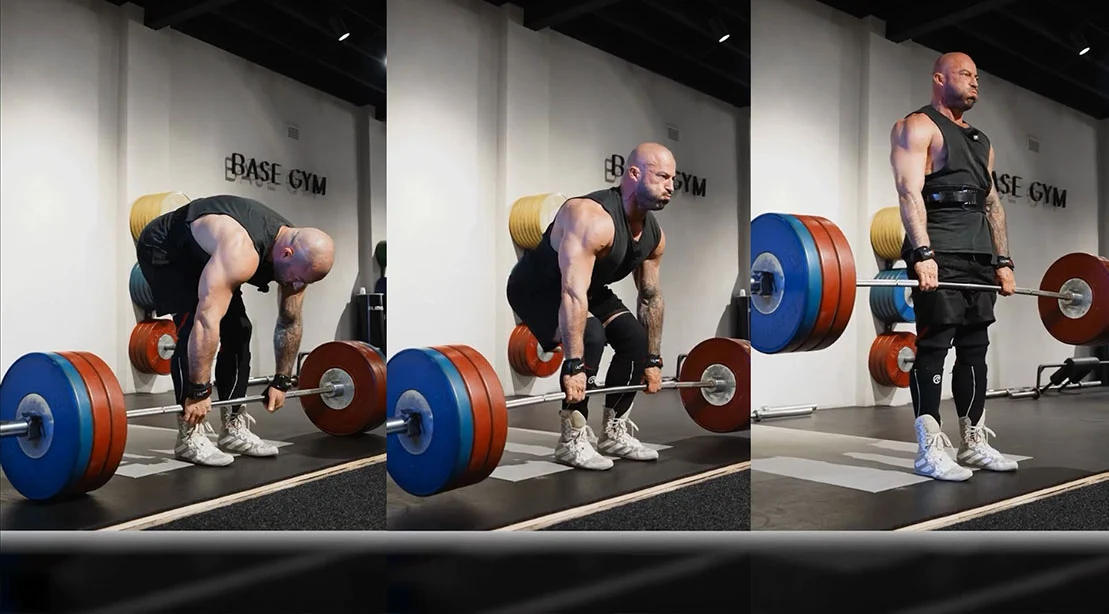
To find the perfect starting position, Oreb instructs lifters to lower their hips until their shins make gentle contact with the bar. "That’s as low as you should go," he says. The shins should kiss the bar, not shove it forward. Once contact is made, the lifter must engage the lats by pulling the armpits toward the pelvis—a cue often described as "crushing an orange in your armpit." Finally, with the head held high and the spine neutral, the lifter should take a deep, diaphragmatic breath to brace the core.
The mantra is clear: "Push the world away." By thinking of the lift as a leg press against the floor rather than a tug-of-war with the bar, the lifter creates a more stable, powerful drive.
Supporting Data: The Björnsson Precedent
The efficacy of Oreb’s system is best exemplified by his most famous student, Hafþór Björnsson. When Björnsson pulled an incredible 1,124 pounds (501kg) in 2020, the world was watching not just his size, but his precision. Under Oreb’s tutelage, Björnsson’s technique evolved from "strongman style" to a highly refined, efficient movement pattern.
Data from elite powerlifting circles suggests that standardized, high-tension setups—like those advocated by Oreb—reduce the risk of spinal shear forces. By keeping the center of mass over the midfoot and maintaining a neutral spine, lifters can handle significantly higher percentages of their one-rep max (1RM) without the structural breakdown often associated with heavy pulling. Oreb’s focus on the "midfoot base of support" mirrors the findings of biomechanical studies that define the most efficient deadlift path as a perfectly vertical line.
Official Responses and Professional Reception
The fitness community has responded to Oreb’s instructional content with overwhelming acclaim. Since the release of his detailed breakdowns on social media, professional coaches and amateur lifters alike have lauded the simplicity of his cues.
"One of the best deadlift technique videos I have ever seen," remarked a prominent strength trainer in a public forum. Another user noted, "I’ve been deadlifting for five years and never realized I was starting with the bar too far forward. The difference in my lockout speed was immediate."
Oreb’s ability to translate complex biomechanics into "gym-floor language" has bridged the gap between scientific theory and practical application. His focus on the "push" versus "pull" dichotomy has become a standard teaching point for many certified personal trainers who now incorporate the "Oreb method" into their client protocols.
Implications for the Future of Strength Training
The implications of Oreb’s teachings extend far beyond the record-breaking halls of the Strongman circuit. For the general population, the deadlift is a functional movement that dictates the ease of everyday tasks—from lifting groceries to moving furniture.
By refining the technique, lifters are less likely to experience the chronic lower-back pain that often turns people away from weightlifting. Oreb’s approach encourages a long-term view of health, prioritizing longevity and technical mastery over the "all-or-nothing" mentality that frequently leads to injury.
As we look toward the future of strength and conditioning, it is clear that the industry is shifting toward a more technical, calculated approach to training. Coaches like Sebastian Oreb are leading this shift, proving that the secret to becoming a "giant" in the gym isn’t just about how much you can lift, but how intelligently you lift it.
For those ready to refine their craft, the path is laid out. Whether you are aiming for a record-breaking pull or simply seeking to build a more resilient body, the principles remain the same: sort your stance, lengthen your arms, and push the world away. The bar is waiting.