The reality of modern environmental disaster management is that emergencies do not respect the calendar. When an oil spill or hazardous material leak occurs on a river during the dead of winter, responders are thrust into one of the most unforgiving environments on the planet. Operating on frozen or semi-frozen waterways—where swift currents churn beneath a deceptively thin crust of ice—requires a radical departure from standard spill response tactics.
For emergency personnel, the challenge is twofold: they must contain an environmental catastrophe while simultaneously managing the extreme physiological and physical risks posed by sub-zero temperatures and unstable ice. This report outlines the critical protocols, safety assessments, and operational strategies required to manage inland spills when the thermometer drops.
The Hazards of the Frozen Flow: Understanding the Environment
Inland spill response in cold weather is categorized by industry experts as "high-risk, low-tolerance" work. While spill response is inherently dangerous, the presence of ice introduces variables that can turn a manageable site into a life-threatening trap in seconds.
The Dynamics of River Ice
Unlike lake ice, which is relatively static, river ice is a volatile, shifting entity. The constant movement of water underneath the ice surface creates hydraulic pressure that can thin the ice from below, often in ways that are invisible to the naked eye. A responder breaking through the ice on a lake faces the danger of cold-water immersion; a responder breaking through on a river faces the added, lethal threat of being swept under the ice shelf by the current. Once under the ice, the chances of recovery drop to near zero. Consequently, the primary objective of any winter spill response is the total prevention of personnel-ice contact until a site-specific safety plan has been validated.
Chronology of Response: From Assessment to Containment
Effective winter response follows a rigid, non-negotiable timeline. Deviating from these procedural steps—often due to the "urge to act"—is the leading cause of responder accidents.
Phase 1: The Initial Size-Up
No personnel should set foot on an ice-covered waterway until a formal assessment has been completed. This size-up must include:
- Hydraulic Analysis: Determining current speed and river depth. High-velocity sections of the river are prioritized as "no-go" zones until proven otherwise.
- Structural Assessment: Evaluating ice thickness, consistency, and structural integrity.
- Load Calculation: Using the formula $P = 50 times T^2$ (where $P$ is capacity in lbs and $T$ is thickness in inches). While this provides a baseline, it must be adjusted downward by 15% to account for the instability of river currents, and by up to 50% if the surface is composed of "snow ice."
Phase 2: Site Preparation and Access
Once the assessment confirms the ice is viable, operations move to the preparation phase. This includes establishing secure access points, installing anti-slip measures on riverbanks, and utilizing weight-distribution platforms, such as 4×8 sheets of plywood, to prevent localized pressure fractures.
Phase 3: Active Response Operations
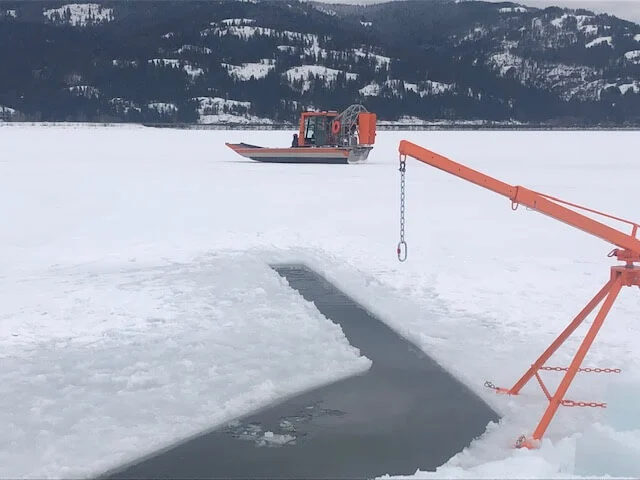
During the containment phase, the number of responders on the ice is strictly minimized. All individuals working on the ice must be belayed by a team positioned on stable ground or a verified platform. If the current is too strong or the ice too unpredictable, operations must pivot to boat-based platforms or airboats, which keep the responders off the ice entirely.
Supporting Data: Understanding Ice Characteristics
To manage a site, responders must be able to "read" the ice. Misidentifying the type of ice can lead to fatal miscalculations regarding load-bearing capacity.
- Lake/Clear Ice: Formed during rapid temperature drops, this is the strongest variety, appearing clear and reflective.
- Frazil Ice: An early-phase, slushy, disk-shaped ice that lacks any structural integrity.
- Candled Ice: Often deceptive, this ice appears thick but is structurally compromised, resembling a bundle of vertical rods. It is highly dangerous.
- Snow Ice: Opaque or milky in appearance, this forms when snow saturates and freezes on the surface. It is significantly weaker than clear ice.
- Anchor Ice: Submerged ice that forms on the riverbed. In winter, this can detach and float, creating ice jams that further complicate spill containment by trapping oil beneath the surface.
Official Protocols and Equipment Standards
The Department of Safety for cold-weather operations mandates specific personal protective equipment (PPE) and infrastructure to ensure the survival of the response team.
Essential PPE
Every responder on the ice must be equipped with:
- Thermal Protection: Drysuits are mandatory to prevent cold-shock response and hypothermia.
- Rescue Gear: Ice awls (for self-extraction), PFDs (rated for low-temperature use), and appropriate head, eye, and saw protection.
- Mobility: Ice cleats are required for all personnel moving on or near the banks.
The Warming Infrastructure
A successful response is impossible if the crew is suffering from the early stages of hypothermia. A dedicated warming tent or hut must be established immediately. This facility should be equipped with:
- Medical Readiness: EMS kits, AEDs, and medical-grade oxygen.
- Thermal Management: Portable heaters, sleeping cots, and an ample supply of dry PPE, including extra gloves and boots for rotation.
- Hypothermia Wraps: Specialized equipment to stabilize any responder who has suffered water exposure.
The Physiological Challenge: Wind Chill and Exposure
The danger of winter response is magnified by the wind chill index. The "feels like" temperature is a critical factor in determining how long a responder can work safely.
When temperatures drop into the single digits, the cooling effect of the wind can lead to frostbite on exposed skin in less than ten minutes. Safety managers must monitor wind speeds constantly. As the wind speed increases, the body loses heat at an exponential rate. During operations, the incident commander must implement a mandatory rotation schedule, pulling personnel off the ice before their dexterity or judgment is compromised by the cold.
Wind Chill Safety Tips
- Layering: Utilize moisture-wicking base layers to prevent sweat from freezing against the skin.
- Hydration: Cold weather suppresses the thirst reflex; responders must be forced to hydrate.
- Buddy System: Never work alone. Each responder must be responsible for visually monitoring their partner for signs of shivering, slurred speech, or confusion—all early indicators of hypothermia.
Implications for Future Spill Response
The increasing frequency of extreme weather events suggests that cold-weather spill response will become a more common requirement for environmental agencies. The implications for the industry are significant:
- Advanced Training: Standard hazmat training is insufficient for river ice environments. Specialized "Ice-Rescue" certifications for spill responders must become the industry standard.
- Investment in Technology: The use of remote-operated vehicles (ROVs) and drones for ice assessment and spill tracking can reduce the number of humans required to step onto the ice, significantly lowering the risk profile of future operations.
- Pre-Staging: Agencies must pre-stage cold-weather equipment in high-risk regions to ensure that the warming tents, ice augers, and specialized PPE are available within the first hour of an incident.
The Golden Rule of Ice Self-Rescue
If a responder does fall through the ice, the survival plan is the only thing that separates a close call from a fatality. The protocol is clear:
- Do not panic: Panic increases the heart rate and draws blood away from the core, accelerating hypothermia.
- Arms out: Extend arms onto the ice to prevent the body from sliding under the shelf.
- Kick to horizontal: Attempt to bring the body to a horizontal position to distribute weight.
- Use the Awls: Deploy ice awls to gain purchase and drag oneself back onto the ice surface using a "crawl-out" technique rather than standing immediately.
Conclusion
Responding to a spill on a frozen river is a battle against the elements as much as it is a technical containment operation. By prioritizing rigorous ice assessment, maintaining strict PPE protocols, and acknowledging the physiological limits of the human body, responders can mitigate the extreme risks of this environment. In the frozen wilderness of a winter spill, preparation is not merely a component of success—it is the only line of defense between the team and the unforgiving current beneath their feet.