Responding to oil and hazardous material spills is a formidable challenge under ideal conditions. When those operations move to riverbanks and frozen waterways during the depths of winter, the level of risk shifts from manageable to life-threatening. For first responders and environmental cleanup crews, the combination of sub-zero temperatures, shifting ice, and the relentless current of a river creates an unforgiving environment that demands rigorous adherence to specialized standard operating procedures (SOPs).
As inland spill response teams have encountered an uptick in winter-related incidents over the past two years, the industry is recalibrating its safety protocols. The mandate is clear: avoid ice work whenever possible. However, when the containment of a spill requires immediate action on a frozen surface, the margin for error effectively vanishes.
The Unique Hazards of River Ice Environments
The primary distinction between lake ice and river ice lies in the underlying dynamics. While lake ice remains largely static, river ice is subject to the continuous, abrasive force of flowing water beneath the surface. This current not only erodes the ice from below—often creating unpredictable thin spots—but also ensures that any responder who breaks through will be swept downstream, potentially pinned under the ice sheet.
This "dynamic" nature makes river ice exponentially more dangerous than static lake ice. The survival window for a responder submerged in moving, freezing water is measured in minutes, not hours. Consequently, the philosophy of winter spill response must be rooted in extreme caution: no personnel shall step onto the ice until a comprehensive, documented safety assessment and an actionable response plan have been finalized and reviewed by the on-site command.
Initial Size-Up: The Foundation of Safety
Before any equipment is deployed or a single step is taken onto the ice, the Incident Commander (IC) must execute a structured "Size-Up." This phase is non-negotiable and serves as the primary barrier between a successful containment operation and a multi-casualty tragedy.
Key Assessment Metrics
- Hydraulic Analysis: Responders must quantify the current speed. Swift currents accelerate ice erosion and complicate rescue efforts should a fall occur.
- Bathymetric Depth: Understanding the river’s depth is critical. Shallow areas may have "anchor ice" attached to the riverbed, while deep channels often have more turbulent, unstable currents beneath the surface.
- Ice Integrity Mapping: Thickness is only one variable. Responders must evaluate the quality and consistency of the ice—checking for crystalline structures, trapped air, or "candled" deterioration.
- Load-Bearing Calculations: Using the industry-standard formula (P=50 x T²), teams can estimate the load-bearing capacity of clear ice. For example, a 4-inch thickness provides an estimated 800 lbs of capacity. However, these figures are theoretical and must be heavily discounted.
- The 15% Rule: Always reduce capacity estimates by at least 15% to account for the instability of river currents.
- The Snow-Ice Penalty: If the ice is covered by snow, it acts as an insulator, preventing freezing and adding weight. Deduct an additional 50% from the capacity estimate when dealing with "snow ice."
Tactical Procedures for Ice Assessment
Judging ice strength by visual cues alone—such as color or temperature—is a fatal mistake. A holistic approach is required, supervised by an experienced Ice Rescue Instructor.
The procedure begins at the shoreline. Using a series of test holes drilled at regular intervals, responders should work outward from the bank. During this process, personnel must be belayed at all times. The use of weight-distributing platforms, such as 4×8 sheets of plywood, is strongly recommended to spread the load of the assessment team. Furthermore, an inflatable rescue craft must be staged and ready for immediate deployment should an assessment team member break through.
Identifying Ice Types
Understanding the "life cycle" of the ice is vital for identifying structural weaknesses:
- Lake Ice: Often clear and reflective; typically the strongest form if formed by rapid, sustained cold.
- Frazil Ice: A slushy, disk-shaped accumulation of ice crystals on the surface; the early stage of formation.
- Candled Ice: A dangerous, deteriorated state characterized by a whitish-gray color. It may appear thick but lacks the structural integrity to support weight.
- Snow Ice: Opaque and milky; formed when snow saturates and freezes onto the ice sheet. It is significantly weaker than clear ice.
- Anchor Ice: Forms on submerged debris; in rivers, this can cause blockages and ice jams, leading to unpredictable water pressure.
Operational Execution and PPE Requirements
Once the initial assessment is complete and deemed safe, operations transition into the mitigation phase. The goal is to minimize the number of personnel on the ice. If access is required, the team should improve walking routes by installing anti-slip matting on the banks and using plywood sheets to distribute weight on the ice surface.
Mandatory PPE for Winter Responders
Responders must be equipped with a specialized kit designed for both cold protection and self-rescue:
- Thermal/Waterproof Layers: Drysuits, insulated gloves, and waterproof boots.
- Safety Gear: Helmets, PFDs (Personal Flotation Devices), and ice cleats.
- Self-Rescue Tools: Ice awls must be carried at all times for immediate egress if a breakthrough occurs.
- PPE Maintenance: The team must have redundant sets of boots and gloves readily available; once gear becomes saturated with freezing water, its insulating properties fail, leading to rapid hypothermia.
The Buddy System and Redundancy
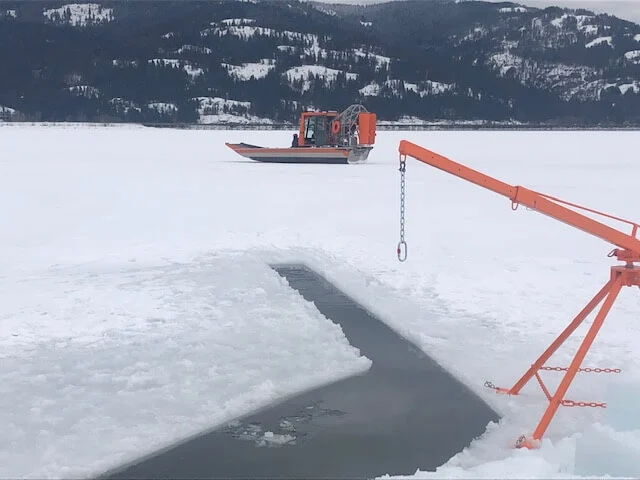
The buddy system is the absolute law of the frozen spill site. No responder should ever be out of sight or reach of a colleague. If the response requires cutting slots into the ice for skimmers or booms, these areas must be cordoned off with high-visibility fencing immediately. If the ice is deemed too unstable for foot traffic, responders must pivot to utilizing boats or airboats as stable working platforms.
First Aid and Warming Protocols
The threat of hypothermia is an ever-present enemy. A designated "Warming Tent" or heated mobile unit must be established at the perimeter of the incident zone. This facility should be equipped with:
- Hypothermia Wraps and Blankets.
- Advanced EMS Kits: Including AEDs and supplemental oxygen.
- Portable Heating Units: To ensure personnel can recover core body temperature.
- Dry Clothing: A stock of spare, high-warmth clothing for any personnel who experience a partial immersion or significant moisture exposure.
Surviving the Breakthrough: Immediate Self-Rescue
If a responder falls through, the primary objective is to resist the panic response. The survival plan should be ingrained in every team member through regular training:
- Maintain Flotation: Use the PFD to stay buoyant.
- Extend Limbs: Place arms out to the side of the ice shelf to distribute weight and prevent further submersion.
- Utilize Tools: Deploy ice awls to gain purchase on the surface, kicking the legs horizontally to create a "swimming" motion to crawl out.
- Roll Away: Once the torso is on the ice, do not stand up immediately. Roll away from the hole to distribute weight until reaching safer, thicker ice.
Environmental Factors: The Wind Chill Index
In northern climates, the actual air temperature is only half the story. The Wind Chill Temperature Index is a critical safety metric. As wind speeds increase, the rate of convective heat loss from the body accelerates. At low temperatures, high winds can lead to frostbite on exposed skin in less than a minute.
Safety officers must monitor weather forecasts continuously. If the wind chill drops below established safety thresholds, the IC must have the authority to suspend operations. The "Wind Chill Safety Tips" are clear: cover all exposed skin, limit time spent in exposed areas, and watch colleagues for signs of frostnip (whitening of the skin) or early-stage hypothermia (slurred speech, shivering, or lack of coordination).
Implications for Future Response
The increase in winter spills highlights the necessity for specialized training. Standard spill response certifications are insufficient for the unique hazards of frozen, moving water. Agencies must invest in ice-specific rescue training, cold-water immersion survival, and the deployment of specialized platforms like airboats.
Furthermore, communication remains the backbone of safety. A robust site safety plan must include a clear, redundant communication strategy, an updated hazard assessment, and a pre-planned medical evacuation route. When working on a frozen river, the environment is the enemy; through rigorous planning, standardized equipment, and an unwavering commitment to safety, responders can turn the tide against the cold.
As the industry continues to evolve, the integration of technology—such as drone-based ice assessment—may further reduce the need for humans to step onto the ice. Until then, the protocols established today remain the only shield against the unforgiving reality of the frozen, fast-water environment.