When the grunge icons of Soundgarden released their haunting 1994 anthem "Black Hole Sun," it was intended as a surreal, psychedelic meditation on existential dread. Three decades later, modern astrophysics has turned that metaphor into a startling physical reality. Scientists peering into the deepest, darkest corners of our early universe have identified a phenomenon that defies conventional stellar evolution: an object of immense proportions, roughly the size of our own solar system, glowing with a fierce, crimson intensity.
This discovery, detailed in a groundbreaking paper published this week in Nature, centers on a celestial anomaly dubbed *MoM-BH-1**. Observed through the unprecedented lens of the James Webb Space Telescope (JWST), this object has forced the scientific community to reconsider the fundamental building blocks of the nascent cosmos. Could these "black hole stars"—objects that appear to be stellar giants but are, in truth, devouring monsters—be the missing link in our understanding of how the universe matured?
The Chronology of a Cosmic Enigma
To understand the magnitude of this discovery, one must first grasp the temporal distance involved. MoM-BH*-1 originates from an epoch when the universe was a mere 660 million years old. To put this in perspective, our current universe is nearly 14 billion years old. We are looking at a snapshot of the "cosmic dawn," a period when the very first structures were struggling to take shape from the cooling embers of the Big Bang.
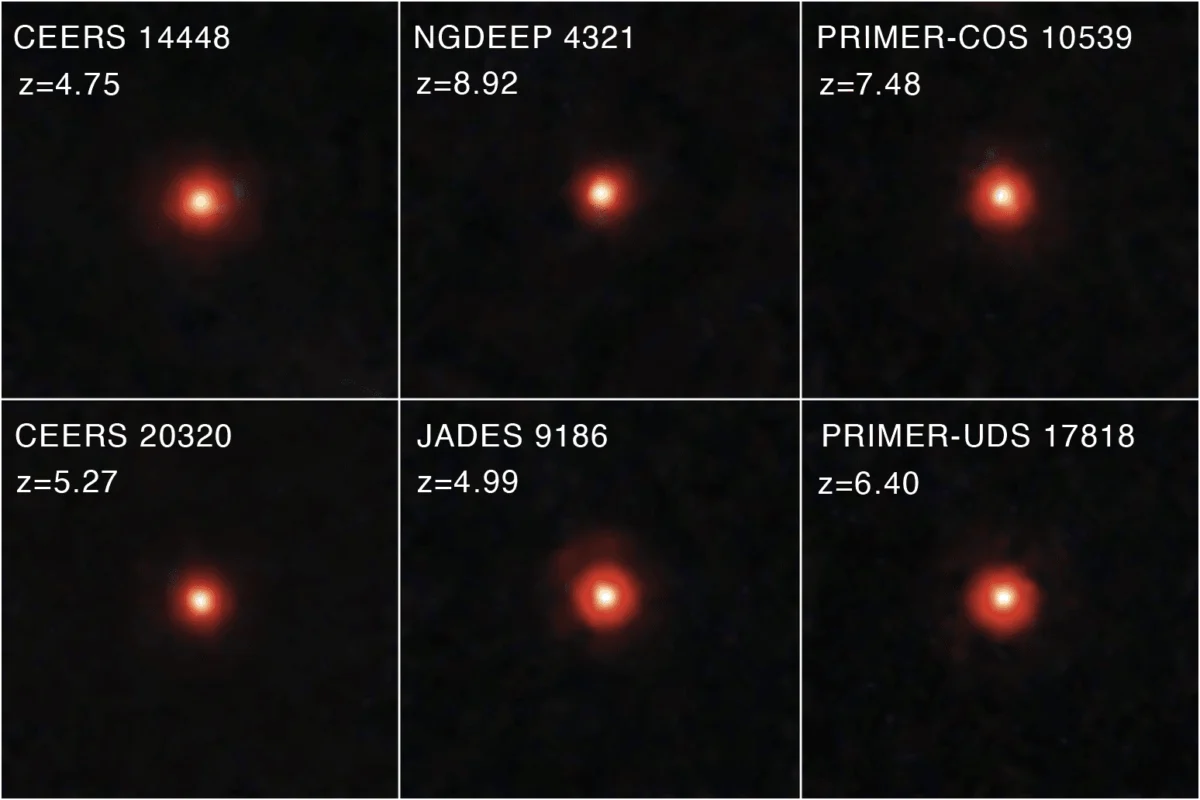
For years, astronomers have been puzzled by the presence of small, bright, reddish spots appearing in deep-field images captured by the JWST. These "little red dots" seemed out of place, not quite fitting the profile of early, compact galaxies or standard stellar clusters.
The research team, led by astrophysicist Rohan Naidu—who spearheaded the investigation while at MIT—began a systematic analysis of these signals. They realized that these objects were not merely background noise or camera artifacts, but distinct, energetic entities. By analyzing the light signatures emitted by these dots, the team observed that while they shared the "optical fingerprint" of massive stars, their behavior was fundamentally "wrong." They were too bright, too energetic, and too obscured by mysterious, dense gas to be conventional stellar bodies.
The Anatomy of MoM-BH*-1: A Star in Disguise
The designation "black hole star" might sound like a contradiction in terms—a linguistic oxymoron that defies the laws of physics. However, the data provided by the JWST suggests a sophisticated, albeit extreme, mechanism.
The Energy Paradox
The most striking evidence for the black hole star hypothesis lies in the sheer output of MoM-BH-1. According to the research team, this object radiates approximately 100 billion times more energy than any known star could possibly generate through standard nuclear fusion. In the life cycle of a star, energy is produced by fusing hydrogen into helium within the core. There is a "ceiling" to this process; once a star reaches a certain size, radiation pressure should theoretically blow it apart. MoM-BH-1 shatters this ceiling, suggesting an internal engine far more efficient—and violent—than fusion.
The Spectral Disappearance
Further intrigue arises from the way light behaves around this object. In standard astronomy, when we analyze the light of a star, we look for "absorption lines"—specific wavelengths that disappear because they are absorbed by the star’s atmosphere. MoM-BH*-1 exhibits these lines, but they are unnaturally deep and broad. The intensity of this absorption is so extreme that it cannot be explained by standard stellar dynamics. Scientists hypothesize that we are looking at a massive black hole at the center, surrounded by an impenetrable, gargantuan shroud of extremely dense, primordial gas. The light we see is the energy escaping through this gas, which "filters" the raw radiation into the deceptive glow of a star.
Supporting Data: Why the JWST is the Key
The JWST has been the primary architect of this new cosmological paradigm. Its infrared sensitivity allows it to peer through the thick veils of dust and gas that hid these objects from the Hubble Space Telescope.
The data confirms that MoM-BH*-1 is not just an outlier; it is part of a larger class of puzzling objects. The "red spot" phenomenon is becoming increasingly common in JWST datasets. Previously, researchers had categorized these dots as:

- Compact, Star-Bursting Galaxies: Extremely dense clusters of young, hot stars.
- Hidden Black Holes: Standard supermassive black holes obscured by cosmic dust.
- Exotic Systems: Structures that exist in the early universe but have no direct analogs in our local neighborhood.
The black hole star hypothesis sits at the intersection of these theories, suggesting that these objects represent a "transitional" state of matter in the early universe—a stage where supermassive black holes were actively feeding on the dense, gas-rich environments of the first galaxies.
Official Responses and Scientific Implications
The implications of this study are profound, touching upon the "how" and "why" of galaxy formation. The scientific community has reacted with a mix of cautious excitement and intense scrutiny.
"Every little red dot is consistent with being a black hole star, embedded in a generic early galaxy," Rohan Naidu noted in a press release. "But what is special about MoM-BH*-1 is that the black hole star is essentially completely outshining its surrounding host galaxy, such that we’re seeing pure black hole star light."
This outshining effect is crucial. It suggests that in the early universe, black holes were not just passive residents of galaxies; they were the dominant engines, potentially dictating the structural evolution of their host galaxies from the very beginning. If MoM-BH*-1 is indeed a black hole star, it implies that the rapid growth of black holes in the early universe was far more common than previously theorized.
Some researchers remain skeptical, suggesting that the "star" appearance might be an optical illusion caused by specific, rare configurations of dust and light. However, the Nature paper presents a compelling mathematical case, showing that the model of a black hole shrouded in a dense, luminous gas envelope fits the observed data points with a higher degree of statistical significance than any conventional model of star formation.
Future Frontiers: What Lies Ahead?
As astronomers continue to pore over the JWST data, the search for other MoM-BH*-1 candidates is intensifying. The goal is to determine if these objects are a universal feature of the early cosmos or a rare evolutionary anomaly.
If confirmed, the existence of black hole stars would fundamentally alter our timeline of the early universe. It would suggest that the first generation of galaxies may have been "lit up" not just by the birth of stars, but by the voracious, shimmering hunger of black holes masquerading as stars.
We are currently witnessing a shift in the standard model of cosmology. Just as Soundgarden sang of a "black hole sun" that would "wash away the rain," these ancient celestial objects may be washing away our outdated assumptions about the infancy of our universe. Each red dot, once considered a mere curiosity, is now a beacon pointing toward a more chaotic, energetic, and mysterious past than we ever dared to imagine.
As the James Webb Space Telescope continues its mission, the universe is proving that the truth is not only stranger than fiction, but often more luminous than the stars themselves. The era of the black hole star has only just begun.