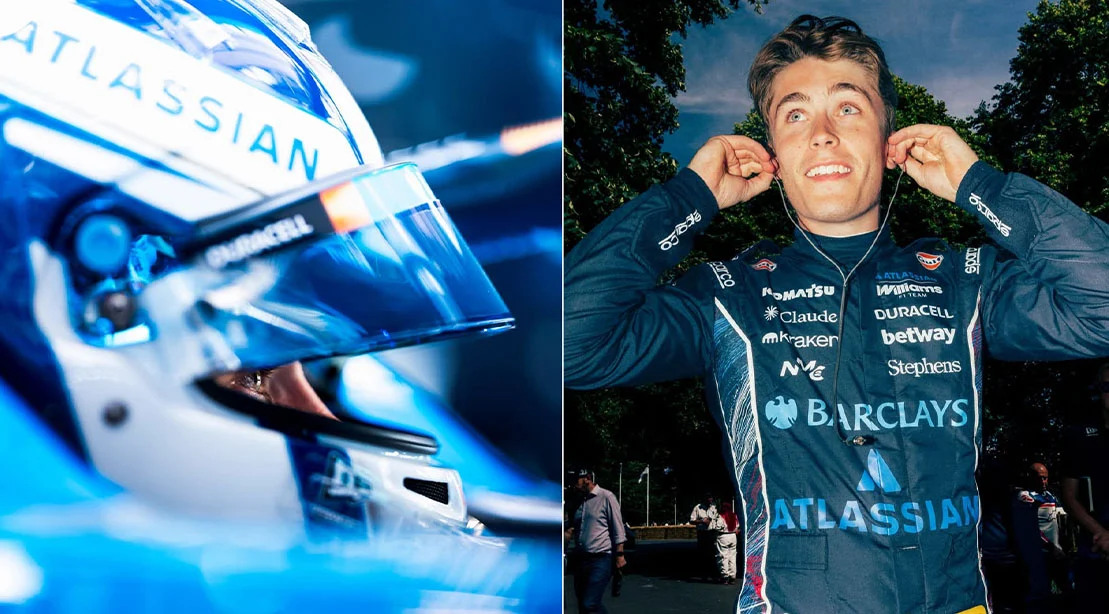
In the high-octane theater of modern motorsport, where a millisecond is the difference between a podium finish and obscurity, few rising stars possess the singular focus of Luke Browning. At 24 years old, the Chelsea-born phenom has established himself as one of the most versatile and resilient talents in global racing. Currently serving as the lead reserve driver for the Williams Racing Formula One team, Browning sits at the precipice of a full-time seat in the pinnacle of motorsport, balancing his personal competitive campaigns—including high-level stints in Super Formula—with the rigorous technical and physical demands of supporting Alex Albon and Carlos Sainz.
As he prepares to step into the FW48 for his second official free practice session at the historic Monza circuit, the Italian Grand Prix represents more than just a track appearance; it is a validation of a decade-long climb through the ranks. In an exclusive interview with Muscle & Fitness, Browning peels back the visor on the relentless training, the psychological fortitude, and the heritage of competition that have molded him into a top-tier athlete.
The Genesis of a Racer: A Life in Fast Forward
The narrative of Luke Browning is not one of sudden discovery, but of sustained, aggressive pursuit. Born in Chelsea, England, Browning’s introduction to speed was immediate. "Everything was a race since I was four or five years old," he recalls.
His early education in competition was unconventional and unforgiving, largely orchestrated by his father. Eschewing the modern tendency toward coddling, his father ensured that every victory was earned, never granted. "My dad is the most competitive man in the world, and he never let me win anything growing up," Browning says. "If I wanted to beat him, I had to be faster, smarter, and hungrier." This ethos of meritocracy became the bedrock of his character. By his mid-teens, the dynamics had shifted; the student had eclipsed the master, and the relentless pursuit of speed had transitioned from a childhood game to a professional calling.
From Two Wheels to Four: The Motocross Crucible
Browning’s early racing career began on dirt, not asphalt. Motocross provided a visceral, high-stakes environment that refined his reflexes and balance. However, the inherent volatility of the sport eventually hit a threshold. Following a significant accident, his mother intervened, mandating the sale of his motorcycle within the week.
Faced with a forced hiatus, Browning didn’t walk away from the track; he pivoted to the most complex and expensive discipline available: single-seater motor racing. "I chose the sport that was arguably the most difficult to get into," he reflects. "That want and desire to be the best was something that really took hold in motorsport."
Chronology of a Rising Star
Browning’s trajectory through the junior formulae has been nothing short of meteoric. His career serves as a masterclass in scaling the ladder of international racing:
- 2016: Recognized for his raw potential as a junior saloon driver, Browning secures the prestigious "Teen Racer of the Year" award, signaling his arrival as a name to watch.
- 2020: Browning dominates the F4 British Championship, securing the title and establishing himself as a force in open-wheel racing.
- 2022: The racing world takes formal notice as he is awarded the Aston Martin Autosport British Racing Driver’s Club (BRDC) award, an accolade reserved for the most promising young British talent.
- 2023: A landmark year. Browning wins the GB3 Championship and secures victory at the legendary Macau Grand Prix, a race historically viewed as the ultimate litmus test for future F1 stars.
- 2023–Present: Joins the Williams Racing Driver Academy. His role evolves from prospect to integral team member, providing technical feedback for F1 starters while maintaining his own active racing calendar.
- 2024: Continues his integration into the Williams F1 program, marked by scheduled practice sessions at iconic venues like Monza.
Physical Engineering: How Browning Preps for Pole Position
The common perception of a racing driver is one of a passenger sitting comfortably in a carbon-fiber tub. The reality is far more grueling. During a race, a driver’s heart rate can hover between 170 and 190 beats per minute for nearly two hours, all while enduring up to 5G of lateral force. Browning’s training regimen is designed to address the specific biomechanical stressors of the cockpit.
Neck and Shoulder Stability
The primary enemy of the Formula One driver is the weight of the helmet combined with high-frequency vibrations and cornering forces. "There are a lot of muscles in the neck," Browning explains. "For me, I wouldn’t do high loads."
Instead of traditional heavy lifting, which risks hypertrophy that could hinder agility, Browning focuses on endurance and stabilization. His routine centers on:
- Rotator Cuff Activation: Utilizing cable work to ensure shoulder stability.
- Isometric Holds: Practicing long holds on cable extensions to improve rotational strength at the end of a load.
- Pallof Presses: Using banded or cable resistance to train the core to resist rotational forces—a vital skill when fighting a car through high-speed chicane transitions.
- Time Under Tension: By prioritizing sustained movement over heavy weight, he builds the muscular endurance necessary to clear lactic acid from his neck during long races, preventing the "head drop" that plagues fatigued drivers.
The Cyclist’s Edge
Despite his transition away from motorbikes, cycling remains a cornerstone of Browning’s cardiovascular base. "If you’re sat in an aero position for a long time—an hour or an hour and a half—this builds up massive endurance down the back of your neck," he notes.
Beyond the physiological benefits, cycling provides a psychological escape. In a sport defined by data, sensors, and constant team communication, the quiet of a long ride serves as a vital tool for mental clarity and stress regulation. It allows the racer to "turn his mind off," essential for preventing burnout in a 24-race season.
The Karting Laboratory
Even as an F1-affiliated driver, Browning returns to the karting track regularly. This is not merely for fun; it is a high-intensity workout. By utilizing a heavier helmet during these sessions, he mimics the G-forces and physical resistance of a modern F1 car. He pushes through these laps until exhaustion, ensuring that when the lights go out on a Sunday, his physical endurance is the least of his concerns.
The Science of Sustenance: Nutrition and Recovery
Physical output is only as effective as the fuel powering it. Browning places immense emphasis on hydration and electrolyte management. "We undertake a process of pre-loading electrolytes well ahead of a race," he says. This is not a casual habit; it is a calculated medical strategy to ensure that cognitive function remains sharp under extreme dehydration.
He notes that the difference between a podium finish and a mid-pack result often hinges on mental clarity in the final ten laps. When minerals and fluids are balanced, his concentration holds firm, allowing him to execute tactical maneuvers while his competitors are suffering from the inevitable cognitive decline brought on by physical strain.
Official Perspective: The Williams Academy Mandate
The Williams Racing Driver Academy has been instrumental in refining Browning’s craft. For a young driver, the transition to F1 is not just about speed; it is about the ability to process vast amounts of telemetry data and communicate effectively with engineers.
"They’ve really looked after me and nurtured me," Browning says of the team. This relationship is a two-way street. While Williams provides the infrastructure and the opportunity to test in the FW48, Browning provides the team with consistent, high-fidelity data that assists in vehicle development. His upcoming practice session at the Italian Grand Prix is a testament to this trust. It is a high-pressure environment where the team evaluates not just his lap times, but his feedback on car balance and tire degradation.
Implications: The Road to the Grid
The path to a permanent Formula One seat is narrow and fraught with competition. However, Browning’s approach is defined by a philosophical acceptance of the grind. When asked about the monotony of maintaining such a strict lifestyle, he is refreshingly candid.
"I don’t particularly enjoy having to maintain this sort of stuff to be here," he admits. "But what I do enjoy is the feeling, when I get in the car, that I’m just as fit as anyone else, if not fitter. And therefore, when I get to the end of the race, I’m going to be able to perform when others aren’t."
This, in essence, is the "Browning Advantage." While others may be talented, his commitment to the invisible work—the neck stability exercises, the electrolyte tracking, the long, meditative cycles—gives him the edge in the final, grueling stages of a Grand Prix. As he readies himself for Monza, the sport watches with anticipation. Luke Browning is not merely waiting for his opportunity; he is methodically engineering himself to ensure that when the door to a permanent seat finally opens, he is the only choice the team needs to make.