Introduction: The Myth of the "Moisture-Managing" Fabric
During periods of high exertion, the human body acts as a biological furnace, often producing sweat faster than the atmosphere can facilitate evaporation. When this happens, liquid sweat accumulates on the skin, necessitating a secondary transport system: the base layer. For decades, outdoor enthusiasts have relied on the marketing promise of "moisture-managing" garments to solve this problem. However, a lingering question has persisted among gear experts and scientists alike: When skin is wet, where does that liquid actually go?
A recent series of exhaustive laboratory tests has sought to quantify the movement of liquid sweat through a simplified clothing system. By tracking how much water remains on the "skin," how much is retained by the base layer, and how much successfully migrates to the outer layer, we can finally move beyond marketing jargon to understand the underlying fluid dynamics. The results suggest that the performance gap between various base-layer fabrics is not merely a matter of material quality, but a complex struggle between capillary physics and mechanical pressure.
Chronology of the Investigation
The study, which began as a comparative evaluation of three base-layer garments, quickly expanded into an eight-fabric assessment to capture a broader spectrum of textile designs. The testing phase was structured to simulate the transition from dry conditions to high-exertion saturation.
- Phase One: Baseline Testing. Initial experiments focused on three standard fabrics to determine basic wicking capacity.
- Phase Two: Expansion. The scope was widened to eight fabrics, representing diverse material chemistries, including both synthetic hydrophobic and hydrophilic blends.
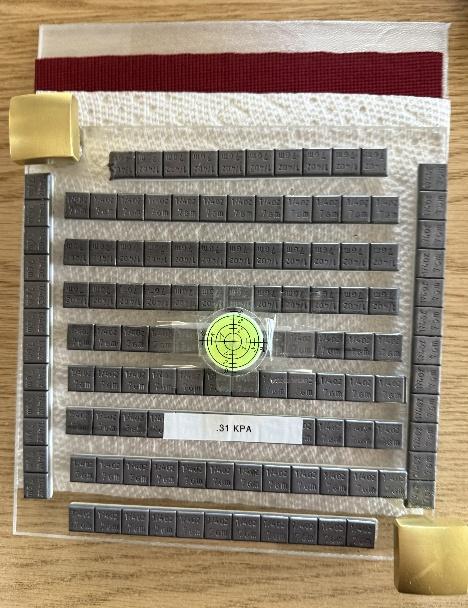
- Phase Three: The Liquid Transfer Test. A custom-built device (Figure 1) was engineered to measure the mass transfer of liquid water under controlled conditions. This allowed for the tracking of moisture migration in real-time.
- Phase Four: Data Synthesis. The results were cross-referenced with foundational physical principles—specifically the works of Young, Laplace, and Washburn—to explain why certain garments become saturated while others remain functional.
Supporting Data: The Physics of "Wetness"
The investigation utilized a custom testing apparatus—a grid of stacked metal plates designed to simulate skin-to-fabric contact. The data collected provides a scientific debunking of several common industry myths.
The Hydrophobic Paradox
Hydrophobic fabrics are frequently marketed as "staying dry" because their fibers do not absorb moisture. However, the study reveals that these fabrics can feel heavy, clammy, and saturated during intense activity. The reason is that textiles are essentially open structures; even if the fibers repel water, the pore spaces between them act as a reservoir.
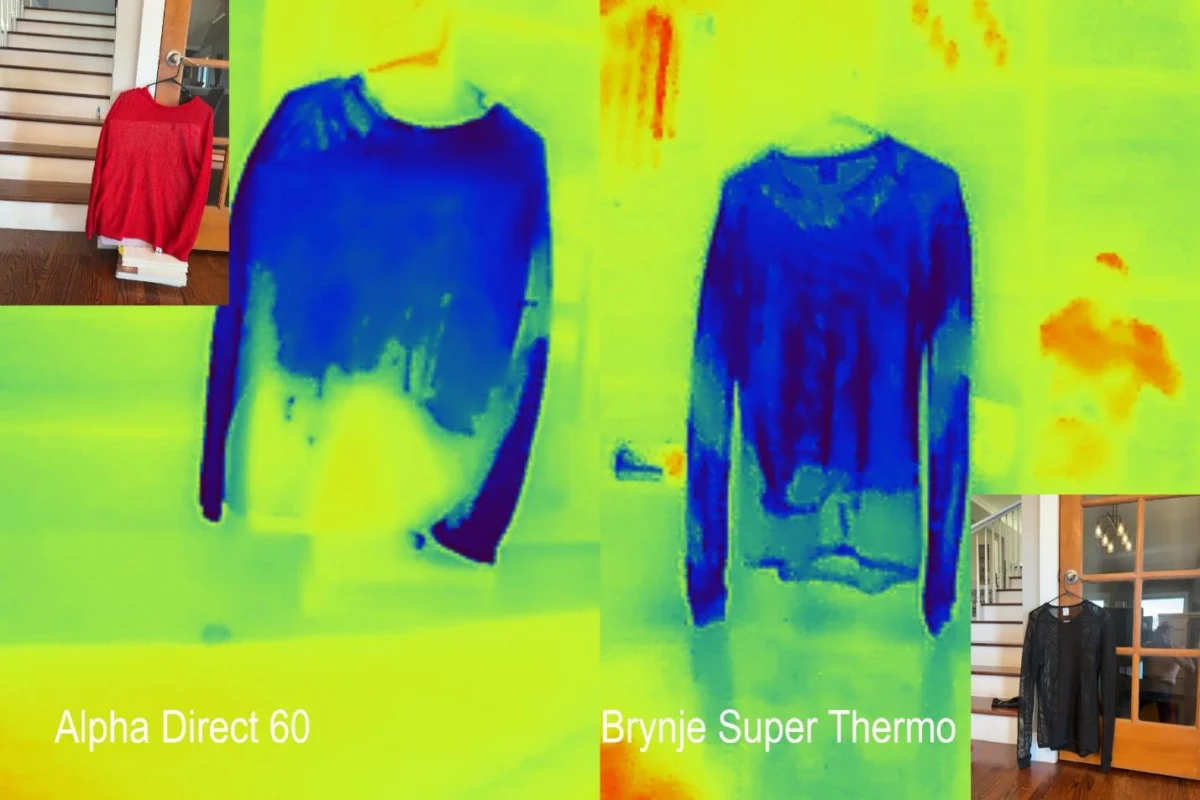
In infrared (IR) thermal imaging (Figure 2), we observed that hydrophobic garments—specifically mesh and high-loft synthetic fleeces—can retain significant quantities of liquid sweat. A Brynje mesh shirt, for instance, retained 87 grams of liquid, or 65% of its dry weight. This proves that a garment can be "hydrophobic" while still being physically wet.
Breakthrough Pressure and Laplace’s Law
The transition of water from the skin into a hydrophobic garment is governed by "breakthrough pressure." Unlike hydrophilic fabrics, which pull water via capillary action, hydrophobic fabrics resist water uptake until an external force (movement, pack straps, or body compression) exceeds the pressure threshold required to push water into the pores.
According to the Laplace equation, this pressure is determined by:
- Pore-opening size: Larger pores generally require lower breakthrough pressure.
- Contact angle: The degree to which a water droplet beads on the fiber surface. Higher contact angles (typically >90° for hydrophobic materials) indicate stronger resistance to wetting.
The Hydrophilic Limit
Hydrophilic fabrics, by contrast, excel at initial moisture absorption. They utilize capillary action to pull sweat away from the skin. However, the data highlights a significant drawback: the same forces that pull water in also make it difficult to pull water out. This creates a "competition" for moisture. When the receiving (outer) layer reaches a certain level of saturation, it can no longer draw water from the base layer. Consequently, the base layer holds onto the moisture, often leading to a "swampy" feeling against the skin.
Official Perspectives and Scientific Context
The findings of this study are rooted in the established scientific literature of fluid dynamics. The author emphasizes that these observations are consistent with the principles formulated by Thomas Young and Pierre-Simon Laplace in 1805, later refined by Edward Washburn in 1921.
Washburn’s equation describes the dynamics of capillary flow, providing a mathematical framework for why base layers behave the way they do. The author notes: "The results presented here apply to the eight fabrics tested. While I do not claim these findings extend to every textile on the market, the physical behaviors observed are consistent with the foundational science of porous materials."
Implications for Future Gear Selection
The study provides several critical takeaways for both manufacturers and consumers:
For the Consumer
- Avoid "Over-wicking" expectations: No base layer is a panacea. If the outer layers are saturated, the base layer will inevitably retain moisture, regardless of its chemistry.
- Understand your activity level: For high-intensity, stop-and-go activities, hydrophobic base layers with large, open-pore structures may perform better by resisting initial wetting, provided there is enough mechanical pressure to "pulse" the moisture outward.
- The "Clammy" Factor: If your garment feels heavy, it is likely that the pore spaces are filled with liquid. This is not a failure of the fiber chemistry, but a failure of the system to transport moisture faster than it is produced.
For the Industry
The findings imply that future textile development should focus less on fiber-level "wicking" and more on pore-network engineering. By controlling the size and connectivity of internal pathways, manufacturers can create garments that optimize the balance between moisture uptake and transfer. Furthermore, the reliance on "moisture management" as a blanket marketing term is revealed to be insufficient; future labeling should ideally specify the breakthrough pressure and storage capacity of the fabric.
Conclusion: A New Bar for Performance
This research fundamentally alters our understanding of base-layer function. By shifting the focus from the fibers themselves to the movement of liquid through the fabric’s architecture, we gain a much clearer picture of how to manage sweat in the field.
For the hiker or climber, the message is clear: performance is a dynamic process. Whether a garment keeps you dry is not just a function of the material, but of the interaction between your exertion level, the pressure applied by your gear, and the capacity of your clothing system to move water toward the outer environment. As we continue to refine these testing protocols, we move closer to a standard where performance is measured by physics, not by marketing brochures.
Summary of Key Findings
- Hydrophobic fabrics act as water barriers until an external pressure threshold is reached, at which point they can transfer water effectively.
- Hydrophilic fabrics provide immediate wicking but are prone to saturation due to their internal storage capacity.
- Systemic failure occurs when the receiving layer reaches its limit, causing moisture to back up into the base layer.
- Mechanical pressure—the result of movement and gear—is an overlooked, vital component in the moisture transport equation.