Introduction: The Physics of Perspiration
During periods of high exertion, the human body acts as a biological furnace. To regulate temperature, it initiates a cooling system: sweat production. However, during intense activity, the body often produces moisture faster than it can evaporate into the surrounding air. This leads to the accumulation of liquid sweat on the skin—the primary cause of the dreaded "clammy" feeling that plagues hikers, runners, and alpinists alike.
For years, the outdoor industry has relied on the catch-all term "moisture-wicking" to describe the performance of base-layer garments. But this label often masks a complex reality. Does a shirt that is labeled "moisture-wicking" actually move liquid water away from the skin, or does it simply absorb it, holding the moisture against your body like a sponge?
To answer this, I developed a specialized liquid transfer test. By simulating a multi-layer clothing system, this study tracks exactly where sweat goes when skin is wet, measuring how much water remains on the "skin" surface, how much is retained by the base layer, and how much successfully migrates to the next garment.
Chronology of the Study: From Three Fabrics to Eight
The project began several months ago as a small-scale evaluation of three distinct base-layer garments. Initial results revealed significant performance gaps, but the data raised more questions than it answered. To provide a comprehensive picture, I expanded the scope to eight fabrics, carefully selected to represent a broad spectrum of modern textile engineering.
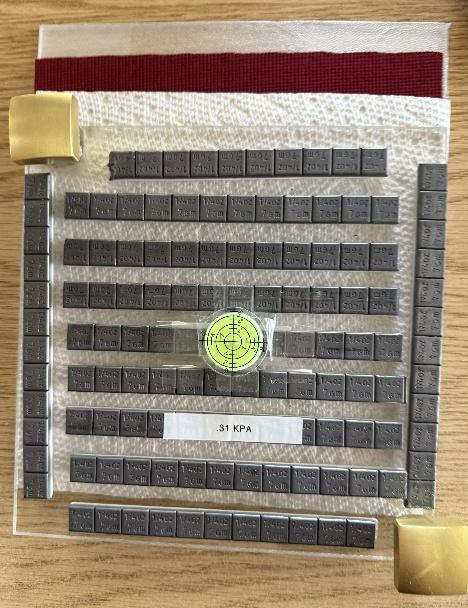
The testing process involved a bespoke device—a grid of stacked metal plates—designed to simulate the pressure and moisture-transport mechanics of a human body in motion. As the tests progressed, consistent patterns emerged, suggesting that the industry’s reliance on simple "wicking" metrics is outdated. We are now able to categorize how base layers behave once sweat transitions from vapor to liquid, providing a clearer, science-based framework for understanding garment performance under high-exertion conditions.
Supporting Data: The Science of Breakthrough Pressure
The study findings challenge two fundamental assumptions in the outdoor gear world: that hydrophobic fabrics are "dry" and that hydrophilic fabrics are always superior for moisture transport.
The Hydrophobic Paradox
Hydrophobic fabrics—often marketed as "staying dry"—are technically effective at repelling water. However, the study confirms that these fabrics can become just as heavy and clammy as their hydrophilic counterparts. Because fabrics are composed of fiber networks with significant interstitial space, liquid sweat can pool within the empty gaps of the garment.
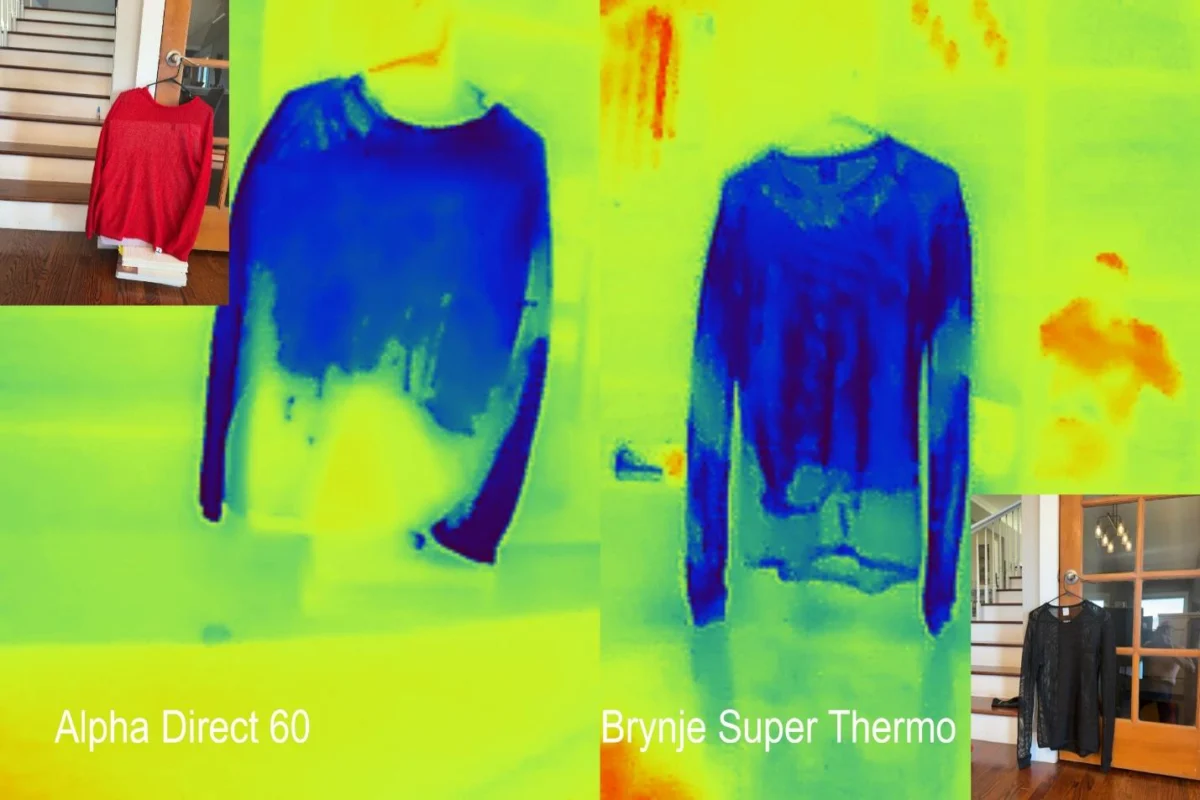
Using infrared imaging, I observed substantial water retention in hydrophobic layers. For instance, a Brynje mesh shirt retained 87 grams of sweat, while an Alpha Direct layer trapped 62 grams. The critical discovery here is the "breakthrough pressure." Hydrophobic fibers do not absorb water via capillary action; instead, they require external pressure—generated by pack straps, body movement, or garment tension—to force water through the pores of the fabric. Until that pressure threshold is reached, moisture simply sits on the skin.
The Hydrophilic Limit
Conversely, hydrophilic fabrics (such as wool or certain synthetic blends) excel at initial absorption. They use capillary action to pull moisture away from the skin. However, the data shows that this same strength is a liability: the forces that pull water in are the same forces that prevent it from leaving. If the receiving layer (the mid-layer) is already saturated or lacks sufficient drawing power, the hydrophilic base layer acts as a reservoir, trapping sweat against the skin.
Official Theoretical Framework
The conclusions of this study are grounded in established fluid dynamics, specifically the work of Young and Laplace (1805) and Washburn (1921). These foundational principles describe the behavior of liquid flow through porous media.
- Capillary Flow: Washburn’s equation explains how liquids move through fibrous structures based on the size of the pores and the surface energy of the fibers.
- Contact Angle: The contact angle—the angle at which a water droplet sits on a fiber—serves as the primary indicator of whether a fabric will "bead" water (hydrophobic, >90°) or "wick" it (hydrophilic, <90°).
My testing validates these principles, demonstrating that the largest pore openings generally reduce the breakthrough pressure required for fluid transfer. However, because textiles are three-dimensional, internal constrictions where yarns cross can complicate these calculations, making fiber geometry as important as chemistry.
Implications: What This Means for Your Gear
The implications of this research are significant for both manufacturers and end-users. The "moisture-wicking" label is no longer a sufficient metric for performance. Instead, consumers should look at how a garment manages liquid accumulation under pressure.
For the Consumer
If you are a high-output athlete, you must balance the "wicking" speed of a hydrophilic layer against its "holding" capacity. If you wear a heavy mid-layer that does not effectively pull moisture away, a highly hydrophilic base layer may actually keep you wetter than a hydrophobic mesh.
Conversely, for those who rely on hydrophobic layers, ensure your clothing system has enough "transfer potential"—meaning your outer layers are permeable enough to allow the moisture forced through by breakthrough pressure to escape into the atmosphere.
For Future Design
The results suggest that the "ideal" base layer is not one that purely absorbs or purely repels, but one that optimizes the pore structure to facilitate a one-way street for liquid moisture. Fabrics that combine a hydrophobic inner surface (to prevent skin-clinging) with a slightly hydrophilic outer surface (to encourage external wicking) represent the next frontier in textile innovation.
Conclusion: A New Standard for Performance
Understanding the "tug of war" between your skin, your base layer, and your mid-layer is essential for staying comfortable in the backcountry. By moving beyond the binary "wicking vs. non-wicking" conversation, this research provides a nuanced look at the physics of sweat.
When you are deep in the mountains, sweat is inevitable. But the ability of your gear to move that sweat away—or hold it against you—is a design choice that can fundamentally alter your performance and safety. As we continue to refine these tests, the goal remains the same: to turn the mystery of "wet gear" into a predictable, manageable science.
Appendix A: Summary of Findings
- Hydrophobic Saturation: Hydrophobic fabrics can hold significant liquid mass in their interstitial pores without the fibers themselves absorbing water.
- Pressure Dependency: In hydrophobic materials, moisture transport is a pressure-gated process. Without sufficient external force, the fabric acts as a barrier.
- The Hydrophilic Trap: Highly hydrophilic materials are excellent at pulling moisture off the skin, but they struggle to release that moisture to subsequent layers, especially when the outer system is saturated.
- Pore Geometry: Apparent pore size is a primary driver of breakthrough pressure, but internal fiber connectivity remains the critical variable in real-world moisture management.
Appendix B: Practical Advice for the Trail
- Layering Strategy: If you choose a hydrophilic base layer, ensure your mid-layer is highly breathable (like a grid fleece) to prevent moisture buildup.
- Compression Considerations: Remember that tight-fitting garments increase the pressure against your skin, which may lower the breakthrough pressure of a hydrophobic layer, potentially speeding up moisture transfer—or, if the layer is already saturated, forcing water back against the skin.