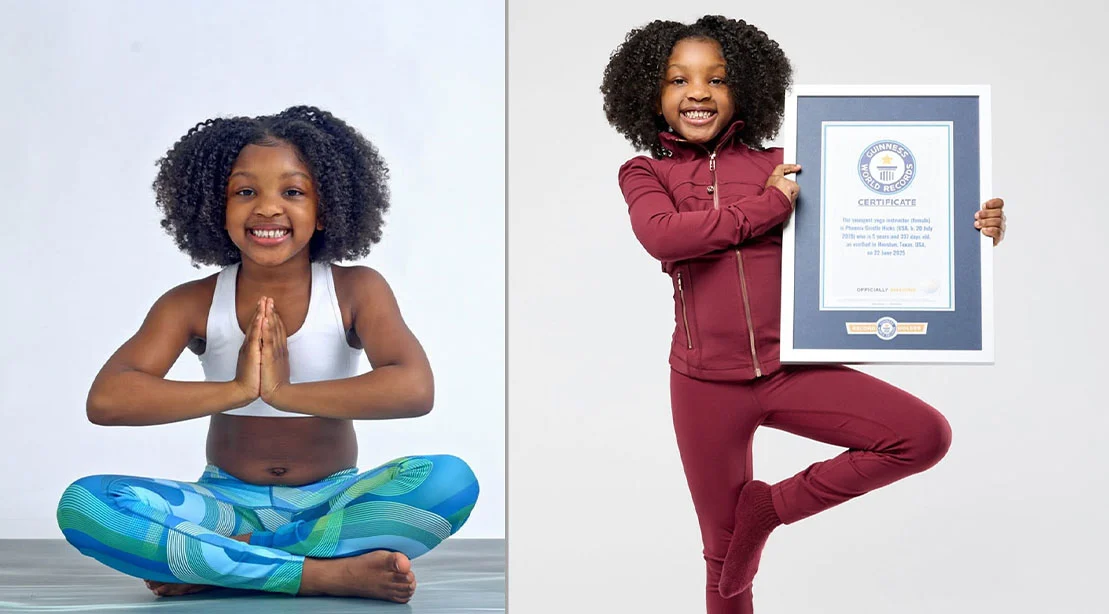
In a world where professional certification and physical mastery are typically associated with adulthood, one young prodigy is challenging every preconceived notion of capability. Phoenix Giselle, at just 5 years and 337 days old, has officially etched her name into the history books, earning a Guinness World Record as the youngest female yoga instructor in the world. Her achievement, now immortalized in the Guinness Book of World Records 2027, is more than just a novelty; it represents a rigorous commitment to a discipline that most adults find challenging to master in a lifetime.
The Genesis of a Record: A Journey of Discipline
The journey to becoming a certified yoga instructor is no small undertaking. It involves hundreds of hours of study, an intimate understanding of human anatomy, pedagogical practice, and personal mastery of asanas (postures) and pranayama (breath control). For the average trainee, this process is demanding; for a child not yet six years old, it is an extraordinary feat of cognitive and physical development.
Phoenix Giselle’s path began, as many childhood interests do, in the humble surroundings of a local "Mummy and Me" yoga class. What started as a bonding experience between mother and daughter quickly blossomed into a profound aptitude for the ancient practice. While most children her age were focused on playground games, Giselle was meticulously learning the nuances of alignment, the complexities of Sanskrit terminology, and the intricate, often dry, subject of human anatomy.
Chronology of a Remarkable Feat
The timeline of Giselle’s ascent to record-breaking status is defined by a level of focus rarely seen in early childhood development.
- The Early Introduction: Exposure to the practice began at a very young age, where she immediately gravitated toward the rhythmic nature of yoga, mimicking her mother’s movements with uncanny precision.
- The Commitment Phase: By the time she approached her fifth birthday, it became clear that her interest was not a passing phase. She officially enrolled in a 200-hour Registered Yoga Teacher (RYT) training program.
- The Training Rigor: For the duration of her certification, Giselle was often the only child in a room filled with adult aspirants. Her schedule was grueling: daily classes, independent study, theoretical examinations, and supervised practice teaching sessions.
- The Certification: At the age of 5 years and 337 days, she successfully met all the requirements, qualifying for the RYT-200 credential, the industry standard for professional yoga instructors.
- Official Recognition: Guinness World Records verified her achievement, officially crowning her the youngest female yoga instructor and cementing her status in the 2027 edition of their global registry.
Anatomy of the Training: Beyond the Mat
To understand the gravity of this achievement, one must look at the curriculum required for an RYT-200 certification. The training is comprehensive, covering subjects that would challenge most high school students, let alone a kindergartner.
The Educational Pillars
Giselle had to demonstrate competency in four core areas:
- Techniques, Training, and Practice: This involves the physical performance of poses, which requires high levels of flexibility, core strength, and proprioception.
- Teaching Methodology: This is the "art" of instruction—learning how to queue movements, adjust students safely, and manage the energy of a room.
- Anatomy and Physiology: A deep dive into the human musculoskeletal and nervous systems. Understanding how a specific pose impacts the body requires a level of biological literacy that is usually beyond the developmental stage of a five-year-old.
- Yoga Philosophy, Lifestyle, and Ethics: A study of the history and ethics of yoga, requiring strong reading comprehension and analytical skills.
"I had to read a lot of books," Giselle recalled in an interview with Guinness World Records. "I had to learn about anatomy, take classes daily, write papers, and complete practice teaching hours." These words highlight that her success was not a byproduct of chance or "child prodigy" luck, but the result of sustained, repetitive, and intentional labor.
The Philosophy of the Young Guru
What makes Phoenix Giselle’s story particularly compelling is not just her technical proficiency, but her emotional intelligence regarding the practice. Yoga is often perceived as a meditative tool for stress relief—a sentiment that Giselle seems to grasp better than many of her adult counterparts.
"When I’m teaching yoga, I feel honored and proud that people allow me to lead them," she notes. This statement reflects a level of maturity that bridges the gap between teacher and student, regardless of age. She approaches her classes with an ethos of inclusivity and patience.
Her favorite pose, the Tree Pose (Vrksasana), serves as a metaphor for her own philosophy. "It’s fun to practice balancing and can be a little tricky at times," she explains. When asked about the inevitable struggle of a student falling out of a pose, her response is one of radical self-compassion: "It’s okay if you wobble or fall. Just try your best." This mantra is the cornerstone of effective yoga instruction, emphasizing the journey over the destination.
Official Responses and the Global Impact
The fitness community has responded to the announcement with a mixture of awe and professional intrigue. Organizations like the Yoga Alliance have long debated the age requirements for certification, but Giselle’s success has forced a conversation about the intersection of developmental psychology and physical discipline.
By achieving this milestone, Giselle has become an ambassador for youth health and wellness. Her influence extends beyond the mat; she has moved into the realm of authorship with her book, BREATHE. The book is designed to translate the complex benefits of yoga into a language that children can understand. As she told her followers on social media, "I wrote BREATHE to help children discover the power within their breath."
The Implications: A New Era for Youth Fitness
The success of Phoenix Giselle raises significant questions about the future of youth sports and extracurricular disciplines.
1. Re-evaluating Developmental Potential
We are seeing an era where children are increasingly capable of high-level specialization. Whether in coding, mathematics, or, in this case, physical arts, the traditional barriers based on age are becoming porous. Giselle’s journey suggests that when children are given the right environment and guidance, their capacity to learn complex systems is significantly higher than previously estimated.
2. The Role of Parental Guidance
The "Mummy and Me" origin of her training highlights the critical role of parental support in fostering talent. The dynamic between the mother and daughter, which Giselle describes as "fun," suggests that the key to her success was the absence of pressure. Instead, the training was framed as a shared journey of discovery, allowing her to retain the joy of the practice while pursuing the rigor of the certification.
3. The Future of Wellness
As a generation of children grows up with access to mindfulness and yoga, the long-term public health implications could be profound. A generation that understands the "power of the breath" at age six is a generation that may be better equipped to handle the stresses of adulthood.
Conclusion: The Path Ahead
Phoenix Giselle is no longer just a record holder; she is a trailblazer in the wellness industry. Her transition from a curious child in a local studio to a globally recognized authority on yoga is a testament to the power of focus, passion, and the guidance of those who foster our potential.
As she continues to grow, her influence on the yoga community will likely continue to expand. Whether she chooses to pursue professional teaching as a lifelong career or views this as the first chapter in a much larger story of personal development, one thing is certain: she has fundamentally shifted the standard for what we expect from the next generation.
In a world that often demands we rush to grow up, Phoenix Giselle reminds us that the most important lessons—like finding balance, embracing the wobble, and learning to breathe—are universal. For those looking to follow her journey or find inspiration in her work, she remains an active voice on social media, continuing to share her practice with the world, one breath at a time. Her story remains a powerful reminder that while we may start small, the potential for impact knows no age limit.