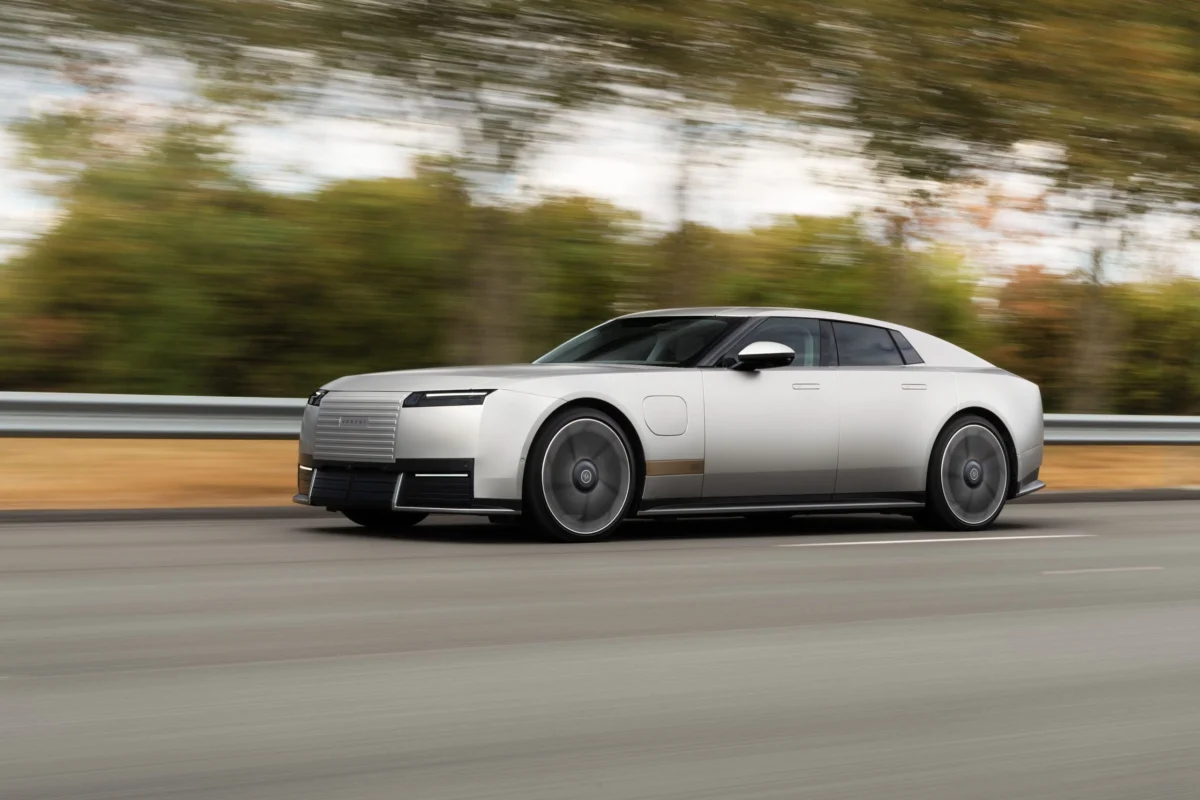
The automotive industry is no stranger to radical pivots, but few have been as turbulent, polarizing, or audacious as Jaguar’s current trajectory. After a 90-year legacy defined by internal combustion, leather-clad luxury, and a distinctly British aesthetic, Jaguar has officially pulled the curtain back on the Type 01—a vehicle that serves as the cornerstone of the brand’s all-electric future. Following a controversial rebrand and the unveiling of a prototype that ignited a firestorm of online criticism, the production-ready Type 01 represents a make-or-break moment for one of the world’s most storied manufacturers.
The Chronology of a Controversial Rebirth
Jaguar’s journey toward its current state began in earnest in November 2024. The company signaled its intent with a bold, almost provocative rebrand that notably excluded any mention of its heritage or its existing vehicle lineup. By December, the curtain was lifted on the Type 00 prototype, a design study so divisive it effectively fractured the automotive community.
The reaction was immediate and, at times, vitriolic. While some design purists lauded the audacity of the new direction, others viewed it as an existential betrayal of Jaguar’s storied lineage. The backlash became so intense that members of Jaguar’s own staff were targeted by angry traditionalists. This period of turmoil saw significant leadership churn, most notably the departure of JLR’s chief creative officer, Gerry McGovern—the architect behind the new design language and the controversial "no-car" marketing campaign.
Despite the "shitstorm," as Managing Director Rawdon Glover has candidly referred to it, the leadership team remained unflappable. Throughout a hiatus in production that saw the brand sell no new vehicles for an extended period, the mission remained clear: to refine the vision into a tangible reality. That reality manifested this past Tuesday in New York City, where the Type 01—the final, production-ready iteration of the Type 00—was unveiled to the world.
Engineering the "Impossible": Design and Performance Specs
The Type 01 is, by every metric, a statement piece. Jaguar’s design philosophy aims to create a grand tourer that "never arrives unnoticed." The production model maintains the dramatic silhouettes of the prototype: a low roofline, elongated rear overhangs, an expansive hood, and striking 23-inch wheels.
Perhaps the most significant technical achievement is the car’s aerodynamics. Despite its imposing dimensions—5,235 mm in length and 1,403 mm in height—the Type 01 achieves a drag coefficient of 0.23 Cd, a feat made possible by active vanes, a deployable spoiler, and sophisticated airflow management.
Performance Data at a Glance
- Powertrain: Tri-motor setup (one 260-kW front motor, dual 310-kW rear motors).
- Total Output: 1,030 PS (Pferdestärke) and 1,365 Nm of torque.
- Acceleration: 0 to 62 mph in 3.2 seconds; 62 to 112 mph in a further 4 seconds.
- Charging: 850-volt architecture; 118-kWh usable battery.
- Range: Up to 400 miles (EPA) / 450 miles (WLTP).
- Charging Speed: Up to 200 miles of range added in 13 minutes via 350-kW DC fast charging.
A standout manufacturing achievement is what Jaguar calls the "impossible panel"—a single, unbroken body piece running over 3 meters from the A-pillar to the rear. With five distinct, acute angles, the panel was deemed impossible by standard modeling systems. It required 22 weeks of development and 1,500 hours of labor—reportedly requiring the return of a retired specialist—to bring the piece to production reality.
Inside the Cabin: A Digital Sanctuary
If the exterior is meant to provoke, the interior is meant to coddle. The cabin is dominated by a central spine that creates distinct zones for each occupant, accented by "brass-inspired" finishes. In a move that continues the trend of modern luxury, Jaguar has opted for a minimalist, screen-heavy interface. A 24-inch OLED display serves as the primary driver interface, while a 7-inch smartphone-style touchscreen handles climate and audio.
In a controversial move for traditionalists, the car features no physical switchgear. Comfort is prioritized through "hot stone massage" seats and an advanced air purification system that removes toxins and allergens, complemented by a customizable fragrance diffuser. Perhaps the most striking departure from tradition is the lack of a rear windscreen; in its place is a digital "ClearSight" rearview display, positioned at the same height as the door mirrors to mitigate the focal-adjustment strain typically associated with camera-based rear visibility.
The Strategy: Navigating the Luxury EV "Goldilocks Zone"
Jaguar’s pricing strategy for the Type 01 is arguably its most critical maneuver. Starting at approximately $170,000 (£130,000), the brand is positioning the vehicle in a "Goldilocks zone." It is priced well above the premium mass market but remains below the astronomical entry points of ultra-luxury marques like Ferrari or Lamborghini.
Managing Director Rawdon Glover believes this positioning is the key to escaping the "commodity trap" of electric vehicles. "The best way to do that is not to play into the tropes of EVs," Glover states. "You’re not going to get there because it’s an electric car. You’re going to get there because the car itself looks a certain way, feels a certain way, drives a certain way."
Competitive Landscape
The luxury EV space has been a graveyard for ambition. Mercedes-Benz has struggled, while Porsche and others have found the transition to be a steep climb. Even as legacy European brands grapple with these hurdles, the rise of Chinese automotive giants—such as Li Auto, XPeng, and Xiaomi—has changed the game. While Glover acknowledges that these brands are masters of technology and feature-per-dollar value, he maintains that Jaguar’s edge lies in its heritage and its ability to offer a "cultural experience" rather than just a technological one.
Implications: A New Identity or a Lost Legacy?
The ultimate test for the Type 01 will be its ability to capture a new, younger, and more diverse demographic. Glover has openly stated that the car is intended for a customer base that is "independently minded" and "creative," moving away from the stereotypical image of the traditional Jaguar owner.
However, the question remains: can a brand so deeply rooted in history successfully pivot to a future that seems to intentionally shed that history? The "impossible panel" and the sheer engineering prowess of the Type 01 demonstrate that the company’s technical capability remains at the pinnacle of the industry. Yet, the brand’s success over the next two years will be measured not by patent filings or aerodynamic drag coefficients, but by its cultural resonance.
"Success will be that we’ve established ourselves at the [new] price point," says Glover. "People are saying, ‘Yep, Jaguar is worth paying more for.’"
For Jaguar, the Type 01 is more than a car; it is a declaration of intent. It is a bold, risky, and technologically sophisticated attempt to prove that a 90-year-old brand can rewrite its own DNA. Whether the market is ready to follow them into this new, electrified, and high-priced future remains to be seen, but one thing is certain: in the world of high-end automotive design, silence is no longer an option. Jaguar has made its noise, and now it must wait to see if the world will listen.