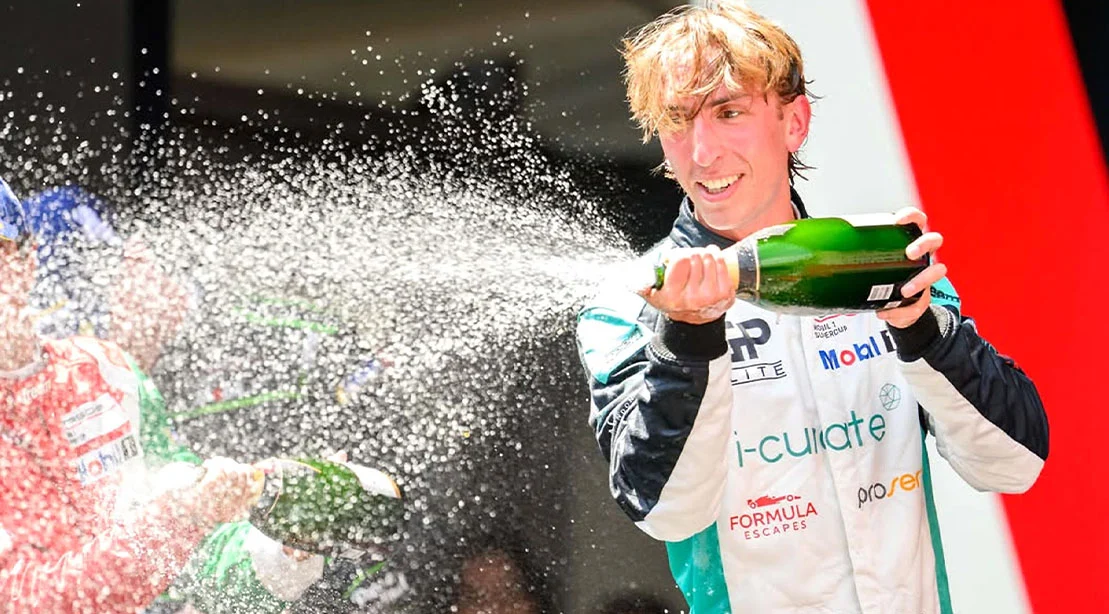
For the modern professional athlete, the adage that "the journey is the destination" is often a hollow sentiment—a platitude reserved for post-match interviews. For British Porsche racer Gustav Burton, however, it is a daily reality. While the 2018 Renault Clio Cup UK Junior champion and 2021 British GT (GT4 Silver) winner possesses the raw talent and tactical acumen to compete with the global elite, he faces a hurdle that is as grueling as any hairpin turn: the volatile economics of high-end motorsport.
In a sport where entry fees, logistics, and technical maintenance can reach astronomical figures, Burton has found himself at a crossroads. Rather than succumbing to the traditional, often stagnant, corporate sponsorship model, the 6’4” racer has opted to disrupt the industry, turning his community into his greatest asset.
The Brutal Reality of the Porsche Supercup
To understand the stakes, one must first understand the environment. Competing in the Porsche Supercup is not merely a test of driving skill; it is an endurance trial of human physiology. Drivers regularly face cockpit temperatures exceeding 140°F (60°C). During a race, a driver endures sustained, intense G-forces that demand elite-level core and limb strength.
"Whilst undergoing G-forces, you’re holding your left foot on the brake and your right foot next to the throttle," Burton explains to Muscle & Fitness. "Imagine swerving in your car as hard as you possibly can; that’s basically what we’re doing constantly for 30 or 40 minutes in a race. It works every muscle in your body."
The physical requirements extend beyond the legs. With a racing helmet weighing approximately 11 pounds, the neck and shoulder stability must be ironclad. Burton utilizes a regimen of reverse flies, front raises, and standing rows to build the necessary endurance to prevent fatigue from compromising his performance on the track. Furthermore, the sport requires meticulous weight management. Because the vehicle’s minimum weight includes the driver, every gram matters. "After every session, we go straight to the scales with our helmet," Burton notes. "If you don’t, you open yourself up to disqualification."
Chronology of a Racing Career: From Junior Titles to Global Stages
Burton’s trajectory has been marked by consistent, high-level success, even as he navigated the financial instability that plagues privateer drivers.
- 2018: Burton announces his presence on the national stage by clinching the Renault Clio Cup UK Junior title, showcasing a maturity behind the wheel that belied his age.
- 2021: He elevates his status by winning the British GT Championship (GT4 Silver), cementing his reputation as a driver capable of managing complex race strategy and tire preservation.
- 2024: Burton achieves a significant milestone, winning the Porsche Sixt Carrera Cup Germany, a series known for its high density of professional talent.
- September 2026: Facing a funding shortfall just days before the Monza round of the Porsche Mobil 1 Supercup, Burton launches an unconventional, community-led crowdfunding campaign that ultimately secures his seat.
The Disruption: Democratizing Sponsorship
For years, the pathway to professional racing was binary: either you were a factory driver with a full contract from a manufacturer like Porsche, or you were a "pay-to-play" driver reliant on large corporate entities. Burton, however, is pivoting.
"If you’d asked me three years ago what my goal was, it would be to become a factory driver," Burton admits. "That’s the dream—Porsche gives you a contract, you’re employed, and you don’t have to worry about sponsorship. But now that my social media following is growing, I see a different path. I want to be self-employed, growing our brand awareness and a genuine community."
When promises from traditional sponsors fell through just weeks before the Monza event, Burton did not retreat. Instead, he leaned into his role as a creator. Through his BackSeat Drivers podcast and his personal social media channels, he effectively "micro-sliced" the cost of racing. By offering "mini sponsorships" starting at as little as $13.50, he allowed his fanbase to participate in his career directly. The response was immediate and overwhelming.
Supporting Data: The Economics of the Track
The financial burden of the Porsche Supercup is not an exaggeration. A single season can cost hundreds of thousands of dollars, covering everything from tires and fuel to track time and logistical support for a crew. By decentralizing his funding, Burton has achieved what many professional organizations struggle to do: he has converted passive viewers into active stakeholders.
This model is not just about survival; it is about building a sustainable business. By controlling his own brand, Burton is no longer beholden to the whims of a single corporate partner. He has diversified his risk, creating a resilient economic ecosystem that allows him to focus on the technical aspects of racing—data analysis, simulator training, and physical conditioning—rather than the anxiety of impending bankruptcy.
Official Responses and Strategic Partnerships
The climax of Burton’s most recent financial battle occurred just days before the Monza race. As he waited on pins and needles to see if the community-led effort would suffice, a significant contribution from Formula Escapes acted as the final catalyst.
"This crowdfunding was an absolute last-ditch effort," Burton shared in a post-race update. "We f***ing succeeded. I cannot believe it… We’re going to Monza!"
The contribution from Formula Escapes, coupled with the sheer volume of individual micro-sponsorships, serves as a proof-of-concept for the "Creator-Athlete" model. It highlights a shift in how sports marketing is evolving; fans are no longer content to be mere spectators. They are increasingly willing to invest in the individual stories of the athletes they follow, provided those athletes remain transparent about the challenges they face.
Implications for the Future of Motorsport
Burton’s journey to Monza is more than a feel-good story; it is a blueprint for the future of privateer racing. As traditional advertising budgets fluctuate, athletes who can cultivate a loyal, engaged digital audience will have a significant competitive advantage over those who rely solely on legacy corporate models.
Furthermore, the "Burton Model" provides a level of transparency that has historically been absent in racing. By bringing fans into the conversation—discussing the weight-ins, the fitness struggles, and the budgetary realities—he has humanized a sport that often feels inaccessible to the average viewer.
However, the model comes with its own pressures. The constant need to create content, interact with followers, and maintain a high-level racing career creates a demanding workload. Burton must balance the life of an athlete with the responsibilities of a media entrepreneur.
As he looks toward the future, the goal remains the same: speed. But the path to that speed has been permanently altered. Gustav Burton has proven that when the doors to the traditional boardroom close, the power of a dedicated community can, quite literally, keep the car on the track. For the young British driver, the destination is still the podium, but the journey has become a masterclass in modern sports entrepreneurship. Whether or not this model can scale remains to be seen, but for now, Burton is not just racing against the clock—he is setting a new one for everyone else in the paddock.