For the past month, the global collective consciousness has been anchored to the pitch. The World Cup, with its intoxicating blend of national pride, tactical brilliance, and sudden-death stakes, has captivated even those who wouldn’t normally distinguish a corner kick from a goal kick. Offices have been hushed, productivity has dipped, and thousands of miles away, people have found themselves emotionally invested in the fortunes of countries they might struggle to locate on a world map.
But as the final whistle blew on the tournament, a familiar, hollow silence descended upon the sporting world. We are left with a soccer ball-shaped void—a sudden lack of high-stakes, real-time drama to occupy our digital attention.
For those looking to fill that gap, there is a burgeoning, highly visceral alternative that offers all the tension of professional athletics, albeit played out across the rugged, untamed landscapes of the world’s most iconic trails. This is the world of the Fastest Known Time (FKT). While I am not a runner and have no ambition to lace up for a 2,650-mile trek, I have become deeply—and perhaps irrevocably—invested in the human drama of the FKT. It is a spectacle of endurance that is playing out right now, and it is every bit as compelling as any World Cup final.
The Anatomy of an FKT: A New Breed of Spectator Sport
At its core, an FKT is an attempt to traverse a specific route—typically a long-distance hiking trail—in the shortest time possible. Unlike sanctioned races, FKTs often occur in relative isolation, yet they are increasingly defined by the technological tether that connects the athlete to the public.
GearJunkie has long chronicled these efforts, from the craggy, high-altitude passes of the John Muir Trail to the relentless, humid inclines of the Appalachian Trail (AT). In the past, these were solitary endeavors, documented only after the fact. Today, they are live-streamed, data-driven spectacles. Athletes now carry GPS trackers that beam their location, velocity, and elevation to public portals, allowing spectators to watch a digital dot crawl across a topographical map in real-time.
For a journalist, this is a dream—and a logistical challenge. We monitor these trackers with the intensity of air traffic controllers. When an athlete nears a record-breaking threshold, the news cycle accelerates. We are essentially watching a slow-motion sprint that lasts for weeks.
The Pacific Crest Trail: A High-Stakes Duel
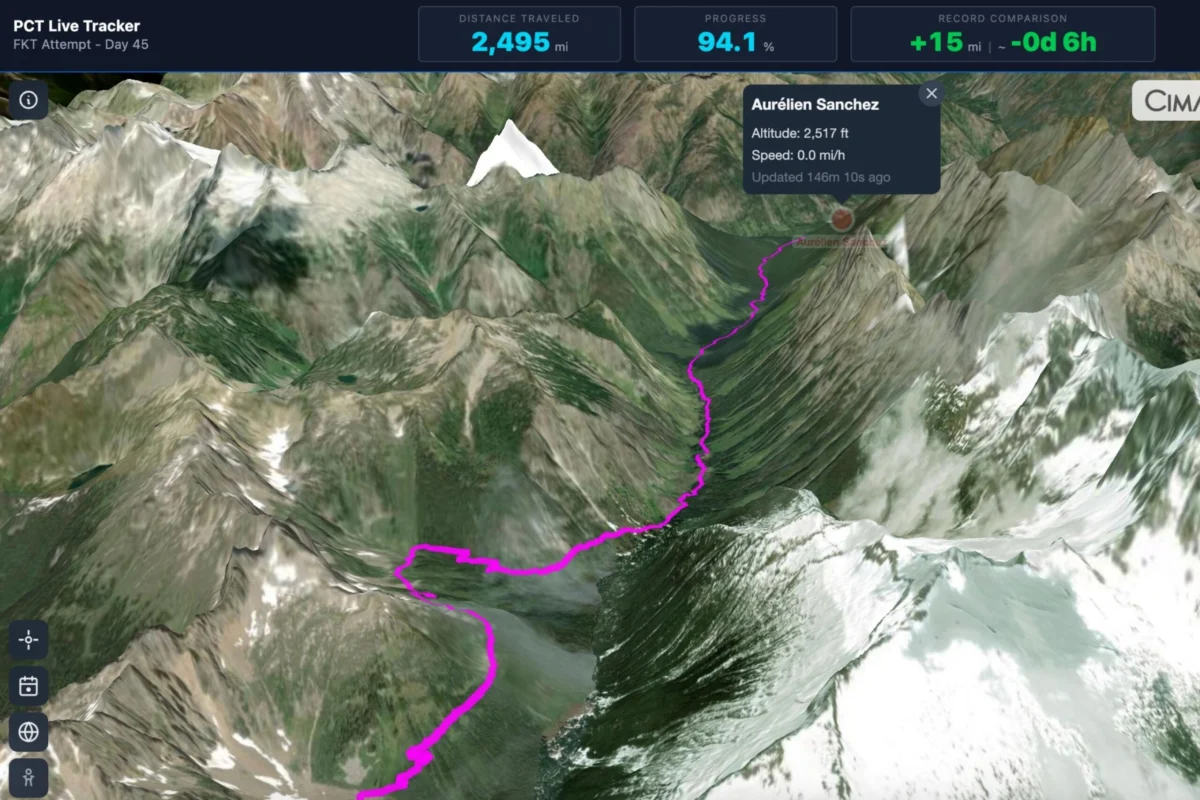
Currently, the most gripping drama in the world of endurance sports is unfolding on the Pacific Crest Trail (PCT). Aurélien Sanchez is in the midst of a Herculean effort to claim the record for the fastest supported completion of the 2,650-mile trail.

The benchmark he is chasing is staggering: 46 days, 12 hours, and 50 minutes—a record set by the legendary Karel Sabbe in 2023. To beat it, Sanchez must maintain a pace that would exhaust a normal hiker over the course of six months.
The tracking interface on the Fastest Known Time website has become my daily homepage. The visual representation of the attempt is deceptively simple: two colored dots, one representing the current record pace and one representing Sanchez. They dance across the map, trading micro-leads. One day, Sanchez is 30 minutes behind; the next, he has clawed back a six-hour advantage. It is a neck-and-neck race that feels almost too close to call, heightened by the knowledge that, unlike a stadium event, there is no crowd to cheer him on at the mile markers. He is racing against the ghost of a performance, in the solitude of the high Sierra.
Chronology of an Endurance Epic
The journey of an FKT attempt is not a linear progression of fitness; it is a volatile timeline defined by attrition.
- The Launch: The athlete starts with a meticulously planned itinerary, bolstered by fresh legs and high morale. The initial pace is often blistering, designed to build a "buffer" against the inevitable fatigue of later weeks.
- The "Grind" Phase: By day 15, the romance of the trail has evaporated. This is when the psychological toll begins to manifest. Athletes deal with chronic sleep deprivation, caloric deficits, and the mundane reality of blister management and gear failure.
- The Crisis Point: Almost every record attempt has a "near-death" moment. For some, it is injury; for others, it is weather or a systemic breakdown of the body.
- The Final Push: As the finish line approaches—the 95% mark—the tension becomes palpable. For Sanchez, this is where the race currently sits. He is navigating the final few hundred miles on a razor-thin margin. The difference between a record and a "DNF" (Did Not Finish) or a "successful completion without record" comes down to a matter of minutes over a distance of thousands of miles.
The Power of Vulnerability and Public Interaction
What separates FKTs from traditional professional sports is the intimacy of the athlete’s digital presence. When Will Peterson attempted the AT record in April, he didn’t just share splits; he shared his suffering. When he contracted a debilitating stomach bug, his social media updates were raw and unfiltered. He documented his inability to move, the crushing disappointment of his body failing, and the eventual, heartbreaking decision to abandon the attempt.
This transparency creates a unique parasocial bond. When an athlete like Peterson or Bob Stewart (who set the record on the 290-mile Benton MacKaye Trail) shares their struggle, the audience isn’t just watching; they are participating. The comment sections on these tracking pages act as a digital stadium. Fans leave notes of encouragement that serve as a lifeline during the darkest, lowest-mileage hours of the night.
This is the "humanity" factor. In a world of over-produced, corporate-sponsored athletics, there is something deeply grounding about watching a person cry in the woods because they are exhausted, only to wake up the next morning and cover another 50 miles.
Implications: Beyond the Record Books
While the purists often scoff at the idea of "speed-hiking"—arguing that the beauty of the trail lies in the slowing down—the FKT movement has evolved into something far more significant than just a race for vanity.

Many athletes are now leveraging their attempts to amplify social causes. Take, for example, Lizzy Fowler. Following a traumatic assault, she used her John Muir Trail FKT attempt as a platform to raise thousands of dollars for organizations supporting survivors of domestic violence. Even when she did not achieve the record, her effort was a resounding success in the eyes of her supporters. She turned a private trauma into a public movement, proving that an FKT is a canvas for social impact.
Furthermore, the rise of the FKT has forced a reevaluation of our relationship with the wilderness. It challenges the boundaries of human physiology, testing what is possible when the only obstacle is the terrain and the only judge is the clock.
Conclusion: The Ultimate Test of Will
FKTs are the purest expression of sport: a public test of private will. They require the athlete to plumb the deepest, most uncomfortable depths of their physical and mental capacities. They force us to ask what we are capable of when we strip away the comfort of modern existence and replace it with a single, uncompromising goal.
As I look at the map for the Pacific Crest Trail, waiting for the next update on Aurélien Sanchez, I am reminded of why we watch sports in the first place. We watch to see the impossible become possible. We watch to see how individuals respond when they are pushed to the very edge of their limits.
Until the next time the world comes together to kick a ball around a pitch, I’ll be here, hitting refresh on a GPS tracker, watching a lone figure traverse the spine of the continent. It’s not just a race; it’s a masterclass in human persistence. And for now, it’s the only drama I need.