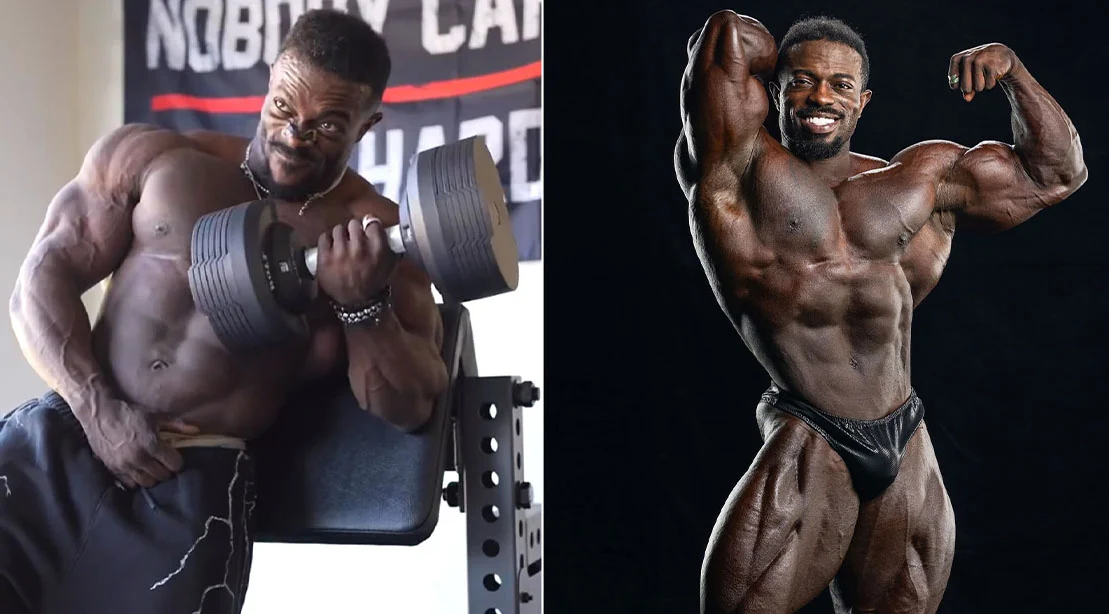
The landscape of professional bodybuilding is often defined by genetic anomalies—competitors who seem to possess effortless symmetry and mountain-peak muscle bellies from the moment they first touch a dumbbell. However, the reality of the IFBB Pro League is far more nuanced. Terrence "Ruff Diesel" Ruffin, a two-time Arnold Classic champion and a titan of the Classic Physique division, serves as the perfect counter-narrative to the "genetics-only" myth.
Fresh off a decisive victory at the 2025 EVLS Prague Pro, which solidified his qualification for the 2026 Olympia final, Ruffin is currently riding a wave of competitive momentum. Yet, despite his accolades and status as one of the most aesthetic bodybuilders in the world, Ruffin has been remarkably transparent about his greatest physical hurdle: his arms. While his physique is a masterclass in conditioning and flow, Ruffin admits that the growth of his biceps was a grueling, multi-year process that required a complete overhaul of his training methodology.
The Evolution of "Ruff Diesel": A Chronology of Success
Terrence Ruffin’s journey to the top of the bodybuilding world is as unconventional as his training philosophy. Before he was gracing the stages of the Arnold Classic and the Olympia, Ruffin was serving his country as a Senior Airman in the United States Air Force. It was during his time in the service that he cultivated the discipline and meticulous attention to detail that would eventually propel him to the professional stage.
2014: The Pro Card Breakthrough
At just 21 years old, Ruffin earned his IFBB Pro Card. For most, this would be the pinnacle of a decade-long dream. For Ruffin, it was merely the opening chapter. He quickly realized that the professional level required more than just athletic potential; it required an intimate understanding of biomechanics and muscle hypertrophy.
2018–2021: The Arnold Classic Domination
As Ruffin climbed the ranks, he began to notice that his arms—while proportional—lacked the "pop" required to stand out in the ultra-competitive Classic Physique division. During this period, he began experimenting with the training principles that would later define his signature look. He transitioned away from ego-lifting and toward a more calculated, science-based approach to hypertrophy.
2025: The Prague Triumph
The 2025 EVLS Prague Pro was not just a victory; it was a statement. Ruffin arrived in Prague with improved maturity in his muscle tissue and a level of arm development that finally silenced his critics. By securing his spot in the 2026 Olympia, Ruffin has effectively signaled that he is no longer just a contender—he is a primary threat for the title.
The Anatomy of the Struggle: Why Biceps Are Stubborn
In the world of bodybuilding, the biceps brachii and the brachialis are notoriously difficult to isolate for some athletes. Ruffin notes that for years, he fell into the trap of over-training and poor mind-muscle connection.
"Arms have taken the longest time to grow for me," Ruffin shared with his nearly 100,000 Instagram followers. "I spent years doing volume-heavy workouts that simply didn’t trigger the growth response I needed. It wasn’t until I pivoted to a high-intensity, low-frequency approach that things finally changed."
Ruffin’s realization aligns with modern sports science: muscles do not grow in the gym; they grow during recovery. By reducing his bicep-specific work to twice a week and focusing on just two to three movements, Ruffin allowed his central nervous system to recover, leading to significantly better output during his training sessions.
The "Ruff Diesel" Protocol: Top 3 Bicep Exercises
Ruffin’s methodology is rooted in unilateral training. By working each arm independently, he eliminates the possibility of the dominant limb compensating for the weaker one, ensuring that both arms develop with equal strength and mobility.
1. Single-Arm Preacher Curls
The preacher curl is a staple of bodybuilding, but Ruffin’s execution is what sets it apart. By leaning against the bench for maximum stability, he isolates the biceps brachii, eliminating momentum from the torso. This movement targets the long head of the bicep, which is essential for creating the "peak" that judges look for in the Classic Physique division.
2. Single-Arm Cable Hammer Curls
While standard curls focus on the biceps brachii, the hammer curl is the secret weapon for overall arm thickness. By keeping the palms facing the torso, Ruffin shifts the load onto the brachialis—a muscle located underneath the bicep. As the brachialis grows, it pushes the bicep upward, creating the illusion of greater size and thickness. Ruffin emphasizes the "cable" aspect of this movement, as the constant tension provided by the cable machine ensures there is no "dead spot" in the range of motion.
3. Single-Arm Heavy Curls
Ruffin’s third move is designed for pure overload. While he values control, he is not afraid of heavy loads. Using a heavy dumbbell, he performs a strictly controlled curl that recruits the entirety of the bicep structure. By focusing on a slow eccentric (lowering) phase, he maximizes time under tension, forcing the muscle fibers to adapt to the metabolic stress.
Scientific Underpinnings: The "Double Progression" Method
Central to Ruffin’s current success is the "Double Progression" method, a concept popularized by coach Paul Carter. This methodology provides a systematic way to track progress without relying on guesswork.
The process is a two-step cycle:
- Step 1: Form and Range Finding. Start with a weight that allows for roughly 8 reps with perfect form. This establishes the baseline for the movement.
- Step 2: Intensity Ramping. Once the upper end of the rep range is achieved with perfect control, the athlete increases the weight. The following sets then target a lower rep range (4–8) at a higher intensity.
This method forces "progressive overload," which is the primary driver of hypertrophy. By tracking his reps and weight, Ruffin ensures that he is always pushing his boundaries, preventing the plateaus that plague many amateur bodybuilders.
Official Responses and Industry Implications
The bodybuilding community has taken note of Ruffin’s shift in training. Coaches and peers alike have praised his transparency regarding the difficulty of his arm growth.
"Terrence is one of the few pros who admits that his physique is a work in progress," says an anonymous IFBB analyst. "Most guys want you to believe they woke up with 20-inch arms. Terrence shows the math. He shows the sets, the reps, and the struggle. That’s why he’s one of the most respected figures in the sport today."
Ruffin’s success carries significant implications for the future of the Classic Physique division. As the sport moves away from the "bigger is better" mentality of the Open category and back toward the aesthetics of the Golden Era, athletes are looking for ways to maximize muscle density rather than just sheer mass. Ruffin’s reliance on biomechanics over brute force suggests that the next generation of bodybuilders will need to be as much scientists as they are athletes.
Conclusion: Lessons from the Bench
Terrence Ruffin’s trajectory from a dedicated Senior Airman to a world-class athlete is a testament to the power of continuous learning. His arms, once his greatest frustration, are now a symbol of his discipline and his ability to refine his craft.
For those looking to replicate his results, the lesson is clear: slow down. Eliminate the momentum, focus on unilateral development, and track your progress with the scientific rigor of the Double Progression method. As Ruffin continues his march toward the 2026 Olympia, one thing is certain: his sleeves will only continue to grow more uncomfortable.
To stay updated on Terrence Ruffin’s training, you can follow his journey on Instagram.