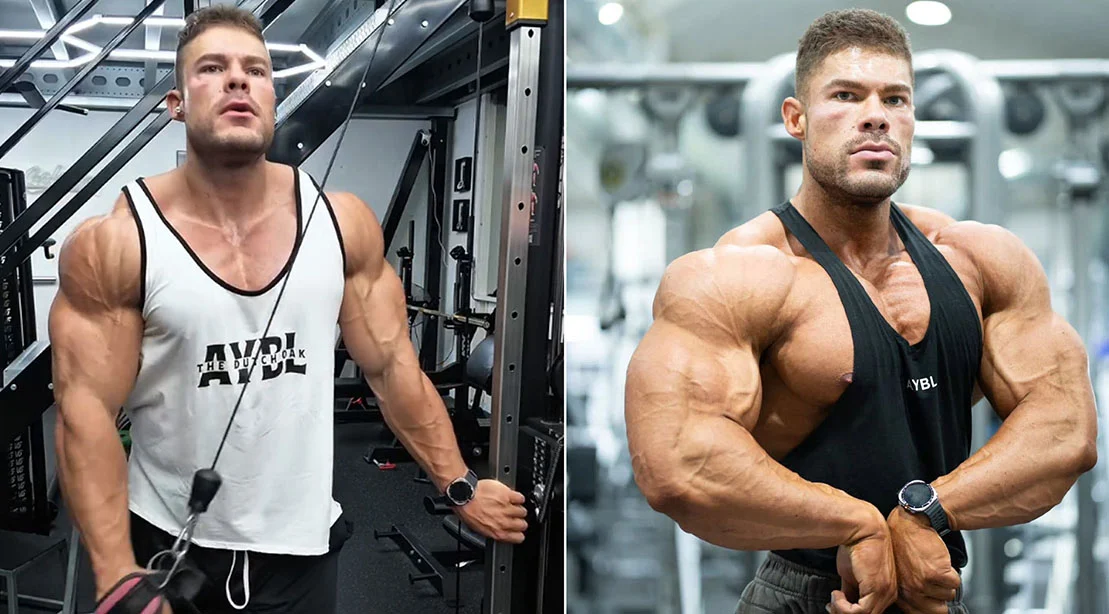
In the high-stakes world of professional bodybuilding, the pursuit of the "classic" aesthetic—a look defined by symmetry, vacuum poses, and sweeping muscle bellies—has been revitalized by none other than Wesley Vissers. Known affectionately as "The Dutch Oak," Vissers has solidified his status as a titan of the sport, most notably with his triumph at the Arnold Classic. However, the hunger for excellence remains insatiable. With his sights firmly set on the 2026 Olympia Classic Physique title, Vissers has opened his training ledger, revealing a straightforward yet brutal upper-body routine designed to sculpt the elite-level mass required to unseat the reigning champions.
The Strategic Objective: The Road to 2026
The transition from a contender to an Olympia champion is rarely about adding indiscriminate weight; it is about precision. For Vissers, the goal is to optimize his upper body architecture—specifically the chest, shoulders, and triceps—to create the illusion of a wider, more imposing frame.
His recent social media disclosures serve as a masterclass in efficiency. Vissers emphasizes that his training philosophy is predicated on the idea that complexity is not a prerequisite for progress. Instead, he focuses on exercises that "match up with actually building muscle," stripping away the superfluous to leave only the movements that demand maximum mechanical tension and metabolic stress. For those looking to emulate the physique of the Arnold Classic winner, the instruction is clear: prepare for a session defined by deep stretches, heavy loads, and the pursuit of a skin-splitting pump.
Chronology of a Championship Session
Vissers’ approach is structured, moving logically from compound movements that tax the largest muscle groups to isolation movements that target specific heads of the deltoids and triceps.
Phase 1: Priming the Chest
The workout begins with the seated chest press. Vissers utilizes this machine to move heavy weight, allowing him to bypass the stabilization demands of free weights and focus entirely on pushing. By prioritizing the eccentric phase—the lowering of the weight—he ensures a deep stretch in the pectorals before initiating a controlled, explosive concentric contraction. This sets the tone for the session, forcing blood into the muscle fibers immediately.
Phase 2: The Smith Machine Advantage
With the chest primed, Vissers transitions to the Smith machine bench press at a slight 20-degree incline. This specific angle is a calculated choice. It targets the upper clavicular head of the pectorals, the anterior deltoids, and the triceps. By using the Smith machine, Vissers eliminates the need to balance a barbell, which allows him to maintain a rigid torso. This posture prevents the common "arch" that often shifts the load away from the chest and onto the lats and lower back, ensuring the upper chest remains the primary mover throughout the set.
Phase 3: Total Fiber Exhaustion
The final chest-focused movement is the pec-deck fly. This is where Vissers shifts from pure strength to pure hypertrophy. By isolating the pecs through horizontal adduction, he pushes the muscle to its absolute limit. His technique here is methodical: he focuses on the "squeeze" at the center of the movement, ensuring that the chest is completely exhausted before moving on to the smaller muscle groups.
Phase 4: Sculpting the Shoulders and Arms
Vissers holds the firm belief that one can never possess "big enough" side delts. Following chest training, he moves to cable lateral raises using a cuff attachment. This method provides constant tension throughout the entire range of motion, something dumbbells struggle to offer.
Following the shoulders, he moves to side triceps pushdowns, another cable-based movement. By targeting the lateral head of the triceps, Vissers adds width to the arm, which is essential for the front double-biceps pose. Finally, the session concludes with overhead triceps extensions. This movement is crucial for the "sweep" of the long head, as the overhead position places the triceps under a maximal stretch, triggering the hypertrophy necessary for that dense, horseshoe look.
Supporting Data: The Mechanics of Hypertrophy
To understand why Vissers’ routine is effective, one must look at the science of muscle growth. The workout adheres to three fundamental pillars of modern bodybuilding:
- Mechanical Tension: By moving "heavy" weights during the chest press and Smith machine press, Vissers triggers the mechanoreceptors in the muscle, signaling the body to increase protein synthesis to handle higher loads.
- Metabolic Stress: The use of cable machines for lateral raises and pushdowns keeps the muscles under tension for longer durations, leading to the accumulation of metabolites that correlate with muscle growth.
- The "Stretch-Mediated" Hypertrophy: Modern research has highlighted that training a muscle in a lengthened state—a key component of Vissers’ overhead triceps extensions and deep chest presses—is one of the most potent stimuli for adding new sarcomeres to the muscle fiber.
By alternating between heavy compound movements and isolation movements that maximize the range of motion, Vissers ensures that no muscle fiber is left unstimulated.
Official Perspective: The Mindset of "The Dutch Oak"
In his communication with his followers, Vissers is remarkably grounded. He consistently reminds his audience that his success isn’t derived from "secret" exercises or complicated periodization. Instead, it is the result of consistency and intensity.
"It isn’t that difficult," Vissers notes, referring to the simplicity of the plan. His philosophy is that most bodybuilders fail not because their program is too simple, but because they lack the intensity to execute the basics properly. When Vissers talks about "getting your sweat on," he is talking about the psychological fortitude required to push through the burning sensation of a high-rep set, even when the muscles are already screaming for respite. This professional outlook is what distinguishes the Olympia-level athlete from the recreational gym-goer.
Implications for the Classic Physique Landscape
The rise of Wesley Vissers has significant implications for the evolution of the Classic Physique division. For years, the category was dominated by individuals prioritizing extreme conditioning or aesthetic symmetry. Vissers, however, is bridging the gap between "Old School" mass and modern scientific training.
His training routine highlights a shift toward high-intensity training (HIT) principles combined with modern machine efficiency. By prioritizing the upper chest and the lateral head of the triceps, he is actively influencing the "look" of the modern competitor. Other athletes in the division are now taking note, observing that the path to the Olympia stage is increasingly paved by those who can master the technical nuances of heavy, controlled lifting.
As the 2026 Olympia approaches, the pressure will mount. Vissers’ willingness to share his blueprint is a bold move—it shows a champion who is confident enough in his own execution that he does not fear others copying his homework. Whether this routine becomes the gold standard for the next generation of bodybuilders remains to be seen, but one thing is certain: The Dutch Oak is not just participating in the sport; he is defining its future trajectory.
For those looking to adopt this training style, the protocol is straightforward:
- Warming up: 3 sets for the initial compound movement.
- Intensity: 2 sets of high-intensity, "all-in" effort for all subsequent exercises.
- Volume: 8 to 12 reps per set, focusing on the quality of the contraction rather than the raw number.
By embracing this, Vissers believes any dedicated trainee can unlock a new level of density and shape, provided they are willing to dig as deep as he does. As the industry turns its eyes toward the 2026 season, the "Dutch Oak" continues to grow, one rep at a time.