For generations, astronomers have viewed the cosmos as a vast, lopsided landscape. According to the current "Standard Model" of cosmology, only about 5 percent of the universe is composed of the familiar "baryonic" matter that makes up stars, planets, and human beings. The remaining 95 percent is hidden, divided between two enigmatic phenomena: dark energy, which accounts for roughly 70 percent of the cosmos, and dark matter, which constitutes about 25 percent.
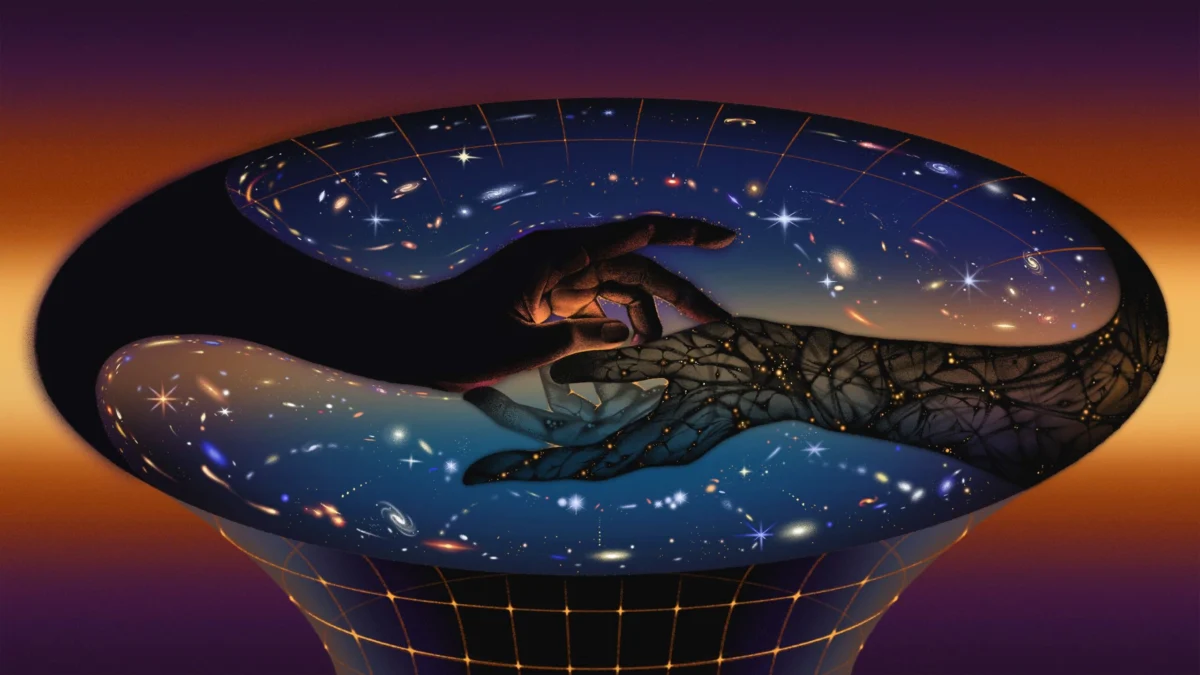
Until recently, these two entities were treated as strictly independent—silent, invisible neighbors in the cosmic void. However, a series of groundbreaking observations and theoretical breakthroughs are beginning to challenge this isolationist view. A growing body of evidence suggests that dark energy and dark matter may not be separate entities at all, but rather two sides of a single, unified coin, inextricably linked by a "dark dimension" that has eluded detection since the dawn of time.
The Cracks in the Cosmological Constant
To understand why scientists are rethinking the "dark sector," one must first understand the crisis of the cosmological constant. For decades, dark energy—the mysterious force driving the accelerated expansion of the universe—was assumed to be a constant, unchanging "vacuum energy" inherent to space itself.
However, the Dark Energy Spectroscopic Instrument (DESI) began to fracture this consensus in 2024. By mapping the clustering of millions of galaxies across 11 billion years of cosmic history, the DESI team uncovered evidence that the strength of dark energy is not, in fact, constant. A 2025 follow-up study, bolstered by an even larger data set, confirmed this: dark energy appears to be weakening over time, after reaching a peak approximately 2 billion years ago.

More perplexing still, the data suggests that in the earlier stages of the universe, dark energy may have been growing stronger—a phenomenon researchers call the "phantom regime." In standard physics, this is akin to a ball rolling uphill; it violates the conventional understanding of energy conservation unless an external force is at play. The prevailing hypothesis among the new guard of cosmologists is that this "phantom" behavior is an illusion caused by a dynamic interaction between dark energy and dark matter.
A Chronology of the Dark Interaction
The concept of "coupled" dark sectors is not entirely new, but it has moved from the fringes of theoretical physics to the center of the stage.
- 2005: Physicist Justin Khoury of the University of Pennsylvania first proposed the possibility of a "coupled" dark sector, questioning whether dark energy’s density could fluctuate if it were interacting with dark matter.
- 2019: Harvard physicist Cumrun Vafa and his collaborators published a seminal paper applying string theory to the dark sector, suggesting that dark energy and dark matter might be manifestations of a "dark dimension."
- 2022: Vafa’s team formalizes the theory that the mass of dark matter particles might vary in response to the changing size of this extra dimension.
- 2024–2025: The DESI results provide the observational impetus needed to test these models. The data reveals the "phantom" behavior that Khoury and his colleagues had long hypothesized.
- January 2025: A study in Physical Review D posits that dark matter may have "bled" energy into dark energy, acting as a brake on the universe’s expansion that is slowly being released.
- May 2025: David Andriot of CNRS presents a model where the evolution of dark matter mass is mathematically "re-boxed" as dark energy, providing a simpler explanation for the DESI anomalies.
Supporting Data: The Hubble Tension
Perhaps the most compelling argument for a unified dark sector is the "Hubble Tension." Cosmologists currently face a major discrepancy: the expansion rate of the universe (the Hubble constant) varies by roughly 9 percent depending on whether it is measured using light from the early universe (the Cosmic Microwave Background) or local, recent phenomena like supernovas.
For years, this 9 percent gap was blamed on potential systematic errors in our equipment. However, as measurement precision has improved, the gap has persisted. Under the new "coupled" models, this discrepancy is no longer a crisis; it is a prediction. If dark energy and dark matter are interacting, the expansion rate would naturally evolve differently than in models where the two are independent. By allowing the two to "communicate," these new theories reconcile the early-universe measurements with the local observations, potentially solving one of the greatest headaches in modern astrophysics.

The "Dark Dimension" Hypothesis
The most radical explanation for this interaction comes from string theory, which posits that our universe contains six or seven dimensions beyond the three of space and one of time that we experience. These dimensions are usually thought to be curled up at the incredibly small Planck scale.
However, Vafa and his colleagues suggest that one of these dimensions—the "dark dimension"—could be significantly larger, perhaps on the order of a micron. In this framework, "dark gravitons"—massive particles that carry the force of gravity—could leak into this dimension. Their presence in the dark dimension would manifest as the gravitational effect we perceive as dark matter, while their subtle interactions with our own dimension could drive the fluctuations we observe as dark energy.
"There is a very natural coupling between dark energy and dark matter," says Georges Obied, a physicist at the University of Chicago. "Changes in the size of the dark dimension would affect both."
Official Perspectives and Expert Skepticism
The shift toward a unified dark sector has received a mixed but increasingly serious reception from the scientific community.

"The notion that you can compute dark energy independently of dark matter is wrong," argues Cumrun Vafa. "That assumption, often made by cosmologists and also followed by the DESI team, led to the physically unacceptable phantom behavior."
While some purists remain wary of introducing complex new variables into the Standard Model, others see it as a necessary evolution. Tim Tait, a particle physicist at the University of California, Irvine, notes that while the "non-interaction" assumption was useful for simplicity, the data is demanding a more nuanced approach. "It would not be surprising if they were manifestations of a kind of unified theory of the dark universe," Tait says.
Experimentalists are also looking for ways to verify these claims. Marc Kamionkowski and Michael Kesden previously established bounds on how strongly dark matter could interact with itself using galactic "tidal tails"—streams of debris formed when galaxies collide. Their previous work, which found no evidence of such an interaction, actually supports the new string-theory-based models, as the predicted interaction strength is low enough to have remained hidden from past observations.
Implications for the Future of Physics
If the "dark dimension" theory holds, it would represent the first experimental triumph for string theory, a field often criticized for being purely conceptual. It would also fundamentally change our understanding of the fate of the universe.
%2C-and-the-Hubble-Heritage-Team-(STScI-AURA).jpg)
If dark energy is weakening, as the DESI data implies, the "Big Rip" scenario—where the universe expands so rapidly that it tears itself apart—becomes less likely. Conversely, the model predicts that the rate of change for dark energy is proportional to its density. Because the energy density of dark energy is so extraordinarily small, the effects are subtle.
"We had to wait the entire age of the universe to detect something that small," Vafa explains.
As researchers continue to synthesize data from DESI, future space-based telescopes, and particle accelerators, the "dark" mystery may finally be coming into the light. Whether the solution lies in a hidden dimension or a deeper interaction between invisible forces, the scientific community is moving toward a consensus: the universe is not made of separate, isolated parts, but a deeply interconnected web of forces that we are only just beginning to map.
"This is the job of theoretical physicists," says Obied. "To explore everything that is possible, to get all the possibilities on the table. Eventually, the data will help us decide."