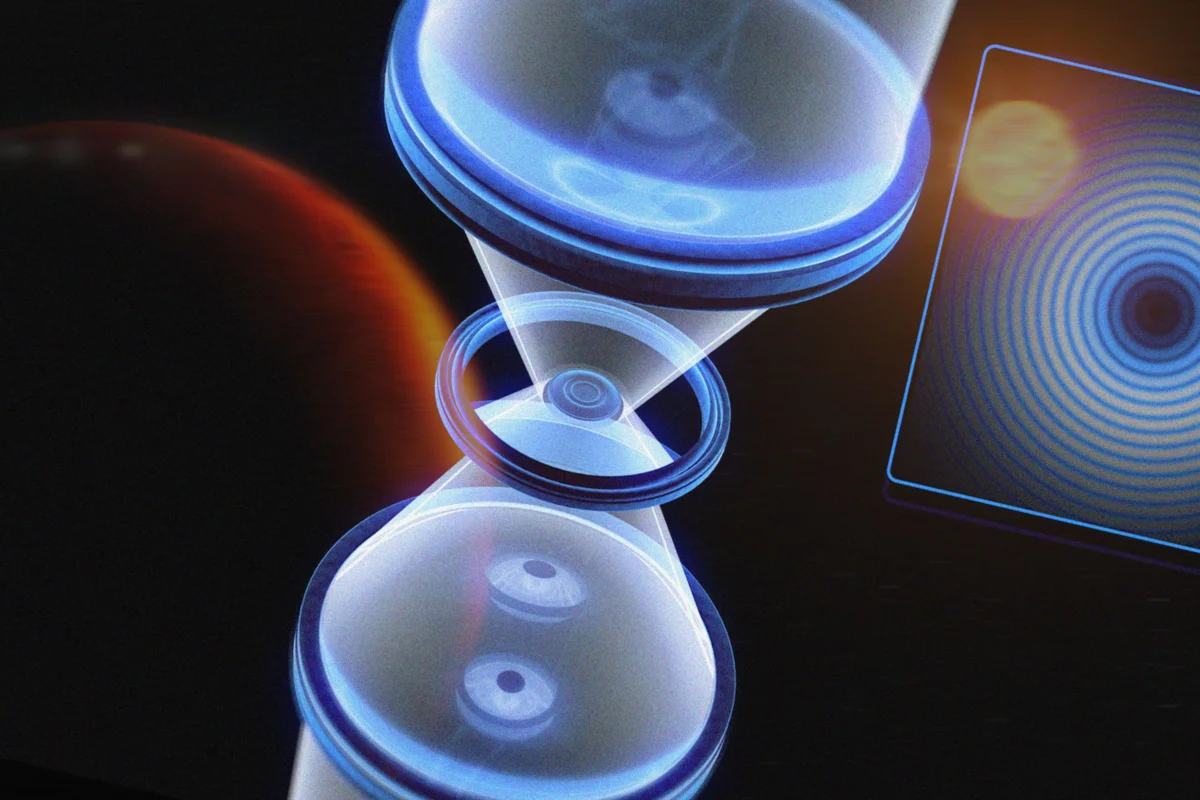
Two mirrors, each no larger than the palm of a human hand, sit at the center of one of the most audacious engineering challenges in the history of space exploration. As NASA prepares for the launch of the Nancy Grace Roman Space Telescope, these unassuming components are set to redefine our relationship with the cosmos, turning our gaze toward the faint, elusive reflections of distant worlds.
The Roman Space Telescope is a mission of grand scope, designed to touch upon nearly every facet of modern astrophysics. However, tucked within its primary suite of instruments lies an experimental apparatus that may prove to be the most consequential: a specialized coronagraph. This device aims to achieve what was once considered science fiction—directly capturing the starlight reflected off the surface of a planet orbiting another star. It is a technological trial-by-fire, a necessary precursor to the day we finally gaze upon a twin of Earth orbiting a sun-like star.
The Core Objective: Illuminating the Invisible
For decades, astronomers have been constrained by the limitations of our current hardware. Identifying exoplanets usually involves indirect methods: observing the "wobble" of a star caused by a planet’s gravity, or watching for the subtle dip in brightness as a planet transits across its host star. Directly imaging a planet, however, is a different matter entirely.
NASA officials often compare the difficulty of this task to photographing a firefly perched on the edge of a floodlight from thousands of miles away. The host star is billions of times brighter than the planet orbiting it, and the glare effectively drowns out any hope of seeing the smaller, cooler object. To bridge this gap, the Roman Space Telescope will utilize a coronagraph—a sophisticated "science-minded sunshade."
While predecessors like the Hubble and James Webb Space Telescopes have carried coronagraphs, the Roman instrument represents a quantum leap in sophistication. It is the first space-based system to incorporate advanced "adaptive optics," a technology that physically deforms a mirror to counteract light distortions, allowing the telescope to surgically block out the blinding glare of a star while preserving the faint light of its orbiting companions.
A Chronology of Innovation
The journey to the Roman coronagraph began long before the telescope’s construction, rooted in the evolution of ground-based astronomy.
- The Atmospheric Hurdle: For years, terrestrial observatories like the Very Large Telescope in Chile and the Keck Observatory in Hawaii have utilized adaptive optics to combat the interference of Earth’s atmosphere. By monitoring the shifting, turbulent layers of air, these telescopes adjust their mirrors in real-time, delivering crisp, clear images that were once impossible to achieve from the ground.
- The Transition to Space: Traditionally, space telescopes were thought to be immune to such issues because they operate above the atmosphere. However, as scientists turned their focus toward "old, cool planets" illuminated only by faint reflected light, it became clear that the static, rigid mirrors of the past were insufficient.
- The Roman Integration: The development of the Roman coronagraph began in earnest as a "technology demonstration" mission. Unlike the primary science mission of the telescope, the coronagraph is an experimental apparatus designed to prove that active, deformable mirrors can operate reliably in the extreme environment of deep space.
- The Road Ahead: Following launch and initial calibration, the mission team will spend months gathering test data. The ultimate goal is to validate this architecture, providing a blueprint for the next generation of observatories, including the proposed Habitable Worlds Observatory, currently projected for the 2040s.
Engineering the Impossible: The Deformable Mirror
The heart of the Roman coronagraph lies in its two palm-sized deformable mirrors. Each mirror is equipped with approximately 2,300 tiny actuators. When a precise jolt of electricity is applied, these actuators expand or contract, infinitesimally reshaping the mirror’s surface.
This process is a high-stakes balancing act. "Any little bit of starlight that gets in the wrong place could just destroy a whole portion of the image," explains Margaret Turnbull, an exoplanet scientist at the SETI Institute and lead of a Roman coronagraph science team.
Beyond the mirrors, the system relies on hypersensitive detectors capable of amplifying the signal from individual photons. Because a planet reflects such a tiny fraction of its star’s light, every single photon is precious. Furthermore, the instrument utilizes "exquisitely detailed masks"—star shades that are far more complex than the simple metal disks used on older telescopes. Bruce Macintosh, an astronomer who leads the University of California Observatories, describes these as "beautiful, complicated shapes" that represent a radical departure from the "brute force" methods of the past.
Official Perspectives: Testing the Frontier
The scientific community views the Roman coronagraph not just as a tool for discovery, but as a critical validation phase.
"We’ll test them in space for the first time, and we’ll understand what work still is left to go," says Vanessa Bailey, an astrophysicist at NASA’s Jet Propulsion Laboratory and instrument scientist for the coronagraph. The strategy is to start with the known: the coronagraph will be pointed at a handful of already-discovered exoplanets. If the instrument fails to capture them, the team will know immediately that there is a fundamental flaw in the hardware or the calibration process.
Julie McEnery, senior project scientist for the Roman mission at NASA’s Goddard Space Flight Center, emphasizes that the best way to prove a technology is to perform meaningful science. "Obviously, the best way of demonstrating that something works is to do something interesting scientifically," she notes.
Beyond testing for known planets, the mission will survey stars surrounded by clouds of dust and debris. By analyzing the gaps in this dust, scientists may be able to infer the presence of planets that are currently too small or too distant to detect via other means, providing a "whole new perspective" on the architectural evolution of solar systems like our own.
Implications for the Future of Astronomy
The success of the Roman coronagraph will have profound implications for the future of space exploration. It is a foundational step toward the "Habitable Worlds Observatory," a mission that will require a coronagraph up to 100 times more effective than the one currently installed on Roman.
The influence of this technology is already spreading. The Lazuli Space Observatory, a project announced by the research institution founded by former Google CEO Eric Schmidt, has already committed to incorporating a similar coronagraph design.
As we look toward the 2040s and beyond, the ability to directly image exoplanets will move from a technical novelty to a standard practice. While the search for Earth-like worlds remains the "tantalizing application," the technology will also provide astronomers with unprecedented views of binary star systems and the mysterious, high-energy environments surrounding bright quasars.
By pushing the boundaries of what is mechanically possible, the Nancy Grace Roman Space Telescope is doing more than just looking for new worlds; it is building the eyes of the future. We are currently in the age of the firefly and the floodlight—a time of immense technical challenge—but if the Roman mission succeeds, the era of the "second Earth" may be only a few decades away. The two tiny mirrors in the palm of a NASA engineer’s hand today are, in a very real sense, the mirrors in which we hope to one day see ourselves reflected in the stars.