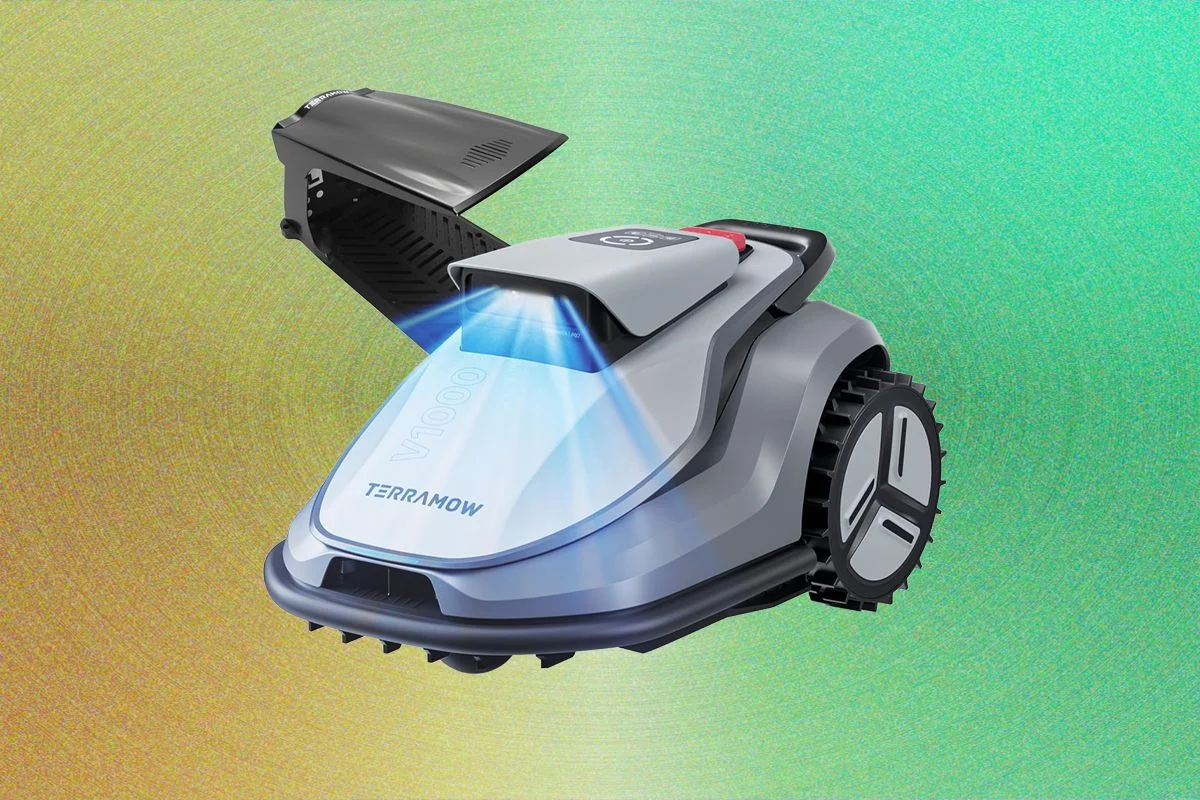
The robotics industry has long promised a “set-it-and-forget-it” future for home maintenance, yet for years, the reality of robotic lawn mowing has been tethered to the drudgery of perimeter wires and complex antenna arrays. The arrival of the TerraMow V1000 signals a potential shift in this paradigm. By discarding physical constraints in favor of a sophisticated triple-camera AI navigation system, the V1000 aims to make the dream of autonomous lawn care accessible to the average homeowner.
The Core Hardware: Simplified Setup and Robust Design
When unboxing the TerraMow V1000, the first thing one notices is the departure from traditional, cumbersome installation kits. Most competitors require hours of painstaking labor to bury boundary wires or calibrate Real-Time Kinematic (RTK) antennas. The V1000, however, relies entirely on its onboard vision suite.
However, a word of caution for potential buyers: while the mower itself is a feat of engineering, the power adapter remains a point of friction. Like many units in its class, the adapter is oversized, which can create compatibility issues with standard outdoor sockets. Prospective owners should plan for an outdoor-rated electrical box and a quality extension lead to ensure a seamless power connection.
A significant value-add included in the box is the covered charging base. In an industry where manufacturers frequently upsell protective garages or sheds for several hundred dollars, TerraMow’s decision to include a weather-shielding station as standard equipment is a refreshing display of consumer-centric design.
Chronology: From Unboxing to Autonomy
The true test of any robotic appliance is the transition from the box to the lawn. For the V1000, this process is arguably the most streamlined in the current market.
Phase 1: Installation and Connectivity
Once the base station is positioned—which, notably, does not need to be placed directly on the lawn—the user connects via Bluetooth or Wi-Fi. The device offers 4G connectivity, with the first year provided complimentary. Following that, a $19 annual subscription fee applies. While some might bristle at the recurring cost, it is important to note that the 4G is purely for remote control and firmware updates when Wi-Fi is unavailable. If your garden is already well-covered by your home’s wireless network, the cellular option is entirely optional.
Phase 2: The Mapping Revolution
Historically, "automatic mapping" has been a marketing buzzword. In previous tests of competing models, users were often forced to manually "drive" the mower around the perimeter of their yard to define cutting zones, followed by hours of corrective editing within the app. The TerraMow V1000 disrupts this pattern. During our testing, the V1000 performed a full survey of the terrain without requiring a single manual input. The AI’s ability to recognize boundaries—even on varied surfaces—demonstrates a maturity in machine vision that was previously absent from the consumer segment.
Supporting Data: Specifications and Performance Metrics
The TerraMow V1000 may not be a heavy-duty agricultural machine, but its specifications are well-calibrated for the residential market.
- Slope Capability: Up to 18 degrees, allowing it to navigate most standard hilly landscapes with ease.
- Cutting Dimensions: A cutting width of 8 inches (20 cm) combined with an adjustable height range of 0.98 to 2.95 inches (25 to 75 mm).
- Battery Efficiency: The unit offers a 150-minute runtime on a single charge, requiring approximately two hours to return to full capacity.
- Zonal Intelligence: Users can define specific zones with custom cutting parameters. This is particularly useful for homeowners who prefer a finer, shorter cut on decorative front lawns while allowing for a more robust finish in the rear.
Like its peers, the V1000 operates on a mulching principle, returning finely clipped grass to the soil to act as a natural fertilizer. This not only promotes a healthier lawn but also eliminates the need for grass disposal.
A Cut Above: AI Navigation and Obstacle Avoidance
The central skepticism surrounding vision-only navigation is its reliability in changing light conditions or complex garden environments. Yet, the V1000 manages to turn this skepticism into a highlight.

The Aesthetics of the Cut
The V1000 does not simply wander aimlessly. It navigates in precise, straight lines, finishing each pass with a deliberate “fish-tail” maneuver. The result is a professional-grade aesthetic, characterized by uniform, narrow stripes.
In terms of edge-mowing, the performance is exemplary. Where the environment allows—such as along flat pathways—the V1000 hugs the perimeter with high precision. While it naturally leaves a modest buffer around complex obstacles like garden sheds or thick-stemmed flora, the "uncut" margin is significantly narrower than what we have observed with traditional wire-guided or GPS-only models.
Safety and Obstacle Detection
For households with pets or children, safety is paramount. The V1000 utilizes its camera array to identify and circumnavigate obstacles in real-time. In our stress tests, which included a soccer ball and a badminton net with thin, challenging-to-detect posts, the mower demonstrated high spatial awareness, skirting around the objects without contact.
Furthermore, the machine’s ability to navigate back to its base station—even when that station is tucked away behind furniture on a concrete patio—highlights the sophistication of its pathing algorithms. The mower does not get "confused" by transitions from grass to hardscaping, a common failure point for lesser machines.
Implications for the Robotic Mower Market
The TerraMow V1000 is more than just a convenient tool; it is a signal of the industry’s trajectory. By proving that high-end AI vision can replace physical boundary wires, the manufacturer has effectively lowered the barrier to entry for millions of homeowners.
The Shift Toward Vision-Based Autonomy
The reliance on visual AI allows for a more flexible user experience. As gardens evolve—new trees are planted, furniture is moved, or seasonal beds are expanded—the V1000 can adapt its map dynamically. It does not require the user to dig up and move wires. This shift reduces the "maintenance of the maintenance tool," addressing the primary reason many consumers abandon robotic mowers: the hassle of ongoing upkeep.
Security in the Modern Age
Beyond performance, the inclusion of GPS tracking for theft alerts is a necessary evolution. As these devices become more visible in neighborhoods, their security features must match their utility. The ability to monitor the mower’s location via a smartphone app provides peace of mind that standard, "dumb" mowers simply cannot offer.
Conclusion: Is the V1000 Right for You?
The TerraMow V1000 represents a significant leap forward in autonomous lawn care. By prioritizing ease of installation and intelligent, vision-based navigation, it succeeds where many predecessors have faltered. While the power adapter requires a bit of logistical planning, the benefits of a wire-free, autonomous, and consistently precise mower far outweigh the minor inconveniences of its setup.
For the homeowner tired of the weekly chore of mowing and the seasonal headache of maintaining boundary wires, the TerraMow V1000 is a compelling, high-performance solution. It turns a tedious, repetitive task into a background process, leaving you with nothing but a perfectly striped lawn and more time to enjoy your garden. As the technology continues to mature, we expect this model to set the standard for what a modern, intelligent mower should be.