
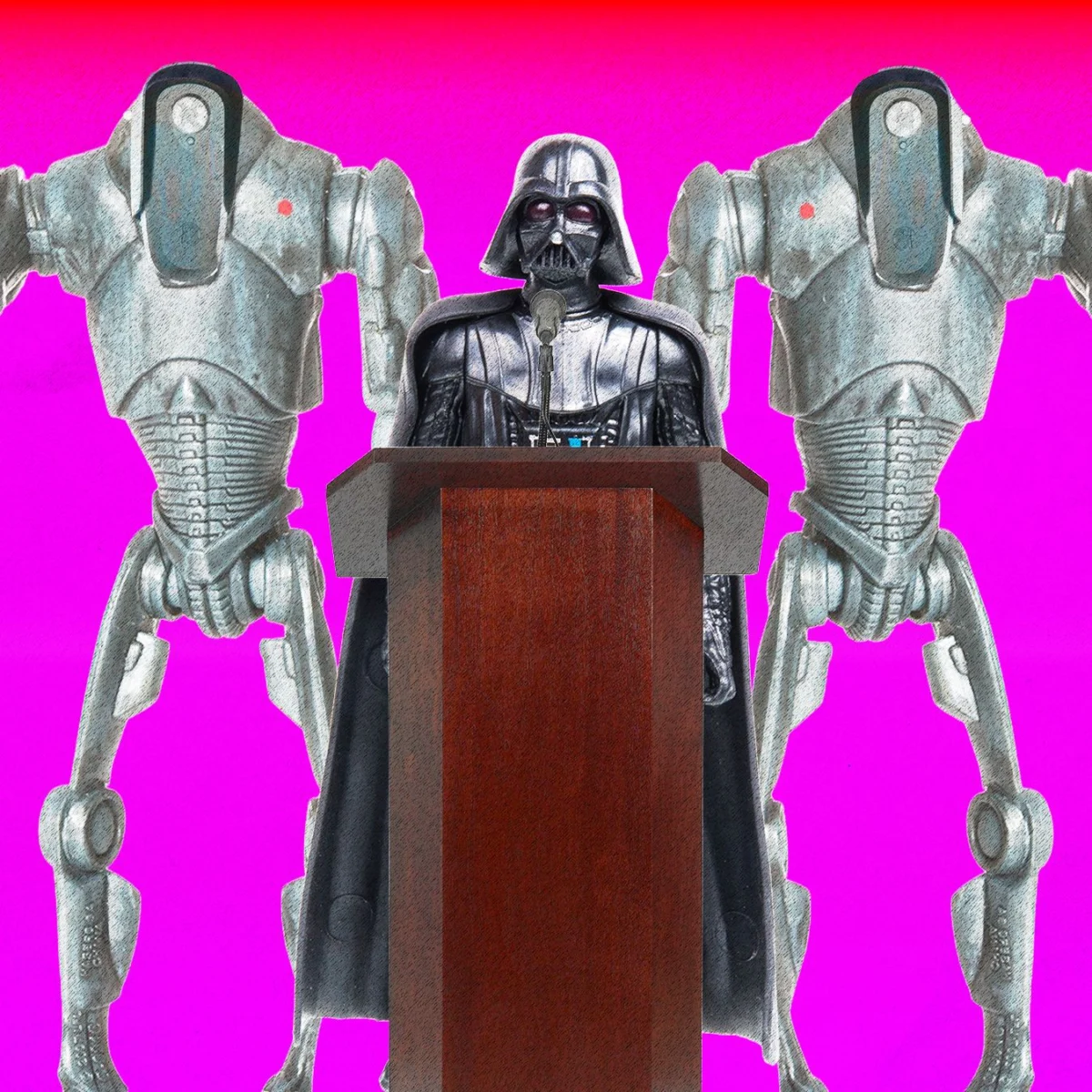
In the sterile, fluorescent-lit chambers of the San Diego City Council, where the rhythm of bureaucracy is usually measured in dull motions and minutes of public comment, the silence was recently shattered by the rhythmic, mechanical wheeze of a respiratory system powered by the Dark Side.
Darth Vader, the iconic antagonist of the Star Wars franchise, stood before the council members on August 19. Between breaths, the Sith Lord offered a chilling endorsement of the city’s decision to renew its contract with Flock Safety, an automated license plate recognition (ALPR) firm that has become the centerpiece of a burgeoning national debate over privacy, policing, and the erosion of civil liberties.
“The Emperor is a fan of Flock,” the figure declared, his voice modulated to mimic the menacing baritone of the cinematic villain. “And we must continue utilizing Flock technologies so that we can follow and surveil the rebel scum as they move from playground to playground, from playground to pool, from pool to gymnasium.”
The stunt, which has since garnered millions of views on TikTok and Instagram, was not merely an exercise in cosplay. It was a calculated act of guerrilla theater orchestrated by Anthony Ralphs, a San Diego-based DJ and labor activist, aimed at forcing a public reckoning with the city’s embrace of persistent, omnipresent surveillance.
A Chronology of Civic Discontent
The path to the council floor for Ralphs began long before he donned the 2004 Hasbro helmet. His journey into the world of municipal advocacy started in earnest in the summer of 2025, sparked by the city’s deepening reliance on private surveillance firms.
The December Pivot
The turning point for Ralphs was the December 9 City Council meeting. At that time, the atmosphere in the chambers was electric. Nearly 300 residents had gathered to voice their opposition to the continued use of Flock Safety. Despite an overwhelming public consensus—with roughly 95 percent of attendees testifying against the renewal—the council voted to proceed with the contract.
“It was extremely discouraging,” Ralphs told WIRED in an interview. “It really lit a fire under me to start going and regularly participating.”
The Silence of the Chambers
In the months that followed, Ralphs observed a disheartening trend: the surge of public energy dissipated, leaving the council chambers largely empty during subsequent sessions. He realized that the efficacy of local government depends on the endurance of its citizens, not just the intensity of their initial outcry. He began organizing, taking time off from his studies at San Diego City College to show up, week after week, to challenge the status quo.
The August 19 Climax
By mid-August, as the council prepared to finalize further budget allocations for the police department, Ralphs reached his limit. Having already exhausted traditional methods of persuasion—including letters, public testimony, and even bringing flowers to representatives—he opted for a more visceral form of communication. The viral performance on August 19 was the culmination of months of research, theater training, and a deep-seated frustration with a council he felt had become disconnected from its constituents.
Supporting Data: The Costs of Convenience
The debate over Flock Safety is not merely ideological; it is grounded in fiscal and legal realities that suggest the technology may be more of a liability than a “force multiplier.”
Fiscal Priorities
While the city of San Diego has grappled with a $120 million deficit—leading to significant cuts in local arts programs—it has simultaneously committed $2.2 million to its contract with Flock. For critics like Ralphs, this represents a fundamental misalignment of municipal values, prioritizing the surveillance of residents over the cultural health of the community.
The Cost of Error
The human impact of these systems has also come under intense scrutiny. A poignant example is the case of Hugo Parra, a San Diego resident who spent 30 days in jail after an erroneous identification by Flock cameras. Parra was proven to have been five miles away from the crime scene at the time, yet the machine-generated data took precedence over his liberty. Parra and a co-defendant are currently suing the city for $1.5 million. When legal fees and potential settlements are factored in, the true cost of the city’s surveillance program threatens to far exceed its initial price tag.
The Technological Panopticon
Flock Safety has become a lightning rod because its capabilities extend well beyond simple license plate reading. A recent WIRED analysis of the company’s code revealed that their AI-powered tools are capable of monitoring far more than just vehicular data.
The software is designed to catalog a vast array of metadata, creating a searchable map of human movement. Critics argue that this creates an "Orwellian-digital, fully surveilled hellscape." The concern is that as these tools become more sophisticated, they are being deployed in residential neighborhoods, public parks, and recreational areas—essentially "following" citizens throughout their daily lives without the requirement of a warrant or reasonable suspicion.
Official Responses and Police Justification
The San Diego Police Department (SDPD) and city officials have consistently defended the use of Flock technology as a necessary tool for modern law enforcement. In their view, the cameras act as a "force multiplier," allowing a stretched police force to respond more effectively to criminal activity, track stolen vehicles, and identify suspects in serious crimes.
However, the lack of transparency regarding the system’s "AI tools" and the recurring reports of police officers misusing the data have fueled public skepticism. While the city maintains that the system is used within legal frameworks, the lack of robust, independent oversight has left many residents feeling that the technology is operating in a vacuum of accountability.
Implications: The Role of Art in Civic Engagement
Anthony Ralphs’ decision to appear as Darth Vader was not an attempt to minimize the seriousness of the issue, but rather to highlight the absurdity of the city’s current trajectory. By framing the surveillance state through the lens of a fictional, tyrannical empire, Ralphs effectively re-engaged the public.
Reclaiming the Public Square
“City council meetings don’t have to be stale rooms with boring thoughts presented in unoriginal ways,” Ralphs noted. He believes that by injecting art and theater into the process, citizens can reclaim the narrative. The stunt forced a conversation that was previously relegated to technical policy debates into the mainstream, turning the phrase "necessary evil" on its head.
A Global Conversation
The viral nature of the protest has turned a local municipal issue into a global dialogue. People who were previously unaware of the implications of automated surveillance are now questioning the trade-off between convenience and privacy. The message is clear: if the tools being used by our government mimic those of a cinematic villain, it is time to reassess the necessity of those tools.
Conclusion: The Path Forward
As San Diego moves forward, the debate over Flock Safety serves as a microcosm of a broader national struggle. In an era where digital surveillance is increasingly integrated into the fabric of urban life, the question remains: at what point does the pursuit of security infringe upon the fundamental right to exist without being constantly tracked?
For activists like Ralphs, the answer is found in consistent, creative, and courageous engagement. Whether through formal testimony or a caped figure at the podium, the goal is to ensure that the voice of the people remains louder than the hum of the surveillance machine. As the dust settles on the viral moment, the true measure of success will be whether the council listens to the humans in the room, or continues to serve the interests of the algorithms they have invited into their city.