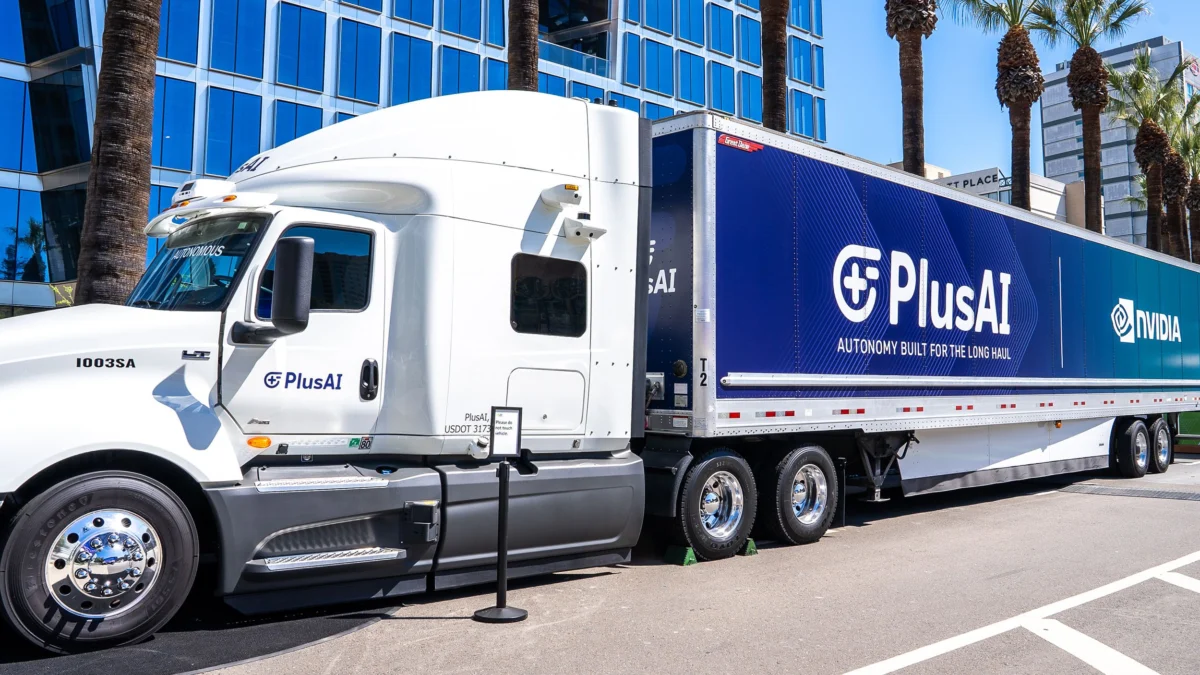
On a routine Thursday morning in Newark, California, a high-ranking executive at the autonomous trucking firm PlusAI received a notification that initially seemed like a routine piece of professional validation. An acquaintance had texted, “I have been proud of you for your adventure and success at Plus. Just saw two of your trucks near my workplace! :)”
It was intended as a pleasant observation, but for the leadership at PlusAI, the message triggered an immediate internal alarm. The company’s autonomous trailers—branded with the logos of both PlusAI and the tech titan Nvidia—were supposed to be securely docked at a warehouse facility half a mile away. They were not, under any circumstances, supposed to be out on the road, let alone idling near an office building in Newark.
What followed was a bizarre intersection of high-stakes corporate espionage, opportunistic cargo theft, and a punchline that likely left the perpetrators questioning their life choices.
The Chronology of an Unlikely Theft
The incident began in the quiet hours before dawn. Under the cover of darkness, unidentified individuals breached the security perimeter of the PlusAI facility in the San Francisco Bay Area. According to local law enforcement, the thieves bypassed the physical security of the trailers—which were secured with standard hand locks—and proceeded to hook their own cabs up to the detached units.
By the time the sun had risen, the two trailers were no longer on company property. The thieves, operating under the assumption that they had successfully hijacked valuable freight, moved the trailers to a secondary location in Newark.
The theft was discovered shortly after the executive received the unexpected text message. PlusAI personnel immediately alerted the Fremont Police Department, which serves the jurisdiction of the warehouse site. As officers converged on the location reported by the bystander, the thieves appeared to realize their tactical error. Fearing discovery or perhaps simply realizing the futility of their haul, the suspects abandoned the trailers and fled the scene.
By Thursday afternoon, the Fremont Police Department confirmed that the equipment had been recovered. The trailers were returned to PlusAI, but the incident remains an open, active investigation. "The case is under investigation, and no arrests have been made," said Amy Gee, a spokesperson for the Fremont Police Department.
The Weight of Reality: A Sand-Filled Surprise
The central irony of the heist lies in the cargo itself. As the thieves broke the seals on the trailers, expecting perhaps high-end GPU clusters or advanced autonomous sensor arrays, they were met with nothing more than 40,000 pounds of sand.
"PlusAI uses simulated loads in its trailers to assist with research and development testing," explained Lauren Kwan, a company spokesperson. The trailers, which were clearly marked as being associated with both PlusAI and Nvidia—the world’s most valuable company—were meant to provide the necessary weight for testing braking, acceleration, and maneuvering for heavy-duty autonomous vehicles.
In the world of autonomous logistics, "simulated loads" are essential. Developers cannot risk transporting multi-million dollar hardware on every test run; instead, they use inert materials to mimic the weight distribution of a fully loaded commercial truck. The thieves had inadvertently stolen two massive, heavy, and entirely worthless containers of construction-grade sand.
The Broader Context: A Surge in Cargo Crime
While the "Sand Heist" carries a comedic undertone, it is a symptom of a much more serious and dangerous trend plaguing the American supply chain. The theft of high-value electronics, particularly hardware designed for data centers, has skyrocketed in recent years.
The Shift Toward Violent Cargo Hijacking
The threat to the logistics sector is no longer just about "grab-and-go" thefts from unattended vehicles. Recent data indicates that cargo theft is becoming increasingly organized and, at times, violent. In August, WIRED reported on two separate incidents in California where thieves deliberately rammed vehicles serving as security escorts for high-value tech shipments.
These sophisticated crews are no longer looking for consumer electronics; they are hunting for the backbone of the AI revolution. The chips, processors, and networking equipment destined for hyperscale data centers are essentially the "gold" of the modern era. When security teams are neutralized, the thieves gain access to shipments worth millions of dollars in a single strike.
A Diverse Target List
The scope of these operations has expanded far beyond traditional electronics. Criminal syndicates have been observed targeting:
- Tesla Batteries: Lithium-ion storage units have become a high-demand commodity, with reports of entire shipments being stolen before they even leave the factory gate.
- Cryptocurrency Mining Rigs: As Bitcoin and other digital assets maintain market value, specialized hardware for mining has become a frequent target for organized theft.
- Industrial Metals: As commodity prices fluctuate, the raw materials used in manufacturing have also seen an uptick in reported thefts.
According to Verisk CargoNet, an analytics and risk assessment firm that monitors supply chain vulnerabilities, enterprise-grade computer and networking equipment now rank among the most common targets in the United States.
Implications for the Tech Industry
The incident at PlusAI highlights the delicate relationship between the autonomous trucking industry and the companies providing the "brains" for these vehicles, such as Nvidia. While Nvidia did not provide a comment for this story, the partnership between the two companies is indicative of the massive investment pouring into the autonomous space.
For companies developing these technologies, the incident serves as a wake-up call regarding physical security. If a facility housing simulation equipment can be breached, the security protocols for actual production-grade hardware must be exponentially more robust.
The Cost of Security
The rising threat of theft is forcing tech companies to rethink their logistics strategies. This includes:
- Increased Surveillance: Implementing real-time GPS tracking and geofencing that alerts security teams the moment a trailer moves from its designated coordinate.
- Hardened Logistics: Using armored transport or armed security escorts for sensitive equipment, a practice that was once reserved for precious metals and cash.
- Deceptive Logistics: As evidenced by the PlusAI incident, keeping the contents of a trailer ambiguous is a defensive strategy. However, the thieves’ willingness to strike vehicles with Nvidia branding suggests that the mere appearance of a "tech load" is enough to warrant an attack.
Conclusion: A Lesson in Risk
The "Great Sand Heist" ultimately ended with the trailers back in the possession of their owners, the sand undisturbed, and no physical harm to the employees. It is a rare "happy ending" in an industry that is currently reeling from billions of dollars in losses due to cargo crime.
However, the event serves as a stark reminder of the risks inherent in the rapid development of AI. As the world rushes to build the infrastructure of the future, the thieves are already waiting at the loading dock. For now, the developers at PlusAI can return to their work, likely with a few extra security locks on their trailers and a renewed sense of caution. The perpetrators, meanwhile, are left with nothing but the memory of a very heavy, very pointless night of labor—and a heap of sand that didn’t pay the bills.