In an industry currently obsessed with the "race to zero"—a trend where manufacturers strip every gram of plastic and every functional feature from gaming mice to reach the lowest possible weight—the Wallhack M-001 arrives as a refreshing, albeit unconventional, outlier. It is a device that favors engineering personality over mere minimalism, prioritizing the tactile satisfaction of the user experience above all else. With a robust magnesium chassis, a hot-swappable battery system that feels straight out of a sci-fi cockpit, and a desktop-bound control hub that elevates the humble dongle, the M-001 is arguably the most fun I have had testing a gaming peripheral in years.
Main Facts: The Anatomy of the M-001
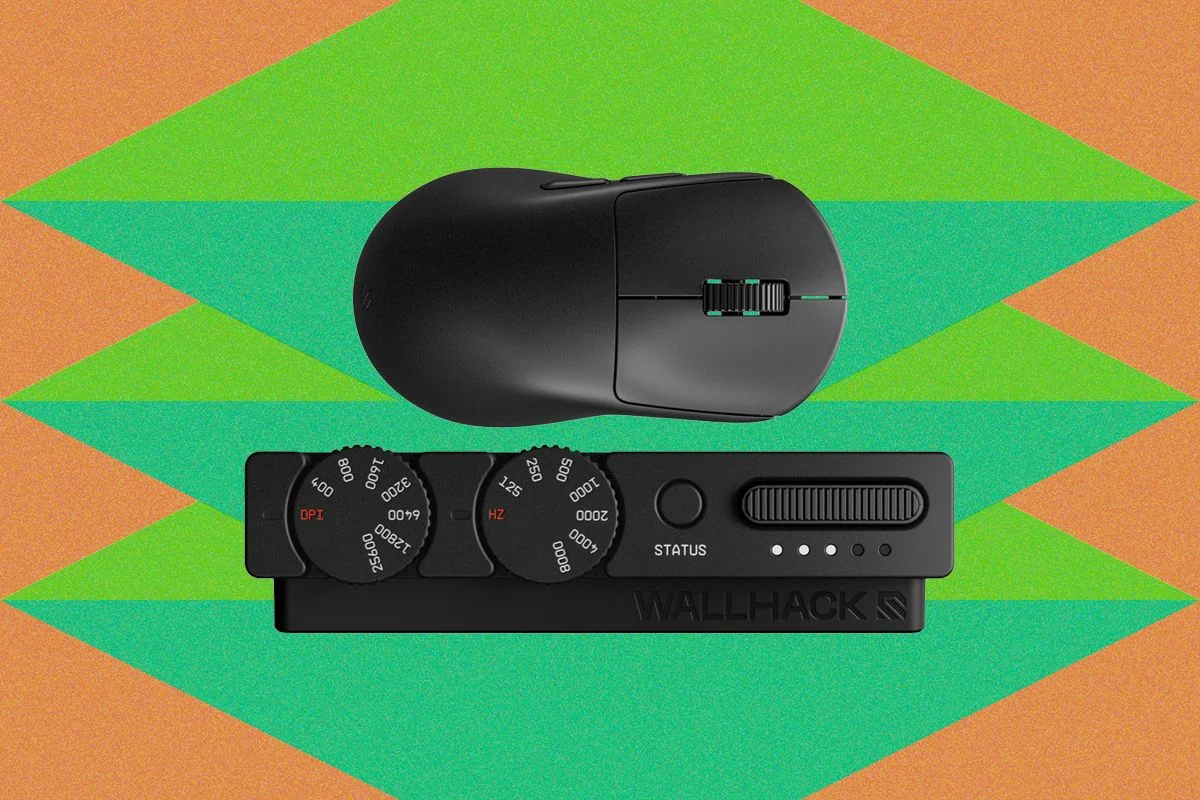
The Wallhack M-001 is a premium, right-handed symmetrical gaming mouse that defies current market trends. Weighing in at 53.6 grams, it is not the lightest mouse on the market—a title currently held by ultralight plastic chassis designs—but it is arguably one of the most structurally sound.

Key Technical Specifications:
- Chassis Material: Premium Magnesium alloy.
- Weight: 53.6 grams.
- Sensor: Pixart PAW3950 (30k DPI capability).
- Switches: Omron Optical (Main); Omron Blue-Dot Mechanical (Side).
- Connectivity: 2.4G Wireless only (No USB-C or Bluetooth).
- Polling Rate: Up to 8,000 Hz.
- Battery System: User-replaceable, hot-swappable cells with a spring-loaded ejection mechanism.
The M-001 is not a budget-conscious device. It carries a premium price tag that reflects its material choice and its innovative, complex control dongle. However, for the user who values build quality and the "analog" feel of mechanical adjustments, it offers a tangible return on investment that plastic-shelled competitors simply cannot match.
Chronology: From Concept to Desk
The evolution of the M-001 represents a shift in how Wallhack approaches the peripheral market. For years, the industry moved away from user-replaceable batteries in favor of integrated, non-removable lithium-ion cells. This transition was driven by the quest for weight reduction and internal space efficiency.

- The Era of Integration: Between 2018 and 2023, the industry saw a mass abandonment of hot-swappable batteries. Mice became sealed units, thinner and lighter, but eventually disposable once the battery degradation hit critical levels after several years of high-cycle charging.
- The Rediscovery Phase: Recognizing that gamers wanted longevity without compromising on weight, niche manufacturers began re-exploring the "cartridge" battery concept.
- Wallhack’s Iteration: Wallhack took this concept and refined the mechanical interface. By designing the PCB as a "stressed member"—borrowing a concept from high-performance automotive engineering—they integrated the battery into the chassis as a central, functional component rather than an afterthought.
- The Launch: With the introduction of the M-001, Wallhack has successfully bridged the gap between enthusiast-grade mechanical design and high-performance gaming hardware.
Supporting Data: Why "Feel" Matters More Than Specs
While the Pixart PAW3950 sensor—the same technology found in the 2022 Razer Viper V2 Pro—is technically "older" by modern tech-cycle standards, our testing confirms that it remains world-class. In a market where marginal gains are often marketed as "game-changing," the consistency of the PAW3950 is a testament to the fact that sensor development has reached a point of diminishing returns.
The Magnesium Advantage
The use of magnesium is the defining characteristic of the M-001. Unlike traditional injection-molded plastics, the magnesium shell provides exceptional rigidity. In lab tests, the shell exhibited virtually zero flex under pressure. This translates to a more consistent click feel and a sense of "connectedness" between the user’s hand and the cursor on the screen. The metallic, cool-to-the-touch finish offers a superior tactile experience compared to the standard matte plastic found on almost every other professional-grade mouse.

The Dongle Redefined
Most wireless gaming mice ship with a small, plastic USB dongle that is easily lost and provides no functional information. The Wallhack dongle is a departure from this norm. It functions as a command center, featuring two physical, ratcheted dials that allow for on-the-fly adjustments to DPI and polling rates. In competitive titles like Marvel Rivals, the ability to adjust DPI mid-match without opening software—or even taking one’s eyes off the screen—is an undeniable tactical advantage.
Official Responses and Design Philosophy
In discussions regarding the M-001, Wallhack has emphasized that the removal of the USB-C port was a deliberate choice, not an omission. By eliminating the port, they were able to reduce the number of internal components, theoretically improving the integrity of the 2.4G wireless connection by minimizing signal interference.

"We wanted to build a device that felt like a tool, not a disposable electronic," a spokesperson for the brand noted during initial reveals. The "Terminal" configuration software, which utilizes a stark, command-line-inspired interface, reflects this philosophy. It moves away from the bloated, resource-heavy aesthetic of mainstream peripheral software, offering a lean, text-based system that allows for granular control over lift-off distance and sensor calibration.
Implications: The Future of Peripheral Design
The M-001 is a harbinger of a potential shift in the gaming peripheral landscape. It suggests that there is a growing market for "heirloom-quality" gaming hardware.

Sustainability and Longevity
The most profound implication of the M-001 is its impact on product life cycles. By making the battery hot-swappable, Wallhack is effectively ensuring that the mouse will not end up in a landfill the moment its battery fails. This "Right to Repair" approach, integrated into a high-end gaming device, is a rare victory for the consumer.
The Aesthetic of Utility
The M-001 challenges the "gamer-centric" design language of neon lights and aggressive, sharp angles. Instead, it adopts an industrial, functional aesthetic. The decision to leave the PCB exposed on the underside, protected by a sturdy frame, is a bold choice that invites the user to appreciate the engineering beneath the hood.

The Competitive Landscape
For the casual user or the extreme min-maxer, the M-001 might seem like an odd choice. However, for the enthusiast who values a unique, satisfying, and high-performance experience, it is a landmark product. It proves that you do not need the latest, most expensive sensor to win, but you do need a device that inspires confidence.
Conclusion
The Wallhack M-001 is not for everyone. Its lack of Bluetooth connectivity, its premium price point, and its unconventional shape will naturally limit its appeal to a specific segment of the market. Yet, for those who choose to invest, it provides a level of satisfaction that is increasingly rare in the world of consumer electronics. It is a reminder that technology—even in something as mundane as a computer mouse—should be designed to be interacted with, maintained, and ultimately enjoyed.

In a world of mass-produced, disposable peripherals, the Wallhack M-001 stands out as a piece of engineering that cares as much about the experience of the click as it does about the speed of the sensor. It is, quite simply, a joy to use.