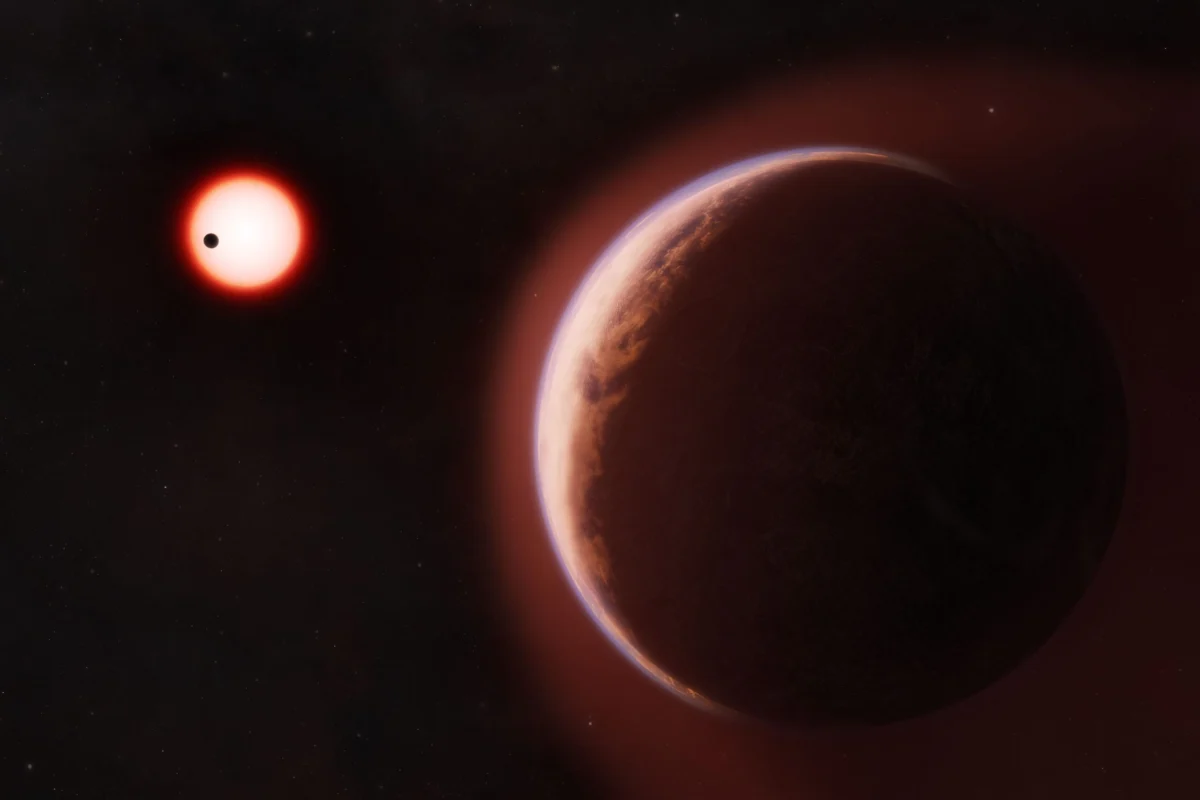
In a landmark achievement that reshapes our understanding of the cosmos, astronomers have confirmed the existence of a rocky exoplanet that possesses a stable atmosphere while orbiting within its star’s “habitable zone.” This discovery, centered on the exoplanet LHS 1140 b, marks the first time humanity has identified a terrestrial-like world that satisfies the three critical pillars of habitability: a solid, rocky composition; a location at a distance from its host star that allows for liquid water; and the proven presence of a persistent atmospheric layer.
Located approximately 48 light-years away in the constellation Cetus, LHS 1140 b is now being heralded as the most promising candidate in the search for extraterrestrial environments capable of supporting life. While researchers stop short of calling it a "twin" to Earth, the planet is undeniably a close "family member," offering a glimpse into the potential diversity of worlds that exist beyond the boundaries of our solar system.
The Triple Crown of Habitability
The scientific community has long sought to identify a planet that meets three specific criteria: it must be terrestrial (rocky), it must exist in the “Goldilocks zone”—the region around a star where temperatures are neither too hot nor too cold—and it must possess an atmosphere. Until now, these variables remained largely theoretical when applied to planets outside our immediate neighborhood.
LHS 1140 b, which orbits a cool, dim red dwarf star, has shattered these barriers. Published this week in the journal Science, the findings represent the culmination of years of rigorous observation and complex data modeling. The confirmation of an atmosphere is the most significant development in this field for decades, as an atmosphere acts as the primary shield for any potential biological processes. On Earth, our atmosphere regulates temperature, prevents water from boiling away or freezing solid, and acts as a critical barrier against the lethal radiation emitted by stars.
A Chronology of Discovery: From 2017 to the Present
The saga of LHS 1140 b is a testament to the incremental nature of modern astrophysics. The planet was first detected in 2017 through the MEarth Project, an observatory network specifically designed to scan nearby red dwarf stars for transiting planets. At the time of its discovery, LHS 1140 b was noted for its size—roughly 1.7 times the radius of Earth—and its orbital period of 25 days.
However, detecting a planet is only the first step. For the next several years, the object remained a point of interest, but its atmospheric composition remained a mystery. It was not until the deployment and subsequent focus of the latest generation of deep-space monitoring tools that researchers were able to peel back the layers of the planet’s environment.
The new findings are based on a comprehensive set of observations gathered throughout 2024 and 2025. By analyzing the way light from the host star filtered through the planet’s periphery during its transit, researchers identified distinct signatures of helium. This "leakage" of gas served as a tell-tale indicator of a massive, stable envelope of gas surrounding the rocky core. Through sophisticated physical modeling, the team reconstructed the history of this atmosphere, concluding that it has likely been present for at least 3 billion years—a duration sufficiently long for complex chemical, or perhaps even biological, processes to have taken root.
The Science of Helium Leaks: Deciphering the Invisible
The methodology used by the team at the Harvard-Smithsonian Center for Astrophysics is as impressive as the discovery itself. Because the planet is 48 light-years away, direct imaging of the atmosphere is currently impossible. Instead, astronomers utilized the transit method, observing the planet as it passed in front of its star.
As the planet transits, the star’s light passes through the outer edges of the planet’s atmosphere. Certain gases absorb specific wavelengths of light, leaving a "spectral fingerprint." The detection of helium signatures provided the "smoking gun" for the atmosphere’s existence. However, the researchers did not stop there. Using advanced computational models, they mapped the rate at which helium escapes the planet’s gravity. This data allowed them to infer the density and longevity of the gas envelope, effectively proving that the atmosphere is not a temporary phenomenon resulting from recent volcanic activity or a stellar impact, but a long-standing feature of the planet’s evolution.
Beyond Earth: A Different Kind of World
While the excitement surrounding LHS 1140 b is palpable, scientists urge caution. Finding an atmosphere does not equate to finding life, nor does it mean the planet is an "Earth 2.0" in the literal sense.
Based on the current atmospheric models, the environment on LHS 1140 b is likely quite different from our own. While the upper atmosphere is characterized by escaping helium, the lower layers—the portion of the atmosphere that would interact with the surface—may contain heavier, more complex molecules such as nitrogen, carbon dioxide, or carbon monoxide. These gases would create a greenhouse effect that could be significantly more intense than Earth’s.
Moreover, the planet’s host star is a red dwarf, which is fundamentally different from our sun. Red dwarfs are cooler and dimmer, but they are also known for unpredictable flaring activity. The stability of life on LHS 1140 b would depend heavily on the planet’s magnetic field and its ability to mitigate the radiation emitted by its host. Despite these differences, the presence of these heavier gases suggests a complex, layered atmosphere capable of trapping heat, which is a prerequisite for sustaining liquid water—the "universal solvent" for life.
Official Perspectives: A Turning Point in Astrophysics
The implications of this discovery are profound, signaling a shift from a "search for planets" to a "characterization of environments." Robin Wordsworth, a professor at Harvard and one of the study’s lead authors, contextualized the discovery in a recent press release.
"Twenty years ago, we wondered whether other terrestrial-type planets even existed," Wordsworth stated. "Then we learned they’re common, and we found some in the habitable zone. The next question was whether any of them had managed to keep an atmosphere. Now, we know at least one has."
This sentiment is echoed throughout the astronomical community. The success of the team in confirming the atmosphere of LHS 1140 b serves as a proof-of-concept for future investigations. The techniques developed during this study—particularly the combination of spectral data and physical mass-loss modeling—provide a blueprint for how scientists can investigate other exoplanets in the coming decade.
Future Implications: What Lies Ahead?
The confirmation of an atmosphere on LHS 1140 b is merely the opening chapter of a much larger story. With the viability of the current detection technique established, the astronomical community is already looking toward more powerful instrumentation. The James Webb Space Telescope (JWST) and upcoming ground-based observatories are expected to provide more granular data on the composition of this atmosphere.
The primary goal of future missions will be to look for "biosignatures"—chemical markers that suggest the presence of biological activity. If the team can confirm the presence of water vapor, oxygen, or methane in the lower atmosphere, the conversation regarding LHS 1140 b will shift from potential habitability to the potential existence of alien life.
Furthermore, the discovery opens the door to characterizing surface features. Scientists are eager to determine whether LHS 1140 b hosts vast oceans, or if it is a rocky world dominated by volcanic plains and ice. Every new observation will help narrow the margin of error in our understanding of this distant, tantalizing neighbor.
As we stand on the precipice of these discoveries, the focus remains clear: we are no longer just looking at points of light in the dark. We are looking at worlds that, like our own, are shrouded in air, warmed by a star, and potentially waiting to be understood. The discovery of an atmosphere on LHS 1140 b serves as a beacon, guiding the future of space exploration toward the ultimate realization that the universe may be far more hospitable than we ever dared to dream.