By GearJunkie Staff | July 20, 2026
If you walked the floor of the Orange County Convention Center during ICAST 2026, the industry’s most prestigious trade show, you didn’t need a map to find the hottest trend in angling. You simply had to follow the trail of spiky, many-legged soft plastics. From the cavernous aisles of the New Product Showcase to the intimate displays of boutique manufacturers, "urchin" baits—once a guarded secret of elite tournament anglers—have officially achieved mainstream dominance.
The sudden proliferation of these multi-appendage lures represents one of the most significant shifts in bass fishing tackle design in the last decade. As manufacturers scramble to capitalize on the craze, the market has exploded with a dizzying array of sizes, materials, and rigging systems, signaling that the urchin is not merely a passing fad, but a fundamental evolution in how we target bass.

Main Facts: The Anatomy of a Trend
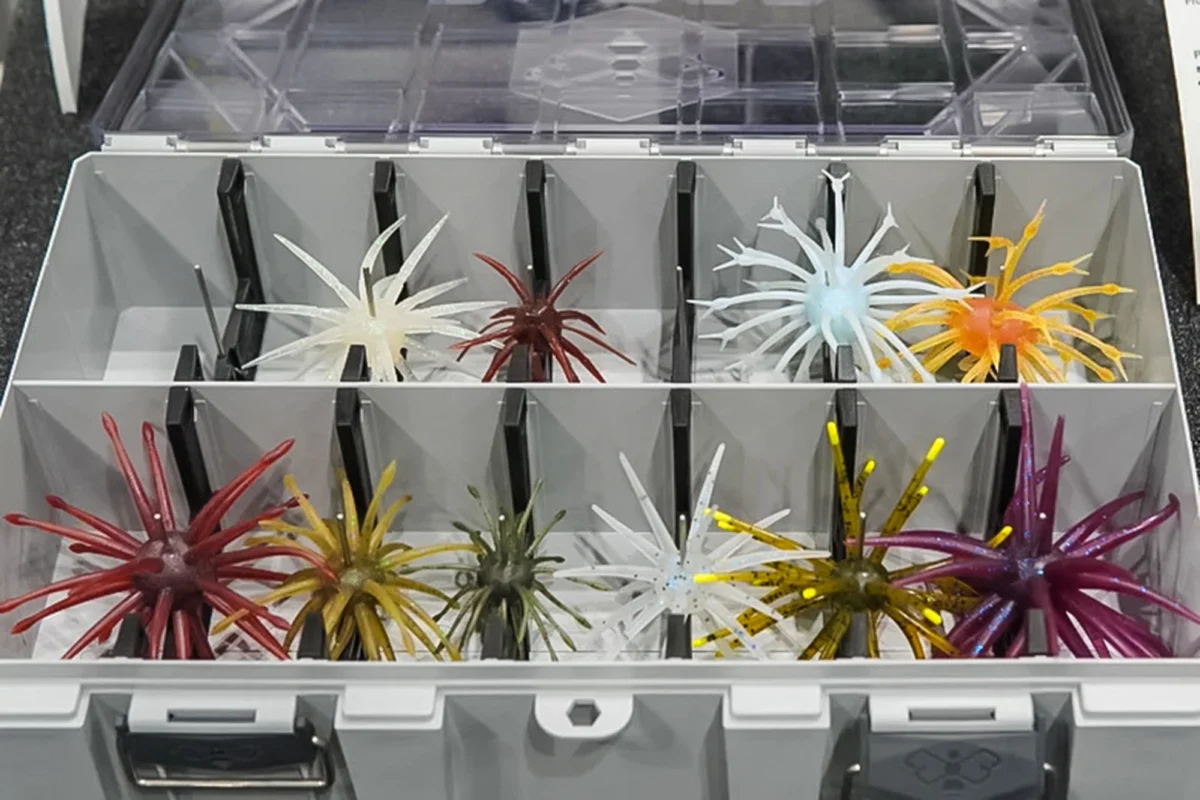
At its core, the "urchin" bait is a study in minimalist complexity. These lures feature a compact, central body—often mimicking a small baitfish or crustacean—bristling with dozens of fine, flexible tentacles or "legs" extending in every direction.
Unlike traditional creature baits, which rely on large tails or flapping appendages for vibration, the urchin is designed for subtlety. In the water, these appendages move with the slightest current or rod tip twitch, creating a hovering, life-like motion that defies easy categorization. They do not perfectly mimic a crawfish, a bluegill, or a shad; instead, they occupy a "macro-biological" space that triggers a predatory instinct in bass, even when the fish are in a neutral or negative feeding mood.
The shift is as much about material science as it is about shape. While traditional soft plastics remain the standard, the rise of high-durability, super-stretchy TPE (thermoplastic elastomer) materials has allowed for thinner, more delicate appendages that can withstand repeated casts and strikes without tearing—a critical requirement for a bait that relies entirely on the integrity of its many legs.

A Chronology of the Urchin Rise
The trajectory of the urchin bait is a classic case study in the globalization of fishing techniques.
The Japanese Genesis (2022–2024)
The roots of the trend lie in the competitive Japanese bass fishing circuit. Baits like the Hideup Coike were early adopters of the multi-leg, urchin-style concept. For years, these lures remained a "pro-level" secret in the United States, imported in small batches by dedicated enthusiasts and tournament anglers who realized that in heavily pressured waters, the "finesse-plus" approach of an urchin could outperform traditional worms or jigs.
The "Fuzzy Dice" Pivot (2025)
Before the full-blown urchin craze, the industry saw a precursor in the rise of what became known as "fuzzy" or "dice-style" baits. These lures, which featured short, dense hair-like appendages, proved that anglers were hungry for baits that offered high surface area and minimal water displacement. The success of these baits in professional tournaments provided the proof-of-concept that manufacturers needed to invest in larger-scale urchin production.

The ICAST Explosion (July 2026)
By the time ICAST 2026 arrived, the "secret" was fully out. Every major manufacturer, from heritage giants like Rapala to innovative startups like Bait Cave, arrived in Orlando with their own interpretation of the urchin. The sheer volume of variations—ranging from micro-urchins for drop-shotting to oversized, weedless-rigged versions for flipping—confirmed that the industry had transitioned from testing the waters to a full-scale market saturation.
Supporting Data: The Power of Forward-Facing Sonar
Why now? The answer lies in the technological transformation of the boat deck. The rapid adoption of high-resolution forward-facing sonar (FFS) has changed the way anglers interact with their prey.
In the era of traditional sonar, anglers were "blind fishing"—casting into an area and hoping for a bite. With modern FFS, the angler can watch the bass in real time. They can see the fish’s body language, its interest level, and its reaction to the lure.

Urchin baits are the perfect "FFS lures." Because they offer such a high degree of natural movement without requiring an aggressive retrieve, an angler can drop an urchin in front of a suspended fish, keep it perfectly still, and watch the fish drift over to inspect it. The bait doesn’t need to be "worked" in the traditional sense; the water column does the work, and the urchin’s appendages react to the slightest pulse of the rod. This ability to "hover" and "tease" a fish has made the urchin the most effective tool in the modern FFS arsenal.
Official Responses and Industry Impact
The industry’s validation of this trend was cemented during the ICAST 2026 New Product Showcase awards, where the urchin swept multiple categories:
- Freshwater Soft Lure: Rapala’s CrushCity "The CEO" 21 took top honors. The lure, which combines a dense core with ultra-fine, pulsating tentacles, was praised by judges for its ability to mimic both baitfish and aquatic invertebrates simultaneously.
- Terminal Tackle: G-Ratt Baits won with their specialized Urchin Rig. Recognizing that standard hooks often collapse the delicate legs of these baits, the company developed a rigging system that maintains the lure’s radial symmetry, allowing it to "bloom" fully once it hits the water.
- Tackle Management: Perhaps the most telling sign of the craze was the win for BUZBE’s Basic Deep – Urchin Bait Box. Traditional tackle boxes are designed for worms and creature baits that lay flat. Urchins, however, are essentially "3D" lures. Storing them in standard trays leads to mashed, useless legs. The BUZBE system provides deep, individual compartments that keep each urchin "bloomed" and ready for immediate deployment.
"We aren’t just selling a lure," said a spokesperson for one of the winning brands at the ICAST gala. "We are selling a system. The bait is only as good as the way it is rigged and stored, and for the first time, we are seeing the entire ecosystem of fishing gear adapt to the requirements of this specific profile."

Implications: The Future of the Tackle Box
What does this mean for the average weekend angler? First, it means that the "urchin" is likely to become a permanent fixture in tackle aisles, joining the ranks of the Senko and the jig.
However, the rapid influx of options brings the challenge of choice. As the market becomes flooded with dozens of variations, the "best" urchin will depend less on the brand and more on the specific application. We are already seeing a bifurcation in the market:
- Finesse Urchins: Made from soft, salt-impregnated plastics, designed for drop-shotting and light spinning gear.
- Power Urchins: Made from durable TPE or hybrid materials, designed to be skipped under docks or dragged through heavy cover.
The primary implication of this trend is that bass fishing is moving toward a more nuanced, "micro-presentation" style of angling. While big, aggressive reaction baits will always have their place, the urchin craze signals that anglers are increasingly focused on the fine details of attraction—the way a lure looks, breathes, and suspends in the water.

For those who have yet to jump on the bandwagon, the message from ICAST 2026 is clear: if you are fishing for bass in 2026, you need a way to present a multi-appendage, hovering profile. Whether you choose the award-winning CEO 21 or one of the many other innovative offerings, the urchin has officially changed the game. The only question remaining is how the bass will adapt to the sudden proliferation of these strange, many-legged invaders. For now, the verdict from the tournament circuit is unanimous: the urchins are biting, and they aren’t going away anytime soon.