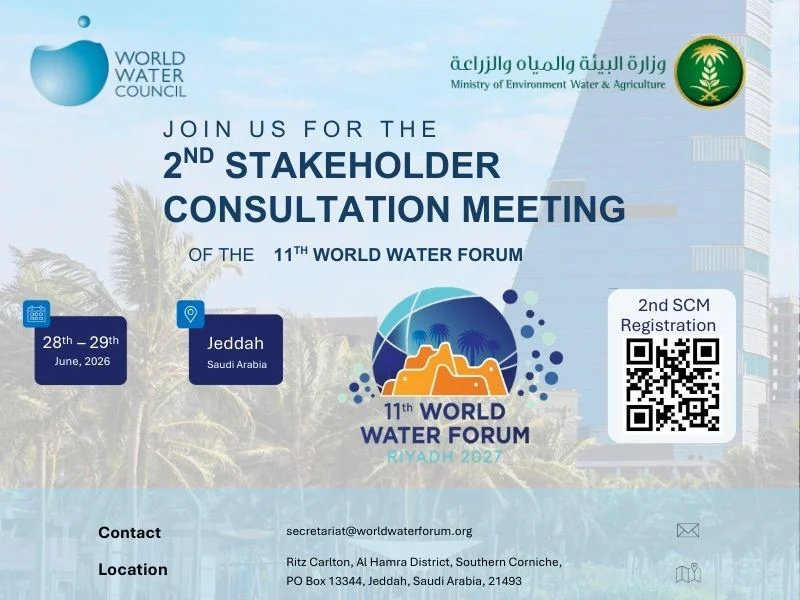
JEDDAH, Kingdom of Saudi Arabia – In a move designed to ensure maximum inclusivity and robust international participation, the World Water Council (WWC) and the Saudi Ministry of Environment, Water and Agriculture (MEWA) have officially announced the rescheduling of the 2nd Stakeholders’ Consultation Meeting for the 11th World Water Forum. Originally slated for an earlier window, the high-level gathering is now set to convene from June 28–29, 2026, at the prestigious Ritz-Carlton in Jeddah.
The decision reflects a broader, proactive strategy by the co-hosts to mitigate potential logistical challenges, ensuring that the critical dialogue surrounding global water security remains unencumbered by regional volatility. By aligning the consultation with the newly adjusted dates for Saudi Water Week, organizers are doubling down on their commitment to fostering a comprehensive environment for policymakers, scientists, and civil society leaders.
Main Facts: The New Roadmap for Global Water Diplomacy
The 2nd Stakeholders’ Consultation Meeting serves as a cornerstone event in the preparatory phase of the 11th World Water Forum. Its primary objective is to synthesize inputs from diverse global sectors—ranging from agriculture and industry to environmental conservation—to shape the thematic agenda of the Forum itself.
- New Dates: June 28–29, 2026.
- Venue: The Ritz-Carlton, Jeddah, Saudi Arabia.
- Synergy: The meeting will run concurrently with the broader Saudi Water Week, which has been extended to span June 28–July 2, 2026.
- Strategic Rationale: Organizers cited "current regional circumstances" as the primary catalyst for the date shift, aiming to guarantee that travel logistics and professional engagement remain seamless for global delegates.
By anchoring the meeting within the framework of Saudi Water Week, the co-hosts have created a continuum of discourse. Participants are encouraged to attend not only the consultation sessions but also the opening ceremony on June 28, which is expected to draw a high-level delegation of ministers, CEOs, and international water experts.
Chronology: Navigating the Path to the 11th World Water Forum
The journey toward the 11th World Water Forum is a multi-year process characterized by rigorous planning and international coordination.
Phase I: Initial Inception and Selection
The selection of Saudi Arabia as the host nation for the 11th World Water Forum was a watershed moment for regional water management. As a nation that has mastered desalination and wastewater treatment in arid environments, Saudi Arabia’s leadership in the sector provided a compelling case for hosting the world’s most significant water-focused gathering.
Phase II: The First Consultation
Following the formal bid, the initial consultation meetings focused on establishing the governance framework. The first meeting successfully outlined the core pillars of the Forum: climate adaptation, water-energy-food nexus, and the digital transformation of water infrastructure.
Phase III: The Pivot to 2026
In late 2024 and early 2025, planners monitored the evolving regional landscape. Recognizing that global water security cannot be addressed without the full participation of stakeholders from all corners of the globe, the decision was made in early 2026 to optimize the scheduling. The move from the initial dates to the late-June window was calculated to maximize the efficacy of the consultation process, allowing more time for preliminary data gathering and stakeholder feedback loops.
Supporting Data: Why Water Security is the Defining Challenge of the Century
The significance of the upcoming Jeddah consultation cannot be overstated. Current global water statistics paint a stark picture, justifying the intensive preparatory work being conducted by the World Water Council and its Saudi partners.
Global Water Stress Indicators
According to UN-Water and the World Bank, over 2 billion people currently live in countries experiencing high water stress. By 2050, the demand for water is projected to increase by 55%, driven by manufacturing, thermal electricity generation, and domestic use.
The Saudi Model: A Case Study in Resilience
Saudi Arabia provides a vital template for the global community. The Kingdom has invested heavily in:
- Desalination Efficiency: Through state-of-the-art reverse osmosis technology, Saudi Arabia has significantly reduced the energy intensity of water production.
- Wastewater Reuse: Under Vision 2030, the Kingdom has prioritized the treatment of municipal wastewater for agricultural and industrial reuse, aiming to recycle 100% of collected wastewater.
- Governance: The consolidation of water management under the Ministry of Environment, Water and Agriculture has allowed for a centralized, efficient policy framework.
The 2nd Stakeholders’ Consultation will leverage this data, using the Jeddah meetings to translate these national successes into scalable global models.
Official Responses and Stakeholder Engagement
The announcement has been met with broad support from international partners. A spokesperson for the World Water Council noted, "Our duty is to create a space where, regardless of external pressures, the global community can unite to solve the water crisis. Rescheduling allows us to ensure that the voices from the Global South, as well as the technical expertise of the North, are equally represented."
The Saudi Ministry of Environment, Water and Agriculture echoed this sentiment, emphasizing the "warm welcome" awaiting all participants. "Jeddah is prepared to host a dialogue that transcends borders. We are not just holding a meeting; we are architecting the future of global water management," the ministry stated in a press briefing.
For NGOs and private sector participants, the extension of Saudi Water Week offers a unique opportunity for networking. The integration of the Opening Ceremony into the consultation window ensures that attendees are present for the high-level policy setting that occurs at the beginning of the week, ensuring that the subsequent consultation sessions are grounded in the overarching goals established by the Forum’s leadership.
Implications: Building a Sustainable Future
The decision to reschedule is more than a logistical adjustment; it is a strategic repositioning of the global water agenda. The implications of this move are threefold:
1. Ensuring Inclusive Diplomacy
By prioritizing the ability of all stakeholders to attend, the co-hosts are upholding the core mission of the World Water Forum: to be a truly democratic platform for water solutions. Water security is not a localized issue, and the participation of disparate voices is essential for crafting a "Global Water Action Plan."
2. Strengthening the Water-Energy-Food Nexus
The scheduling of the consultation in conjunction with Saudi Water Week allows for a more holistic approach to policy. By discussing water alongside the agricultural and industrial activities that rely upon it, delegates can avoid "siloed" thinking. This integrated approach is expected to be a hallmark of the 11th World Water Forum.
3. Resilience in the Face of Regional Volatility
The decision highlights the necessity of adaptability in international governance. In an era of unpredictable geopolitical shifts, the ability to pivot while maintaining the integrity of the mission is a critical competency. The 2026 Jeddah event will serve as a test case for how large-scale international forums can maintain momentum despite external uncertainties.
Looking Ahead: The Road to the 11th World Water Forum
As the date approaches, the eyes of the international community will remain fixed on Jeddah. The 2nd Stakeholders’ Consultation is expected to produce a series of white papers and draft resolutions that will form the backbone of the final Forum report.
The co-hosts have promised that further details regarding the agenda, registration procedures, and technical sessions will be released via the official Forum website in the coming months. Partners are encouraged to remain engaged through the established digital channels, where ongoing working groups continue to refine the thematic focus areas.
The 2026 meeting is not merely an administrative milestone; it is the moment where theory begins to transition into action. As the world faces unprecedented climate-driven water scarcity, the collaborative spirit fostered in Jeddah will serve as the engine for the solutions that follow. The World Water Council and the Kingdom of Saudi Arabia remain steadfast in their commitment: to ensure that water remains a bridge for cooperation rather than a source of conflict in the decades to come.
For those planning their participation, the message from Jeddah is clear: The dialogue is essential, the stakes are high, and the collaboration will continue unabated.