Executive Summary: A Unified Voice for a Greener Future
The International Ecotourism Society (TIES) recently concluded a comprehensive global survey aimed at capturing the current sentiment, challenges, and future outlook of professionals operating within the ecotourism sector. With 971 viable responses spanning 91 countries across every continent, the data provides a definitive snapshot of an industry at a critical crossroads.
The findings are resoundingly clear: ecotourism is not merely a niche trend but a rapidly accelerating global phenomenon. With less than 0.5% of respondents suggesting a slowdown, the industry is witnessing a near-universal consensus on the growth trajectory of sustainable travel. As TIES prepares to integrate these insights into its future programming, the message from the field is a mandate for increased educational resources, linguistic accessibility, and a concerted effort to address the structural hurdles of "green" travel.
Chronology: From Inquiry to Industry Insight
The journey toward this dataset began as an outreach initiative in the previous TIES newsletter. Recognizing that the face of tourism was shifting rapidly toward sustainability, the organization sought to move beyond anecdotal evidence and capture empirical data from its diverse membership and professional network.
- Phase 1 (Outreach): The call went out to professionals ranging from independent consultants and tour operators to academic researchers and destination managers. The goal was to establish a representative sample that mirrored the diverse geographic footprint of TIES.
- Phase 2 (Data Collection): Over several weeks, responses poured in. While the United States represented the largest single contingent, the survey achieved remarkable geographic diversity, capturing perspectives from Sudan, the Palestinian territories, Israel, Venezuela, Bhutan, Montenegro, Bosnia and Herzegovina, Nepal, Côte d’Ivoire, and Iran, among 80 other nations.
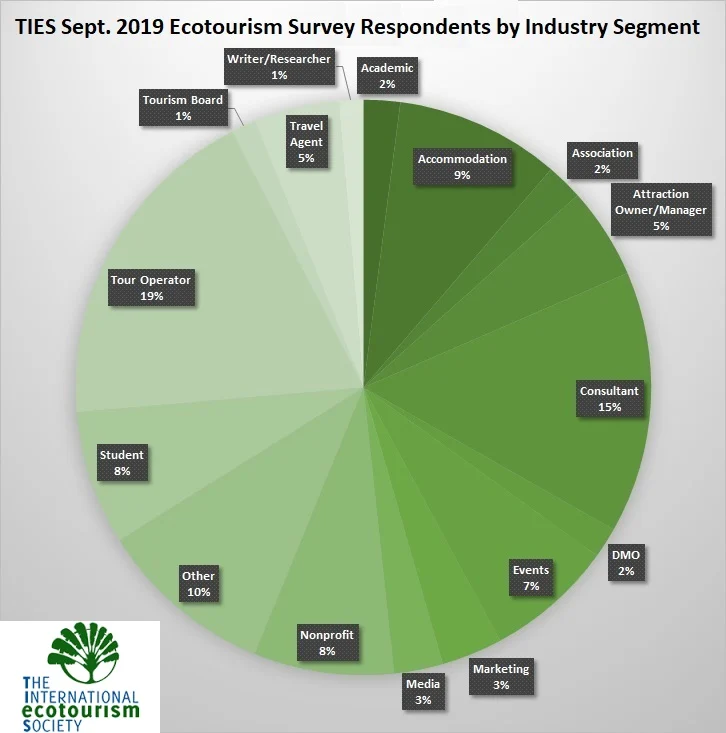
- Phase 3 (Analysis): Upon closing the survey, TIES researchers categorized the 971 valid responses. While 90% of respondents easily fit into pre-defined industry segments, feedback regarding the need for multi-sector classification highlighted the increasingly fluid nature of modern tourism roles.
- Phase 4 (Strategic Synthesis): The resulting data, now being disseminated, serves as the cornerstone for TIES’s strategic roadmap for the coming decade.
Supporting Data: The Landscape of Industry Participation
To understand the nuance of the survey, one must look at the makeup of the contributors. The respondent pool was diverse, yet revealed surprising gaps in representation that TIES leadership has noted for future improvement.
The Composition of the Respondents
The survey asked participants to self-classify based on industry segments. While the resulting data provides a robust look at the current market, the distribution was not entirely uniform. A notable takeaway was the lower-than-anticipated participation from the academic community. Despite academia representing a significant portion of the TIES membership base, their response rate suggests a need for better engagement strategies in future research initiatives.
Growth: The Unanimous Consensus
Perhaps the most striking metric is the industry’s perception of growth. When asked to evaluate the velocity of the ecotourism market, the response was nearly uniform. A staggering 99.5% of respondents confirmed that the industry is growing, with a significant majority characterizing this growth as "fast."
This aligns with wider industry trends identified by major travel platforms. For instance, recent surveys conducted by Booking.com have echoed these findings, highlighting that global travelers are increasingly prioritizing sustainable options, thereby incentivizing tour operators to pivot their business models toward conservation-focused travel.

Official Responses and Strategic Pivot
The survey served as a diagnostic tool, allowing TIES to assess how well it is serving its global constituency. The feedback regarding linguistic inclusivity and operational priorities has prompted immediate internal shifts.
The Call for Linguistic Diversity
One of the most actionable requests from the global community was the need for multi-language support. While English remains the lingua franca of international business, there is a clear demand for TIES to broaden its reach.
- Spanish: A clear majority of respondents identified Spanish as the most critical language for future development, citing the robust and growing ecotourism markets within Spanish-speaking nations.
- French and Mandarin: These languages were also highlighted as high-priority, with respondents noting that the rise of outbound tourism from China makes Mandarin an essential tool for future engagement, despite the current modest response rate from that region.
TIES has officially committed to a roadmap that will see the integration of Spanish language content across its digital platforms. This "first-step" approach is designed to create a scalable framework, enabling the organization to eventually roll out support for the 39 other languages suggested by the survey participants.
Redefining Organizational Focus
Perhaps the most surprising revelations came from the question: "What initiatives should TIES be supporting?" The results forced a re-evaluation of the society’s priorities:
- Education (41%): An overwhelming majority requested that TIES prioritize educational initiatives, suggesting that the industry feels a significant knowledge gap.
- Conservation & Climate Partnerships (18%): A clear directive to link tourism directly to environmental preservation.
- Ecodestinations (14%): A request for descriptive, country-by-country breakdowns of ecotourism offerings.
- Publications & Social Media (20%): A combined interest in digital content and informational resources.
Notably, traditional advocacy areas such as UN partnerships and high-level policy work ranked lower, as did membership growth. This suggests that the membership views TIES primarily as a knowledge-broker and educational hub rather than a traditional trade union or lobbyist organization.
Implications: The Challenges Ahead
The survey did not shy away from the darker realities of the industry. When asked about the challenges facing ecotourism, respondents provided a candid list of obstacles that threaten the integrity of the movement.
The "Green" Paradox
The most cited challenges paint a picture of an industry struggling with its own success:
- Overtourism and Greed: Many professionals expressed concern that the "ecotourism" label is being co-opted for marketing purposes, leading to overdevelopment that undermines the very nature of the destinations being visited.
- Structural Barriers: Lack of awareness, difficulty with permits, and complex financing were identified as major hurdles for small-to-medium enterprises trying to enter the market.
- The Consumer Disconnect: A critical point raised by respondents was the "lack of traveler ability to book ecotourism fairly." Essentially, the industry recognizes that while demand is high, the infrastructure to help the average traveler distinguish between authentic, sustainable offerings and "greenwashed" alternatives remains insufficient.
A Roadmap for Action
In response to these findings, TIES has indicated that it will soon unveil a detailed plan regarding its work in the educational sector. By partnering with academic and industry experts, the society aims to bridge the gap between intent and implementation.
The sentiment from the report is ultimately one of optimistic pragmatism. While the challenges—ranging from climate change to the commercialization of nature—are severe, the collective voice of 971 professionals suggests that the ecotourism movement is maturing. It is moving from a fringe concept to a sophisticated, data-driven, and highly necessary sector of the global economy.
As TIES looks toward the future, the organization acknowledges that its role is no longer just to promote ecotourism, but to safeguard its integrity. By focusing on education, accessibility, and the rigorous definition of what constitutes a true ecodestination, TIES is positioning itself to lead the industry through its next, and arguably most important, phase of growth.
About The International Ecotourism Society (TIES)
Established in 1990, TIES is the oldest and largest non-profit organization dedicated to promoting ecotourism. Through its global network of professionals, the society strives to provide the knowledge and support necessary to ensure that tourism serves as a tool for conservation and community development.
For more information on the full survey results and upcoming initiatives, visit www.ecotourism.org.