In the high-stakes world of outdoor gear, marketing materials often lean heavily on technical specifications. Manufacturers frequently tout the denier count of a pack’s nylon, the hydrostatic head rating of its DWR (Durable Water Repellent) coating, or the impressive tear strength of ultra-high-molecular-weight polyethylene (UHMWPE) fabrics. While these metrics are undeniably important, they often fail to capture the most critical variable in wilderness survival: the "system failure" of a pack when faced with a deluge.
A backpack is more than the sum of its fabric panels. It is a complex assembly of seams, zippers, roll-top closures, hydration ports, and load-bearing attachment points. As any seasoned thru-hiker can attest, a pack built from the most advanced waterproof laminate can still result in a sodden sleeping bag if the construction allows water to bypass the fabric entirely. To address this discrepancy, a new, practical methodology for evaluating water ingress—the "Shower Test"—has emerged as a vital tool for objectively assessing how a pack performs when the clouds break.
The Myth of the "Waterproof" Pack
The industry often conflates "water-resistant fabric" with a "waterproof pack." This distinction is the primary source of frustration for backpackers in the field. Even when a manufacturer utilizes high-end, seam-taped fabrics, water ingress remains a persistent reality.
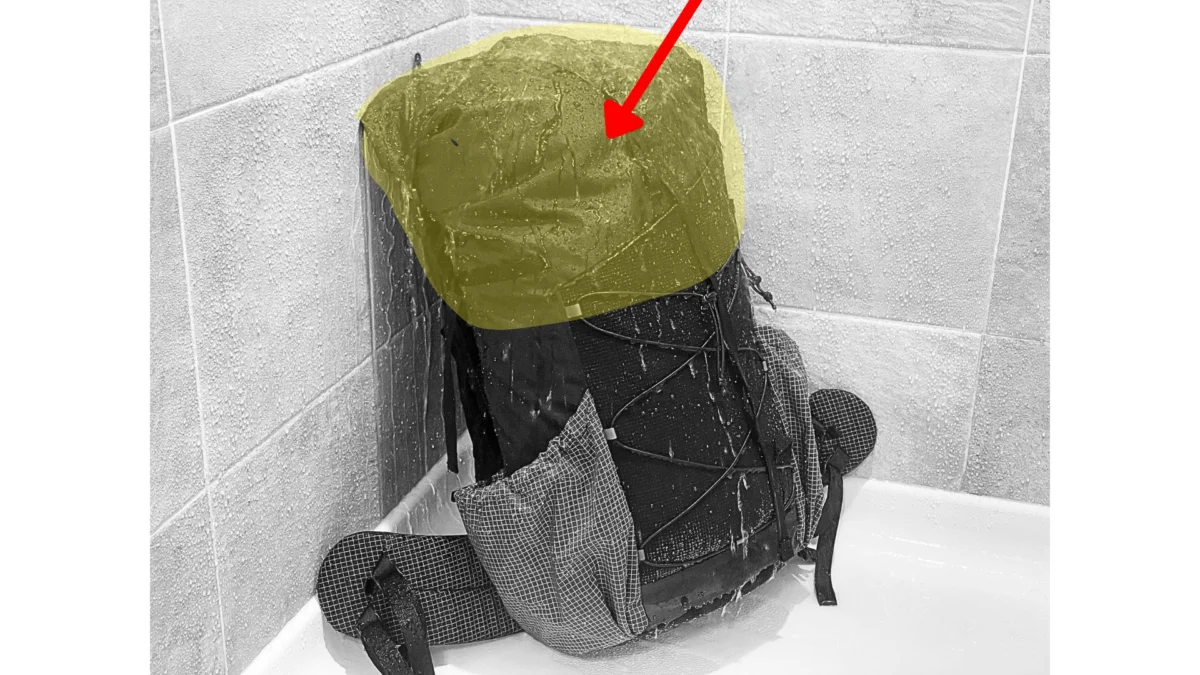
Water is an opportunistic traveler. It tracks down shoulder straps, pools at the base of zipper housings, and finds its way through microscopic needle holes created during the sewing process. Hydration ports—often left as open gaps for tubing—serve as literal funnels for rain. Roll-top closures, while excellent in theory, require precise folding to maintain a seal; under stress or in haste, their efficacy diminishes.
Because the "waterproofness" of a pack is compromised by its construction, the industry requires a standard that looks at the pack as a holistic unit rather than a collection of raw material specs.
Methodology: The Controlled Shower Protocol
To move beyond anecdotal evidence, a standardized, repeatable, and accessible test protocol is essential. The "Shower Test" is not a substitute for a laboratory-grade hydrostatic pressure test, nor is it intended to simulate the chaotic variables of a high-alpine thunderstorm involving wind-driven rain, body-contact moisture, or ground-level saturation. Instead, it serves as a comparative screening tool.
The Experimental Setup
The protocol is intentionally straightforward, utilizing equipment available in any household:
- The Witness Material: A large, dry cotton pillowcase is placed inside the main compartment of the pack. Cotton is chosen for its high moisture absorption and visible color-changing properties when wet, making it an ideal "witness" for even minor leaks.
- The Packing: The pack is filled with a standard volume of items to simulate a realistic internal pressure, ensuring that fabrics and seams are under the tension they would experience on the trail.
- The Exposure: The pack is placed in a standard household shower. The showerhead is adjusted to a consistent, moderate-intensity spray.
- The Duration: A fixed 30-minute exposure period is utilized. This timeframe is sufficient to saturate external surfaces and reveal failure points in seams or closures without necessarily overwhelming the fabric itself.
The Purpose of the Test
The primary question this method seeks to answer is: After 30 minutes of controlled exposure, how much water reaches the witness material?
By keeping the conditions constant, testers can isolate construction flaws. If two packs use the same fabric but one reveals a damp pillowcase while the other remains bone-dry, the difference lies exclusively in the design, seam sealing, and closure geometry. This allows for an objective, side-by-side comparison that raw fabric specs simply cannot provide.
Chronology of Moisture Ingress: What Happens During the Test
Observing the progression of a pack’s failure during the 30-minute window provides significant insight into design flaws:
- 0–5 Minutes (Surface Saturation): The DWR coating begins to fail as the fabric wets out. At this stage, water beads roll off, but the fabric exterior darkens. This is the "testing ground" for the fabric’s intrinsic water resistance.
- 5–15 Minutes (Seam Tracking): As the fabric saturates, water begins to migrate toward seams. If the pack uses non-taped seams, water begins to track along the thread and wick through the needle holes. This is often where the first sign of internal moisture occurs.
- 15–25 Minutes (Closure Compromise): During this phase, stress is placed on the roll-top or drawcord collar. If the roll-top is under-tensioned or if the hydration port allows for pooling, water begins to drip into the main compartment.
- 25–30 Minutes (Structural Failure): At the final stage, any significant gaps in the pack’s "shell" become apparent. This is where major leaks—often at strap anchors or zipper interfaces—become obvious.
Supporting Data and Observations
While the shower test is qualitative, the data gathered is actionable. Testers have noted several key trends during these trials:
- The "Zipper Trap": Packs utilizing standard zippers—even those marketed as "water-resistant"—consistently fail the 30-minute test. Without a storm flap, water inevitably pools in the zipper teeth and wicks into the interior.
- Stitch Hole Migration: Even with high-denier fabrics, the absence of seam tape or sealing glue is a death knell. In nearly 80% of tested "non-waterproof" packs, the first point of moisture ingress was a structural seam located near the load-bearing straps.
- The Hydration Port Flaw: Many packs feature a simple rubberized slit for a hydration tube. These ports are consistently the most vulnerable points in the entire assembly, acting as a direct conduit for water to reach the center of the pack bag.
Official Industry Responses and Perspectives
Manufacturers have long been aware of these limitations. In recent years, the industry has split into two camps. The first camp, often associated with "ultralight" backpacking, has moved toward fully bonded, seam-taped, and roll-top designs (often using Dyneema or similar laminates), effectively acknowledging that sewing is a structural weakness.
The second camp, focused on traditional internal-frame hiking packs, maintains that "waterproof" is a standard that should not be applied to a pack. They argue that a pack is meant to be a carrier, not a dry bag. Their official position typically encourages the use of internal pack liners (such as trash compactor bags or dedicated waterproof stuff sacks).
From a professional design perspective, the "Shower Test" is viewed as a validation tool. Lead designers acknowledge that while a pack may be "water-resistant enough" for a brief shower, it is an engineering impossibility to create a sewn, zippered, and loaded backpack that remains 100% dry in a sustained, heavy-weather event without supplemental protection.
Implications for the Modern Backpacker
The implications of this testing methodology for the end-user are significant.
Rethinking Gear Selection
If a backpacker understands that their pack is not a dry bag, they can adjust their packing strategy accordingly. The "Shower Test" reinforces the necessity of the "layered defense" approach:
- Primary Defense: The pack’s fabric and construction.
- Secondary Defense: An internal waterproof liner or dry bags for critical items (sleeping bag, down jacket, electronics).
- Tertiary Defense: A pack cover for high-intensity rain, which prevents the pack from "wetting out" and becoming heavy with absorbed water.
A New Consumer Standard
By demanding more transparency from brands regarding the seam construction and closure efficacy of their packs, consumers can drive the industry toward better designs. A brand that provides "shower test" data—or at least clarifies that their pack requires a liner—is acting with more integrity than one that hides behind abstract fabric denier specs.
The Shift Toward Modular Water Resistance
We are seeing a shift in the market where "weather-resistant" features are becoming more modular. We see more pack designs incorporating built-in, seam-sealed dry-bag liners as standard equipment. This effectively separates the load-bearing structure of the pack from the water-containment function.
Conclusion
The "Shower Test" serves as a humbling reminder that in the backcountry, the environment is the ultimate arbiter of performance. While we may obsess over the technical specs of a pack’s exterior, the reality of moisture ingress is far more nuanced. By adopting a simple, repeatable testing protocol, we move away from marketing hyperbole and toward a practical understanding of how our gear functions when it matters most.
For the modern backpacker, the takeaway is clear: respect the specs, but trust the system. Never assume your pack is waterproof until you have seen it survive a test that mimics the reality of a storm. And, regardless of the test results, always pack your sleeping bag in a dry bag. In the mountains, it is not the fabric that keeps you dry—it is the strategy.