Accidents in the backcountry are rarely convenient, but they are often predictable. In the high-stakes environment of river running, the "pin"—where a raft or kayak becomes wedged against an obstacle by the force of the current—is one of the most critical scenarios a paddler can face. How a crew prepares for and resolves these situations is the difference between a successful rescue and a catastrophic loss of gear or life.
Despite the gravity of these incidents, many river runners rely on off-the-shelf, commercially available "pin kits." While these kits are marketed as comprehensive solutions, seasoned guides and swift-water rescue professionals argue that they are frequently inadequate for the realities of modern river travel. To be truly prepared, one must move beyond the "one-size-fits-all" mentality and build a system designed for the specific topography, hydrology, and logistical challenges of the rivers they navigate.
The Anatomy of a Failed Rescue: A Scenario Study
To understand the shortcomings of standard gear, consider a common scenario: A multi-day expedition on the Middle Fork of the Salmon River. A member of the crew breaks an oar during the approach to the notorious Haystack Rapid. The resulting loss of control causes the boat to miss its intended line, leading to a high-side pin on a mid-stream rock.
The stakes are high. The raft is carrying the expedition’s kitchen, the night’s food supply, and the team’s morale. The river is wide—over 250 feet—and the boat is stranded 100 feet from the nearest viable shoreline.
Fortunately, the group has a standard 150-foot pin kit stored on the sweep boat. The team moves with efficiency: they deploy the kit, manage to get a throw-rope to the pinned vessel, and tie it off to a solid anchor point upstream. But as they begin rigging a Z-drag—the gold standard for mechanical advantage in river rescue—they hit a wall: they have run out of rope.
The Mathematics of Failure
Why does 150 feet of rope, the industry standard for commercial kits, fail in this environment? The answer lies in the physics of the rescue:
- The Z-Drag Tax: Implementing a 3:1 mechanical advantage system (the Z-drag) consumes significant line length. Between the anchor, the pulleys, and the zig-zagging configuration, you lose nearly one-third of your total rope length to the rigging itself.
- The Anchor Dilemma: Rivers rarely provide perfectly positioned anchor points. You are often forced to move upstream or inland to find a rock or tree capable of holding the force of a pinned boat, consuming even more rope.
- Knots and Rigging: A standard Figure-8 on a bight, used to secure the line to an anchor, consumes roughly four feet of rope. By the time you account for the distance to the boat, the mechanical advantage system, and the necessary safety knots, that 150-foot spool is effectively reduced to a fraction of its usable length.
Most commercial kits are built for convenience and retail price points, not for the worst-case scenario. When the margin for error is zero, 150 feet of rope is not a solution; it is a limitation.
Essential Components: Re-engineering Your Pin Kit
A professional-grade pin kit is not just a bag of gear; it is an integrated rescue system. Below are the core components that should be reconsidered to ensure true operational readiness.
1. Rope: Beyond the Half-Inch Standard
Many kits utilize 1/2-inch static rope, which is rated for massive loads (up to 40kN or nearly 10,000 lbs). While strength is vital, excessive thickness often sacrifices utility. In most river rescue scenarios, the limiting factor is not the tensile strength of the rope, but the ingenuity of the pull. If a boat isn’t moving, adding more force often risks breaking gear or pulling an anchor.
Many professionals are transitioning to 9mm static rope with a 5,000 lb (22kN) rating. This diameter allows the user to carry 330 feet of rope in the same volume and weight as 150 feet of 1/2-inch line, providing the extra reach needed for wide riverbeds without compromising safety.
2. Webbing and Slings
Anchors are the foundation of any rescue. Tubular webbing is the traditional choice, but it is often misused or underestimated. Carrying only 10 feet of webbing is a recipe for failure; complex anchors around rocks and trees require significant material.
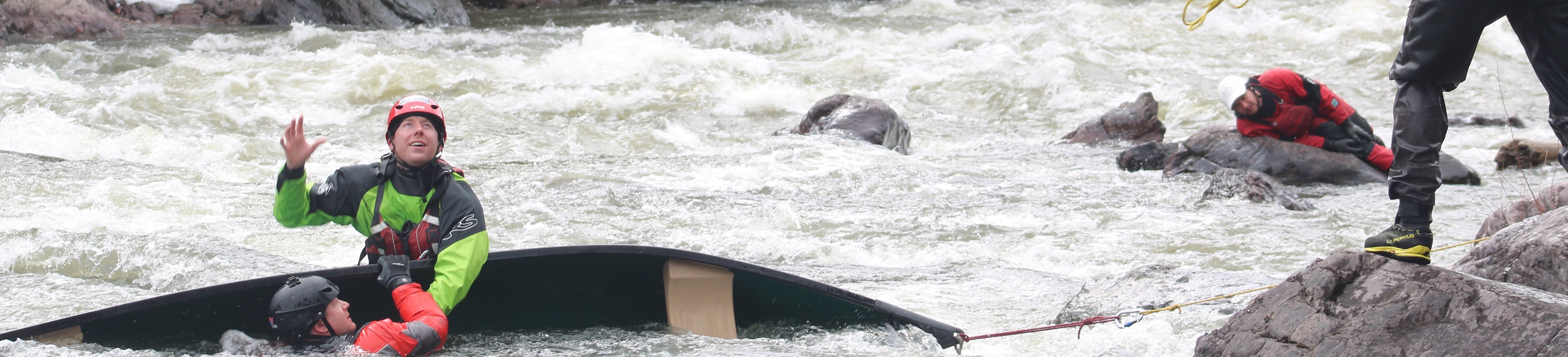
Modern alternatives like 13mm Dynex "Rabbit Runners" and 240cm slings offer a superior strength-to-weight ratio. By carrying a mix of tubular webbing and manufactured slings, a rescue team gains the flexibility to build secure anchors in diverse environments—whether it is a jagged boulder or a thick stand of riverside timber.
3. Mechanical Advantage: Pulleys and Prusiks
Pulleys are non-negotiable. Using a carabiner as a pulley creates immense friction, negating the mechanical advantage you are trying to achieve.
- Prusik Minding Pulleys (PMP): Ensure your kit contains high-quality PMPs. These pulleys are designed to allow a Prusik knot to travel through them, which is essential for maintaining the "capture" in a haul system.
- Redundancy: A minimum of three pulleys is recommended. This allows for complex redirects, protecting the rescue team from the line of fire should a component fail, and enables the implementation of more sophisticated mechanical systems.
4. Carabiners and Hardware
In a high-stress rescue, gear can be dropped, cross-loaded, or crushed. Never use non-locking or non-rated carabiners in a rescue system. Every carabiner in your kit should be a locking, load-rated carabiner reserved exclusively for rescue operations. If you are using your "water bottle carabiner" to secure a haul system, you are compromising the integrity of the entire rescue.
Maintenance and Logistics: The "Hidden" Requirements
The most sophisticated gear is useless if it is neglected. Water, sand, and UV radiation are the enemies of rescue equipment.
The Case for a Dedicated Dry Bag:
Investing in a high-quality, submersible dry bag—such as those manufactured by Watershed—is one of the most practical upgrades a boater can make. A sealed dry bag ensures the rope remains dry and free of abrasive sand. It also eliminates the need for post-trip drying, which is frequently skipped, leading to long-term degradation of the nylon fibers. Furthermore, a dry bag provides buoyancy, ensuring that your kit is recoverable if it accidentally goes overboard.
Official Guidelines and Expert Recommendations
Industry experts and swift-water rescue instructors emphasize that the kit is only as good as the person operating it. Training—specifically in rigging, knot-tying, and mechanical advantage—must accompany any investment in gear.
Implications for the River Community:
The trend toward "ready-made" kits has led to a false sense of security. As rivers become more crowded and the popularity of multi-day trips grows, the frequency of incidents is likely to rise. Boat shops and professional outfitters have a responsibility to move away from selling basic kits as "sufficient" and instead educate customers on the necessity of customization.
If you are unsure about the adequacy of your current setup, consult with specialized climbing or whitewater rescue shops. They can provide the technical insight required to tailor your kit to your specific vessel and the terrain you frequent.
Final Thoughts
Accidents are inevitable, but they do not have to be fatal. A pin kit should be viewed as a living tool—a collection of gear that is constantly evaluated, maintained, and adapted. By prioritizing length, versatility, and the quality of individual components, you ensure that when the river throws its worst at you, you are prepared to handle it with precision.
Remember: the goal is not just to have a kit, but to have the right kit. As the saying goes in the rescue community, "You don’t rise to the occasion; you sink to the level of your training and your equipment." Ensure both are up to the task.
For those seeking guidance on selecting or sourcing high-quality rescue components, feel free to reach out to our technical support team for recommendations on gear configurations tailored to your specific river environment.